New URL for the "Ancient and Medieval Macedonian History" blog
http://ancient-medieval-macedonian-history.blogspot.com/
Ι apology for the inconvenience.

New URL for the "Ancient and Medieval Macedonian History" blog
http://ancient-medieval-macedonian-history.blogspot.com/
Ι apology for the inconvenience.


by N. G. L. Hammond
[This paper first appeared in Greek, Roman and Byzantine Studies, 36, 2 p 173ff and appears here by kind permission of Professor Hammond]
Aelian informs us that fishermen used a rod and a line , each about six feet long, and an artificial fly to catch “fishes of a speckled hue” in a river called the Astraeus in Macedonia (NA 15.1). The method and the description indicate that the fish were trout. Aelian presumably chose to name the Astraeus as the river more famous for its trout, because we cannot suppose that it was unique among Macedonian rivers in harbouring trout. The only clue to the position of the river which Aelian gives us is that it lay “between Beroea and Thessalonika.”
Can we get any closer?
Leake took us farther afield in suggesting that “Astraeus” was another name for the Haliacmon; [1] but that river did not flow between Beroea and Thessalonica. The Loeb editor of the passage in Aelian makes the comment “presumably the Axius is intended”, [2] but surely Aelian knew the Axius under its given name. We need rather to note that there is a nymph Atraea, appropriate to a river of her name, “Astraeus,” and that she was selected as the nurse of the lady Beroe (Nonnus Dion. 41.212f), the patroness of Beroea (the city was sometimes called Beroe). We conclude that the Astraeus was near Beroea and that it flowed on the Thessalonika side of Beroea. The eastern neighbour of the Astraeus was the Ludias, which rose in Almopia, flowed through the Almopian city Europus and in the time of Herodotus flowed into the Haliacmon, but later its waters joined those of the Axius to form Lake Ludias by Pella. [3] On this evidence the Astraeus entered the Haliacmon in the time of Herodotus. It still did so ca 360 B.C. when Ps.-Scylax (66) named the Ludias as the next after the Haliacmon in his description of the coast of the Theramic Gulf. This probably continued to be the course of the Astraeus, whatever the date may be of the passage from Aelian, who wrote ca 200 but included excerpts from earlier writers.
In my study of the historical geography of Macedonia, I showed that the low-lying part of the coastal plain northeast and east of Beroea has undergone numerous changes since the time of Herodotus, when the Ludias flowed into the Haliacmon, to that of Leake, when the Ludias and the Axius "formed a joint stream." [4] The size and the location of a lake or lakes has also varied over the centuries. [5] As regards recent times, a map of 1928 showed in the centre of the plain a large lake (that of Yannitsa) into which all the waters flowing from the western foothills found their way through swamps. Thereafter the lake was drained and a “Regional Channel” was made to carry the waters from the western foothills not into the plain, but into the Haliacmon. [6] Because the channel follows the natural lie of the land, it is probably the line of the ancient Astraeus. That is where I showed the course of the Astraeus in my Atlas of the Greek and Roman World in Antiquity (London 1991) map 12 and in The Miracle That Was Macedonia (London 1991)
fig. 2. [7].

The upper courses of the rivers flowing from the foothills between Edessa and Beroea have undergone fewer changes. One was reported in antiquity: a new channel was made for the river Scirtus, which had inundated the buildings of Edessa (Procop. Arc. 18.38), then at “Longos” below the modern town. From this passage we learn that the name of the river at and to the east of Edessa, before it flowed into the lower Astraeus, was Scirtus, “the Leaper,” which cascaded over the cliffs of modern Edessa. It is now called the Vodhas and it enters the Regional Channel. In ancient times the Astraeus was joined by its northern tributary, the Scirtus, and kept its own name as it flowed on to the Haliacmon.
On 22nd April 1994 I was taken by Nikolaos Paschialides to eat the finest trout in Macedonia (he is a gourmet in regard to fish) at a restaurant in Ayios Nikolaos, a village that I visited for the first time. The Arapitsa emerges from a large "headspring" (kephalovrysi) [8] on the mountainside as a considerable river of which the waters are constantly cool, pellucid and bright; and it is this upper part of the river that is particularly rich in large trout. The modern saint of the headspring is St Nikolaus. In antiquity the saint was the nymph Astraea, who gave her name to the river. She was "the starry one," and her name befitted the glittering waters of the river as it emerged from the mountainside.
There was probably both a town and a district called Astraea after this nyumph, for the name recurred in Paeonia and in "Illyria," [9] the latter being the area annexed by Philip II in the Lakeland, and in both areas the name seems to have been taken by the Macedonians who were transplanted from that area in the homeland. If so, we should name the foothills of Mt Bermium to the north and south of Agios Nikolaos ‘Astraea’, because they gave off the waters which made the region below so productive that it was called “the gardens of Midas” (Hdt. 8.138.2). The ancient site of a town at Gastra near Naoussa may have been either Astraea or Mieza, for the region east and below Gastra was certainly called Mieza. It included the so-called “School of Aristotle” and the three fine Macedonian-built tombs that have been excavated at Lefkadhia. [10]
Clare College, Cambridge
September 1994
[1] W.M. Leake, Travels in Northern Greece (London 1835; hereafter ‘Leake’) III 293, 488.
[2] A.F. Schofield, tr., Aelian, On the Characteristics of Animals III (Cambridge [Mass.] 1959) 203 n.a.
[3] Plin. HN 4.34; Hdt. 7.127.1; Strabo 7 frr. 20, 23.
[4] A History of Macedonia I (Oxford 1972: hereafter ‘HM’) 142 f.
[5] Leake III 436; E. Oberhummer, “Pella,” RE 19.1 (1937) 343; both quoted in HM I 144f.
[6] Sheet “Yiannitsa 1928,” Sheets “Edessa and Yiannitsa 1944” = Sheets D 6-7, War Office version; the maps are at 1:100,000.
[7] I take the opportunity to correct the error in fig. 1, where the cartographer incorrectly joined the Ludias and the Astraeus. Mr. A. F. Sismore kindly pointed out this error to me.
[8] Such headsprings are not uncommon in limestone formations. I have seen many in Epirus: see my Epirus (Oxford 1976) 55, 172.
[9] See HM I 201, citing Ptol. Geog. 3.13.27 and Steph. Byz. s.v “Aστραιαwhere I suggested that ‘Iλλνρίας might be a mistake for Mακεδονίας; I have since then retracted that suggestion. I placed the Astraea by Lakes Ochrid and Prespa in The Miracle That Was Macedonia fig. 2. There are numerous springs at Izvor, derived from Lake Prespa and entering Lake Ochrid, which may have reminded the Macedonians of the headspring of the Astraeus. I visited Izvor in 1972.
[10] For Gastra, Mieza, and the “School” see references and comments in HM I 163f. I had the good fortune to visit the “School” in 1968 with its discoverer, PH. Petsas.
source:flyfishinghistory.com
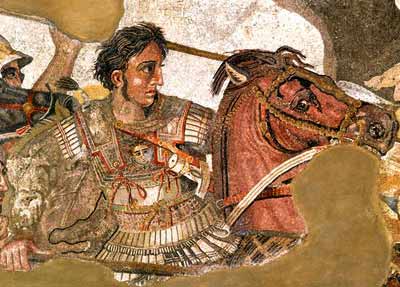
Everybody knows the Borza claim that Alexander’s trierarchs “are named according to their ethnicity”. Let's read what Professor Miltiades Hatzopoulos answer as about this Borza thought :
The list of the Macedonian trierarchs comprises at least two persons whose impeccable Greek “ethnicity” the American historian would readily recognise: Nearchos son of Androtimos and Laomedon son of Larichos hailing respectively from the Cretan city of Lato and the Lesbian city of Mytilene. Borza makes no mention of this difficulty in his comment on the list, but attempts to deal with the first case in a note referring to a different context, hesitating between casting doubts on the reliability of the list and on that of Nearchos’ origin. In fact, just as the presence of the “forgotten” category of the Cypriots contradicts the alleged binary opposition between Greeks on the one hand and Macedonians on the other, discrepancies such as the above belie the supposed “ethnic” character of the list and cannot be explained, unless the latter reflects “nationality”, “Staatsangehörigkeit”, rather than “ethnicity”.
Borza, who sets great store by the case of Eumenes’ handicap as an “ethnic” Greek, despite his long years in Macedonian service, could not convincingly argue that Nearchos and Laomedon and thousands of other Greeks from beyond Olympus ceased to be “ethnic” Greeks –whatever that may mean– when they settled in Macedonia.
The explanation of the presence of Nearchos and Laomedon in the Macedonian list is obvious: contrary to Eumenes, when they moved to Macedonia, they did not simply settle in the country, but became citizens of Amphipolis and ipso facto also of the Macedonian Commonwealth.
It is thus more than clear that the trierarchs are not “named according to ethnicity”. The classification is determined by political criteria. All citizens of Macedonian civic units are classified as Macedonians, whatever their origin.
Who then are the Greeks?
Medios son of Oxythemis from Larissa, Eumenes son of Hieronymos from Kardia, Kritoboulos son of Platon from Kos, Thoas son of Menodoros and Maiandros son Mandrogenes from Magnesia, Andron son of Kabeles from Teos.
Now, the home cities of these trierarchs share a common feature: they were all members of the Hellenic League (of which Macedon itself was no part), Larissa and Kardia from the time of Philip II, Kos and Magnesia and Teos since 332. On the other hand the kingdoms of Cyprus, which joined Alexander at the siege of Tyre, never adhered to the League officially styled as “the Hellenes”.
Also Professor Hatzopoulos says as about the ethnicity...
The word “ethnicity”, as already mentioned, is practically untranslatable in languages such as Greek, German or French, except as a calque from Engish. Its success in the latter language, and in particular in American English, is probably due to the shift in meaning of the term “nation” in a country without a long national tradition, which, instead of the people, came to be used for the “state”, causing the need for the creation of a new term. For a Greek the existence of an öθνος or for a German the existence of a “nation” is clearly independant from that of a state apparatus.
A closer look at other passages collected and adduced by Borza as supposedly revelatory of the –“ethnic” that is to say, according to him (vide supra), of the cultural– distinction between Greeks and Macedonians betrays similar difficulties and discrepancies. As M. B. Sakellariou has aptly stressed, the contrast and occasionally the antagonism between Greeks and Macedonians in the age of Philip and Alexander, of which the American historian makes so much, was political and had to a certain extent social causes.
Those who deny that the Macedonians were Greeks assert that they took the Greek names for gods, heroes, festivals, months and people from the Greeks. In the first place, however, there is no other example of a people neighbouring on the Greeks whose names were 95% Greek before the middle of the fourth century; many centuries later than this, a large percentage of Paionians, Thracians, Mysians, Lydians, Karians and Lycians had local names, even though they had begun to feel Greek cultural influences much earlier. Furthermore, a number of the Greek-sounding names given by the Macedonians to gods, heroes, festivals, months and persons do not occur outside Macedonia or areas in which Macedonians had settled.
source :PERCEPTION OF THE SELF AND THE OTHER: THE CASE OF MACEDON, Macedonian Identities, pages 61,62

| “He was very brave, then,conquered a large part of the Greek land, namely Thrace and Macedonia, the Tribalia and Dalmatia, in those added Neada (sic) and Ellada and still Aitolia.” |

| “Then Katakouzinos came to agreement with Mourat and they gave oaths and exchanged written agreements which apply even today that Turks wont harm the Greeks, neither in Romania, nor in Macedonia in the century, and when Turks promised things will be like that, Kantakozinos left to the Turks the passage from Kallipolis.” |

| “When Kaloyan was a king at that time, in Constantinople, Palaiologos, then Turks broke the oaths which they had agreed with the Greeks, and conquered the city of Kallipolis and the surrounding villages, took Macedonia and they started conflicts everywhere, and in the passage they look to exist their own ships in order to guard it, after they pushed and sent away the Greeks from the area.” |

| During the reign of Anastasius, Bulgarians started to conquere this land, they passed to Bidynio and firstly begun to conquer the Lower land of Ochrid and later all of it. |

| “This King Vasileios crashed Samouil, Czar of Bulgars, twice and conquered Bidynio and PLiska, and the Great Preslava and the Small one, and many other cities [..]” |

| “This Kaloyan, Czar of Zagorion moved and destroyed many Greek cities in the entire Thrace and in the entire Macedonia [..]” |
Yesterday we had another lecture hold in the amphitheater of the Mechanical Engineering Faculty in Skople where the two infamous Engineers Tentov and Boshevski promoted their Rosetta Stone Hoax to the public, on the scope of indulging to the mind of the average FYROMian a sense of false pride based on his alleged “ancient roots”.
The result was to be expected. Their lecture was televised by several major TV houses and was part of the main-term news on all of them. To make the things worst, TV anchors are giving false statement that the Rosetta Stone was “hitherto untranslated”, without using qualifiers in relations to Tentov/Boševski statement like “allegedly”,”according to the authors” and alike, but instead enthusiastically confirming. Today you can see the aftermath of yesterday’s lectures in the main internet sites of FYROM.
Since FYROM’s population loves to swallow anything which will allegedly promote their non-existing links with antiquity, let us remind them for once more simple and logical Facts which they conveniently love to ignore.
(a) The two UNQUALIFIED engineers Tentov and Boshevski have admited themselves that they “are not specialists in the area of linguistics”. [*]
(b) Even Tom Boshevski’s colleagues, members of MASA think of ”his discovery as “science fiction”". [*]
(c) The two UNQUALIFIED to Linguistics, Engineers have sent their discoveries to the Institute (Oriental Institute in Chicago, a research centre part of the University of Chicago) but as they admitted themselves “ So far there have been no reactions, nor a reply”. It looks the experts in Linguistics didnt even bother with the irrational findings of Tentov and Boshevski. [*]
(d) Since none from the academics coming from the US universities and from around the world who are experts in Linguistics, unlike the two Unqualified Engineers took them seriously, Tentov and Boshevski “bravely ignored the local and international intellectual community and have presented the language and script of the Ancient Macedonians”. [*]
[e] A statement from one of the two Engineers in the press “I have not heard a negative response from official experts in this field, except ignorance and refusal to meet to discuss the topic“. Actually as you admitted yourselves none even replied. Thats why you have not heard a negative response. The reason is obvious. No expert even bothered to waste his/er time with “science fiction”.
[f] The fact that no serious Academic from the greatest Universities around the world bothered with this “great discovery”, forced Tentov and Boshevski to make the following statements:
I am all for holding dialogue with all that can contribute, specifically with international historians who have taken the WRONG PATH in solving this problem. ”
“It would be difficult for them to deal with the news that they made a MISTAKE in translating the artifact, for which they have written and published many books and spent a lot of money. ”
So according to Tentov and Boshevski “International Historians are in the WRONG PATH” and Institutes have made a MISTAKE” in translating the artifact!!!!! Everybody else, including the world Academia is wrong but the two Unqualified Engineers arent!!!
To end with this pitiful demonstration of nonsense its a fact that the usage of Demotic is attested in Egypt from the mid 6th century, in other words 250 years before the start of the Ptolemaic dynasty.

From the British Museum we find:
http://www.britishmuseum.org/explore/highlights/article_index/r/the_rosetta_stone_translation.aspx
“..and the decree should be written on a stela of hard stone, in sacred writing, document writing, and Greek writing, and it should be set up in the first-class temples, the second-class temples and the third-class temples, next to the statue of the King, living forever. ”
http://www.fordham.edu/halsall/ancient/rosetta-stone-translation.html
Ancient History Sourcebook:
The Rosetta Stone: Translation of the Greek Section
“54. Hard stone in sacred [that is hieroglyphic] and native [that is demotic] and Greek characters and set up in each of the first, second, ”
You can read also the refutation of the Rosetta Stone hoax promoted in FYROM here:
http://issuu.com/history.of.macedonia/docs/boshevski_and_tendov_s_egyptian_illusions
“I have, over the years, talked about different aspects of dictionary making and of the range of vocabulary attested in Demotic. Many of you may find it interesting to know how the Egyptians conceptualized their own language/writing systems. At the end of the Decree of Canopus, one of the so-called “trilingual” decrees set up by the Egyptian priesthood to honor various Ptolemaic rulers, it is stated that various officials are supposed to write the text of the decree on a monument of stone or copper to be posted in the open areas of the first, second, and third class temples of Egypt. It further indicates that the text is to be written in the “writing of the ‘house of life,’ document-writing, and the writing of the Greeks.” The “house of life” was an institution associated with temples, serving as a scriptorium, library, and center for performance of rituals.The writing of the “house of life” was hieroglyphs, the script used in the topmost inscription of the trilingual. In the Rosetta Stone, another of these trilingual decrees in honor of Ptolemaic rulers, the hieroglyphs are called the “script of the divine word.” The Demotic section, in the middle of the decree, is here, and elsewhere, referred to as “document-writing.” This name reflects the fact that Demotic, when it first came into use, was used exclusively for personal documents (letters, contracts, and so on). Gradually Demotic replaced hieratic (a cursive script derived from hieroglyphs) for administrative documents and then for literary, including religious, texts. Hieroglyphs continued to be used for formal monumental inscriptions. Most classical Greek authors who discussed Egyptian scripts distinguished between a “sacred” script (hieroglyphs and hieratic) and a “popular” (Herodotus’s “demotika”) script. Greek texts written in Egypt usually distinguished two Egyptian scripts, the sacred and the “Egyptian” (as in the above-mentioned Canopus Decree). Clement of Alexandria, writing in the second or third century of our era, distinguished all three Egyptian scripts: “hieroglyphic,” “hieratic,” and “epistolary.”
Greek was not, of course, the only non-Egyptian language and script with which Demotic writing Egyptians came into contact. During the time of the Persian Empire, before 330 B.C. and before Alexander and the Ptolemies, Aramaic was the lingua franca of the Near East.
Numerous documents written in Aramaic have been found in Egypt. Many of these were personal documents written by or for Persian administrators or Aramaic-speaking immigrants or settlers in Egypt, especially the communities of mercenaries settled at various posts throughout Egypt (including the Jewish colony at Elephantine). But some official documents were also written in Aramaic. One such document was a summary of the laws of Egypt, drafted by senior Egyptian “soldiers, priests, and scribes” at the request of the Persian King Darius. Although no copy of this “code” of the laws of Egypt has been preserved, a reference to its composition is found in a short Demotic text (currently in the Bibliothèque Nationale in Paris) which notes that copies were prepared in the “writing of (As)syria” (i.e., Aramaic) and in “document writing” (i.e., Demotic). One assumes that this compilation was made to enable Persian administrators to run Egypt, but it is important to note that they were to do so according to Egyptian law and custom.”
[*]Interview in Dnevnik.
http://www.dnevnik.com.mk/?itemID=EBE00D5F1DA4DA488BD360F278A7533B
Thanks to Battlefield of Cannae and Samios Makedonas for their infos.
source :history-of-macedonia.com
Every now and then we are having attempts by scientists to construct the “real face of Cleopatra”, accoring always to each one’s perceptions. We had recently one more attempt taking place by the Egyptologist Sally Ann Ashton who believes “the compute regenerated 3D image is the best likeness of the legendary beauty famed for her ability to beguile“.
You can read the whole article here.
The final result of Dr. Ashton’s perception of Cleopatra’s face is this one.

Dr Ashton, of Cambridge University, said the images, to be broadcast as part of a Five documentary on Cleopatra, reflect the monarch’s Greek heritage as well as her Egyptian upbringing.
‘She probably wasn’t just completely European. You’ve got to remember that her family had actually lived in Egypt for 300 years by the time she came to power”.
Here is my main objection. Dr Ashton’s conjecture is based on an misconception. Firstly, Cleopatra VII was daughter of Ptolemy XII the ‘Auletes’ and Cleopatra V Tymphaena who were also brother and sister. It was a custom among the members of Ptolemaic Dynasty to marry between eachother. Ptolemies were one of the few royal families who continued their dynasty through incestuous marriages. This way, Ptolemies distinguished themselves from mortals - as egyptian and greek gods did - and appeared as successors to the Pharaohs. Politically, their incestuous marriages had the effect of strengthening the dynasty, excluding foreign influences. The line of descent was characterised by these intermarriages except by extremely rare cases, such as ie Ptolemy III Euergetes who married Berenice II, eventhough she was also of greco-macedonian descent and Cleopatra’s VII paternal grandmother, a cocunbine, whose identity is not known with certainty. The latter has brought forward a groundless speculation - mostly by afrocentrist supporters- that this ancestor of Cleopatra VII might be a member of Egypt’s native population. However considering the strict policy of Ptolemies until then, NOT to have been married with any member of the Native Egyptian population it makes the whole conjecture not to hold any ground.
The premise of Dr Ashton’s main argument that ”Cleopatra’s family had actually lived in Egypt for 300 years by the time she came to power” therefore she “probably wasn’t just completely European but of a woman of mixed ethnicity” is groundless.
source : history-of-macedonia.com

By Marcus A. Templar
In defending his and his compatriots’ “Macedonian” ancestry, it seems that Dr. Todor Čepreganov, Ph. D, and Director of the National History Institute at Ss. Cyril and Methodius University in Skopje (todorc@yahoo.com) has been quoted as saying, “Eugene Borza (Prof Emeritus Penn State University) published many books on Alexander the Great and Antic [ancient] Macedonia, has asked, ‘Why would the Macedonians invade, kill and enslave their own people?’”[1]
Since Dr. Čepreganov did not understand that it was only a rhetorical question, I offer Eugene Borza’s response to his own question: “ancient history is replete with examples of bona fide Greeks who fought constantly against one another.”[2] I would love to send a copy of Borza’s paper to the good professor, although one can read Borza’s statement on the first page of JSTOR (second paragraph, fifth line) without a subscription.[3]
There is not a single historian outside the Former Yugoslav Republic of Macedonia (FYROM) and its diaspora that would give a different answer. Non-FYROM Slav historians respect themselves and their degrees. As for the FYROM “historians” and their diaspora, I would suggest that they take a good look and study very carefully the WHOLE book The Peloponnesian War authored by Thucydides, the first and foremost scientific historian ever, and the reasons behind the authorship of this book. The title could give them a hint! It would be useful, as well, for the same “historians” to read about the Melian Dialogue in the same book (Thucydides V, 84-116) and the result of that debate. I do not want to confuse these “historians” with offering information on other battles like the Battle of Helos that took place in circa 1213 BC, 20 years before the Trojan War (1193-1183 BC). Nevertheless, the Battle of Leuktra (371 BC), the two Battles of Mantineia (418 BC and 362 BC) could give them the clue.
Regarding the part “Why … enslave their own people?” I am referring the good professor to Pausanias who affirms:
I know also of the following rite which is performed here. By the sea was a city Helos, which Homer too has mentioned in his list of the Lacedaemonians: These had their home in Amyclae and in Helos the town by the seaside.” It was founded by Helius, the youngest of the sons of Perseus, and the Dorians afterwards reduced it by siege. Its inhabitants became the first slaves of the Lacedaemonian state, and were the first to be called Helots, as in fact Helots they were. The slaves afterwards acquired, although they were Dorians of Messenia, also came to be called Helots, just as the whole Greek race were called Hellenes from the region in Thessaly once called Hellas.[4]
I must note that the Macedonians never “enslaved” anyone the way the Spartans did, but it seems Dr. Čepreganov had cut class the day his professor was teaching that chapter. Nevertheless, how is it possible for someone who claims to be a professor and historian with a degree in History to read the book The Peloponnesian War and quote everything on ancient Macedonia and Macedonians, but miss the reasons why the author wrote the book? It is as if one reads Lev Tolstoy’s book War and Peace quoting various parts and not knowing that the war and peace that Tolstoy wrote about was between France and Russia!
If the good professor wants to offer a real service to himself and his compatriots, he should start working on their Slavic history, language, and heritage. Of course, if he still feels “Macedonian” he could author a scientific paper filled with scientific arguments using primary sources of the time on the imaginary amalgamation of the Slavic population of geographic Macedonia with the Greek speaking Macedonians, as Fanula Papazoglu determined on page 333 of her dissertation “Macedonian Cities during Roman Times.” Dr. Mikhail D. Petruševski was the editor of her dissertation that was written in Serbian, and the University of Skopje approved it in 1957. Perhaps professor Čepreganov would like to offer a catalogue of about 1,500 ancient Macedonian monuments and inscriptions, of course all Greek, hidden in the basements of museums in Skopje! The inscription of Oleveni would do it for starters.[5]
However, the professor was also quoted as saying:
Ernst Badian (Harvard University - History Department) explains the last battle between Macedonians and Greeks: ‘After hearing and rejoicing on the news of Alexander’s death, Greek soldiers and mercenaries saw their chance to remove themselves from Macedonian despot rule and rebelled. However, a Macedonian army under Pithon did defeat the rebels. Pithon, no doubt recognizing their immense value for the empire as a whole, persuaded them to go back to their posts, assuring them personal safety in return. Yet, contrary to his oath, seventeen thousand Greeks were cut down, after surrendering their arms, by the enraged Macedonians, and Pithon could not stop them. The patent needs of the empire and the oath of their commander were swallowed up in the explosion of what we can only regard as the men’s irrational hatred for their Greek enemies.’
Since the good professor has no scientific argument on his own, I would like to respond to Dr. Badian’s argument, but why do I have the feeling that the good professor of Skopje was not interested in Badian’s whole statement. I have no doubt that Badian has read Polybius V, 108, 3, 7, 8 where he says that a few Macedonian cities had revolted against Philip, who eventually re-captured them.
Here is the text,
3. He therefore set forth at once with his army to recover as soon as possible the revolted cities, … 7. as he was convinced that this was the only way by which he could recover his principality of Pharos. 8. Philip, then, advancing with his army recovered the cities I mentioned, took Creonium and Gerus in the Dassaretis, Enchelanae, Cerax, Sation, and Boei in the region of Lake Lychnis, Bantia in the district of the Caloecini and Orgyssus in that of the Pisantini. 9. After these operations he dismissed his troops to winter quarters. This was the winter in which Hannibal after devastating the wealthiest part of Italy was going into winter quarters at Gerunium in Daunia, 10. and the Romans had just elected Gaius Terentius Varro and Lucius Aemilius Paulus to the consulate.[6]
As the professor can see, not only “Greek” cities, as he put it, revolted against the Macedonian kings, but also Macedonian cities against their own king.
For the sake of the reputation of Skopje’s Academy of Sciences and Arts and all its members, one only hopes that Dr. Todor Čepreganov is neither a member nor a representative of the academic view of his country. For if he was a member and a representative of the academic view of his country, the education in the Republic of Skopje has reached rock bottom in scientific thought and arguments equal to the level of the sixth graders those books were intended for (indeed yes, the capital of a country can name the whole country, i.e. Mexico, Panama, Rome, Byzantium to name a few.) If in the end the professor’s scientific findings convince historians of his part Slavic and part Greek Macedonian ancestry, then we might have something to talk about. Until then, I have news for the professor: he is a Slav!!!
There is reciprocity in all fair and balanced scientific arguments. The FYROM Slavs cannot demand from the Greeks to prove scientifically that the ancient Macedonians were Greeks and simultaneously demand from the world to take their word that they are “the Macedonians” through an amalgamation that never existed. Why should anyone take the word of the Slavs for their unproven “Macedonian” ancestry, but not the word of the ancient Macedonian kings that they were Greeks?
Whether the ancient Macedonians were Greeks or not is an unprofitable historical question. The Athenians were Pelasgians according to Herodotus, but the dear professor has not spent a minute trying to argue scientifically whether the ancient Athenians were Greeks or not. Since however, he insists that he is “Macedonian” and connects himself to the ancient Macedonian culture, I would recommend that instead of concentrating in de-Hellenizing the ancient Macedonians, the professor should try to connect his Slavic ancestry to the Greek Macedonians; scientifically, of course!
I wish him Good Luck in his efforts; he definitely needs it!
[1] http://macedoniaonline.eu/content/view/3584/49/
[2] Eugene N. Borza, “Athenians, Macedonians, and the Origins of the Macedonian Royal House,”Hesperia Supplements (American School of Classical Studies at Athens),1982.
[3] http://www.jstor.org/sici?sici=1064-1173(1982)19%3C7%3AAMATOO%3E2.0.CO%3B2-J
[4] Homer Iliad 2.584; Pausanias III, 2.7; Pausanias III, 20.6
[5] Fanula Papazoglu, Central Balkan Tribes in Pre-Roman Times (Amsterdam, Hakkert, 1978), 556. The plaque found at the town of Oleveni near Bitola is written in Greek.
[6] http://penelope.uchicago.edu/Thayer/E/Roman/Texts/Polybius/5*.html
source :history-of-macedonia.com

Sanctuary of Demeter in Dion (Photo from the Greek Mag. “Archaeologia)
Dion (fr Gr Ζεύς, gen, Διός) means a holy, sanctified site Dion, in Macedonia, occupies a very narrow stnp of land between Mount Olympus foot and the Thermalhos Sea. The Olympian Zeus temenos, the main sanctuary of all Macedonians In antiquity was located there. Its history is related to the royal names ot Macedonia, such as Archelaos, Philipos II, Alexander. Cassandros, Philipos V and Perseus.

Prof. Soteriades (Left) & Prof Bakalakis (Right), Photo from the Greek Mag. “Archaeologia”
In 1928 G Soteriadis, Professor and Lector, at that time, of the University ol Thessaioniki started excavating the site. The excavation was carried on until 1931 and brought to light a number of Hellenistic and Roman buildings Most important among them was a vaulted Macedonian tomb with a Doric facade, an Ionian anteroom and a spacious funerary chamber with a large marble bed. A second phase of excavations started In 1963 and lasted, with a tew Intervals, until 1972. During this phase, which was realized due to Professor G. Bakalakis. Initiative, the south part ot the fortification wall as well as the Roman theater have been researched. Since 1973 the excavation has been supervised by Professor D. Pandermalis. The steadily progressing works had as a primary objective the research of the sanctuaries and then that of tha town and cemetery. The feast of Olympian Zeus in Dion was the most venerated event In the religious life of ancient Macedonians The festive activities were lasting for nine days and, besides sacrifices, theatrical and athletic competitions were also included. In the temple of Olympian Zeus the statues of the Macedonian kings were in display as well as the stelae Inscribed with Important official texts, such as treaties of alliance, definition of borders, honorary decrees.

Head of Goddess Demeter found in Dion (Photo from the Greek Mag. “Archaeologia”)
Demeter, the goddess ol earth fertility, was also venerated in Dion as in most of the Greek sanctuaries. Demeter’s temple was discovered in 1973 a few meters away from the town walls ot Dion. The older edifices are Iwo small lemples of the sixth century BC, that were replaced by bigger ones in the early Hellenistic period. The meticulous research through the layers of destruction produced a late fourth century BC marble head of the goddess, a number of sculpture, an abundance of clay idols, pottery, coins and jewels. The sanctuary was repaired in the Roman penod and its life lasted until the fourth century AD.
To the east ot Demeter’s temple was discovered in 1978 a temenos dedicated to the cult of the Egyptian gods Sarapis, Isis and Anubis were worshipped there, but mainly Isis Lochia, tha goddess who was taking care of women during the critical period after childbirth. The central temple of the sanctuary was dedicated to her. However, from inscriptional and other sources we draw the conclusion that another goddess of childbirth has originally been worshipped here, the goddess Artemis Eileithyia, who in the Hellenistic period has been succeeded by Isis Lochia.

Statue of a Muse (probably Terpsichore), Photo from the Greek Mag. “Archaeologia”
Another temple was dedicated lo Isis as goddess of Luck, while a third to Aphrodite Hypolympidia (=Aphrodite worshipped at the foot of Mount Olympos); a charming cult statue of this goddess, dating from the second century BC, has been discovered during the excavations. The theater of Dion is located at the area of the sanctuaries outside the town walls. It has been constructed by accumulating large quantities of earth in the years of Philipos V; its seats are made of big Hellenistic bricks. The theater displays a spacious orchestra and a coelon so designed as to accomodate a large number of people, since it was the theater not of a local, but of an important, famous sanctuary. A strong wall over 2,600 m. long, built in the years of Cassandros, was protecting the town. The fortification was further reinforced by a number of lowers standing 33 m. from each other. This wall was once repaired in the Hellenistic period and was rebuilt in the second half of the third century AD, when fierce barbaric raids had to be repelled. In the fourth century AD a new, but mediocre, wall was built around the Early Christian settlement, a small, faded reminiscence of the ancient town.
The public baths, excavated in the south sector of the town, is an impressive group of buildings of 200 AD: Shops and workshops, public lavatories, a court for gymnastics, a small roofed theater ( = odeum), bathing areas, recreation rooms and a chamber dedicated to the cult of Asclepius. A unique group of sculptures representing Asclepius’ whole family has been found in it.
A large villa with a roomy bath, two atriums, a spacious banquet hall, a series of shops etc, is under excavation to the east of the town. The villa has been endowned with a wonderful mosaic pavement showing the triumphal epiphany of Dionysus. This central theme is framed by six smaller panels decorated with theatrical masks.

Dionysus Mosaic, Photo from the Greek Mag. “Archaeologia”
Four statues of philosophers have been discoverd in the same room, while in another, smaller one with a niche, the statue of the venerated god Dionysus. The cemetery of Dion lies, mainly, to the north and east. Its funerary monuments date from the fifth century BC to the fifth century AD. Most important among them are the vaulted Macedonian tombs and most eminent of all the one with the Doric facade, the Ionian anteroom and the largo funeral chamber with the decorated marble bed.
Since 1980 are excavated to the west of Dion tymboi ol the Early Iron Age (1000-700 BC). They usually contain box-shaped graves, whose funeral offerings is, mainly, pottery. The women’s jewelry is made of copper, rarely of gold and semi-precious stones like sard. The pottery is closely related to that of Thessaly.
The central area of the Early Christian Dion is occupied by a three-aisled basilica of the late fourth century AD, decorated with mosaic pavements and wall paintings. The church was ruined by an earthquake and was rebuilt in the early fifth century, but on a much higher level. Another Early Christian basilica has been recently discovered outside the town walls —at the border of a
cementery - and is now excavated. In the stoa outside its narthex a marble, built trapeza has been found; its relation to an adjacent cenotaph probably suggests the worship of a Christian martyr. Dion seems to become abandoned during the fifth century AD due to a succession of natural disasters (earthquakes, flood). Since then its inhabitants found shelter on safer locations at the foot of Mount Olympos, where new settlements were built.
Source: Greek Magazine ”Archaiologia”, Dec. 1989.
http://history-of-macedonia.com/wordpress/2008/12/06/dion-the-religious-centre-of-ancient-macedonians-in-macedonia-greece/


