
The restoration works on the palace of Aigai at the archaeological site of Vergina of northern Greece have provided archaeologists with additional information on the impressive construction, described as in league with the Parthenon atop the Acropolis in central Athens and three times as large.
The recently completed three-million-euro initial restoration phase was funded by the 3rd Community Support Framework (CSF) and according to findings presented at the 22nd scientific meeting on archaeological excavations and work the Macedonia and Thrace provinces, restoration works have helped to document many facts on the building's ground plan. Construction work on the palace of King Philip II of Macedon began in 350 BC and was completed in 336 BC providing important information on ancient Macedonian architecture, because it was completed without interruptions and posterior interventions or alterations.
The restoration of the two-storey gallery (stoa) in the building's front section was a "revelation" for archaeologists' studying ancient architecture, as it contradicted earlier beliefs according to which such galleries were a later practice, dating in the 2nd century BC. The galleries' architectural sections are built based on the "golden mean" ratio (1 to 1.6). Archaeologists believe that Pytheos was the palace's architect, who had also designed the mausoleum of Halicarnassus, while the mausoleum's sculptor Leocharis had also worked on the palace of Aigai.
http://www.ana-mpa.gr/anaweb/user/showplain?maindoc=7472140&maindocimg=7471646&service=102
Saturday, April 04, 2009

Thursday, April 02, 2009
What the ancient sources recorded as regards Alexander death

1. Diodorus Siculus (17.117, 1–3)
4. Arrian (7, 24–26)
Arrian tells essentially the same story as Plutarch. Alexander had been drinking ‘far into the night’ and accepted Medius’ invitation to another ‘merry party’ where he again set to drinking, continuing till late at night after which ‘(he) went straight to sleep with the fever already on him’. There is no record in Arrian’s text of a catastrophic event, but he describes the same slow deterioration with a high fever and death about 10 days later. ‘These details are all to be found in the Diaries’.
5. Justin (12, 13–14)
Justin tells the same story of prolonged drinking followed by Medius’ invitation to continue. But, he adds,
‘‘On the sixth day, Alexander’s voice failed. His friends put it about that the cause of his illness was excessive drinking, but it was in fact a conspiracy though the scandal was suppressed by the power of his successors.’’
There are clearly discrepancies in these accounts. Both Plutarch and Arrian expressly quote from the ‘Royal Diaries’. The authenticity and authorship of such diaries has been questioned by modern scholars and, of course, if there were any, they have been lost. Views, pro and con, have been expressed by Pearson( The diary and letters of Alexander the Great. Historia 1954–5; 3: 429–55.), Hammond ( Collected Studies III Alexander and his Successors in Macedonia. Amsterdam: Hakkert, 1994, pp. 151–172) and Lane Fox( Alexander the Great. London: Robert Hale, 1968,p. 468). Bosworth ( Conquest and Empire. Cambridge: Cambridge University Press, 1988,p. 299) points out that the diaries may have been edited to remove evidence of a catastrophic event during drinking to suppress suspicions of poisoning.
The plain fact in all of this is that the noble Macedonians drank in legendary quantities and drunken quarrels and murder occurred not infrequently (Plutarch, 9, 23; Curtius Rufus, 8,1–43; Arrian, 4, 14; ). What appears clear from the ancient accounts is that Alexander indulged in prodigious and long continued drinking. There may have been a catastrophic event. He developed a high fever, slowly deteriorated and died about 10 days later.
‘‘He drank much unmixed wine.and finally downed a whole beaker in one gulp. Instantly, he shrieked aloud as if smitten by a violent blow.and was led by the hand back to his apartments.’’
2. Curtius Rufus
There is a large lacuna at 10.4 and, when 10.5 begins, the king is already mortally ill, and ‘died moments later’.
3. Plutarch(Alexander, 75–6)
‘‘He allowed himself to indulge in a number of .drinking bouts. He gave a splendid banquet in honour of Nearchus. (and) when Medius invited him he went to his house, and there, after drinking through all the next day, he began to feel feverish.’’Plutarch expressly denies a ‘big drink’, or the onset of a sudden pain.
‘‘These are details with which certain historians felt obliged to embellish the occasion...and invent a tragic end and moving finale to a great action. Aristobulus tells us that he was seized with a raging fever.became very thirsty and drank wine which made him delirious.’He then goes on to describe continued high fever, gradual deterioration and death about 10 days after Medius’ party. Plutarch avers that ‘most of this account follows the version which is given in ‘‘the journals’’ almost word for word’.
4. Arrian (7, 24–26)
Arrian tells essentially the same story as Plutarch. Alexander had been drinking ‘far into the night’ and accepted Medius’ invitation to another ‘merry party’ where he again set to drinking, continuing till late at night after which ‘(he) went straight to sleep with the fever already on him’. There is no record in Arrian’s text of a catastrophic event, but he describes the same slow deterioration with a high fever and death about 10 days later. ‘These details are all to be found in the Diaries’.
5. Justin (12, 13–14)
Justin tells the same story of prolonged drinking followed by Medius’ invitation to continue. But, he adds,
‘Alexander took a cup, but had not drunk more that half of it when he suddenly uttered a groan as if he had been pierced by a spear.and was racked by such agony that he asked for a sword to put an end to it, and the pain on being touched was like that of a wound’.There is the same description of a slow deterioration, but no mention of a fever.
‘‘On the sixth day, Alexander’s voice failed. His friends put it about that the cause of his illness was excessive drinking, but it was in fact a conspiracy though the scandal was suppressed by the power of his successors.’’
There are clearly discrepancies in these accounts. Both Plutarch and Arrian expressly quote from the ‘Royal Diaries’. The authenticity and authorship of such diaries has been questioned by modern scholars and, of course, if there were any, they have been lost. Views, pro and con, have been expressed by Pearson( The diary and letters of Alexander the Great. Historia 1954–5; 3: 429–55.), Hammond ( Collected Studies III Alexander and his Successors in Macedonia. Amsterdam: Hakkert, 1994, pp. 151–172) and Lane Fox( Alexander the Great. London: Robert Hale, 1968,p. 468). Bosworth ( Conquest and Empire. Cambridge: Cambridge University Press, 1988,p. 299) points out that the diaries may have been edited to remove evidence of a catastrophic event during drinking to suppress suspicions of poisoning.
The plain fact in all of this is that the noble Macedonians drank in legendary quantities and drunken quarrels and murder occurred not infrequently (Plutarch, 9, 23; Curtius Rufus, 8,1–43; Arrian, 4, 14; ). What appears clear from the ancient accounts is that Alexander indulged in prodigious and long continued drinking. There may have been a catastrophic event. He developed a high fever, slowly deteriorated and died about 10 days later.
Monday, March 30, 2009
Ancient Pella workshop discovered

A recently excavated ceramics workshop has yielded a plethora of information concerning the economic activities of Hellenistic-era Pella, one of the most significant sites in the ancient kingdom of Macedon, according to archaeologists in Thessaloniki on Monday, who spoke during a presentation of artifacts and findings.
The workshop, unearthed by archaeologists of the culture ministry's 17th directorate of prehistoric and classical studies, was discovered north of the new entrance of the Pella archaeological site. It is believed to have been in operation between the final quarter of the 4th century BC and 200 BC.
A plumbing system used to clean the potter's clay is among the most notable findings, while a furnace and storage areas were also uncovered. Movable artifacts include pottery casts, vessels, fragments of statuettes and silver and bronze coins.
A plumbing system used to clean the potter's clay is among the most notable findings, while a furnace and storage areas were also uncovered. Movable artifacts include pottery casts, vessels, fragments of statuettes and silver and bronze coins.
Caption:
An aerial view of an ancient ceramics workshop recently excavated at the Pella archaeological site in northern Greece, one of the most significant sites in the ancient kingdom of Macedon, the homeland of Philip II and Alexander the Great, was presented in Thessaloniki on Monday, March 30, 2009 by culture ministry archaeologists. ANA-MPA / STR.
source:ANA-MPA
Tuesday, March 24, 2009
Afghanistan requires back the Greek heritage that was destroyed from the USAID
“We have the biggest Greek theatre in the world after Epidaurus”, the Afghan professor Harzi courageously declares. It was destroyed as well with all our monuments Moutzaheadin and Taliban. Now we request the assistance of civilized countries in order to gather the remains.’’
The truth is hidden in these phrases for the unrooting of Greek past that the Afghans consider their national heritage. USAID used a large sum of money in order to transmute the cultural background of Afghans, eradicate the “Soviet education” and make a nest of Moutzaheadin in Islamic schools in the borders with Pakistan where the Afghans were arriving in order to acquire bread and hate. Inhuman moulads undertook the propaganda of Islamic sariah law and Soviet books became holy books for children (only for the boys of course), children that learn not to count with cute little sheeps, but with bombs that with ‘’eradicate’’ the ‘’infidels’’. The same USAID that now finances the educational books of Cyprus in order to ‘’reconciles’’ the two communities!!
And the rage of Afghan scientists overflows when they explain that the Americans sent metal detectors with the pretext of demining, but in the substance were useful in order to are located the Ancient Greek Macedonian Graves and the precious relics they were hiding! The American intermediaries waited for the merchandise in order to sell them in museums and private collections. Extensive use of explosives destroyed many temples and monuments in order to make the illegal excavations easier. Pillagers encouraged the moulads to ‘’get rid of anything that was ‘’pagan’’. Anything that could not be transported was simply turned in ruins from hate and greed. The Greek treasures were stolen by the museum of Kabul despite the desparate calls of workers that saw their culture lost in the dark. The fact that they felt proud for their Greek Macedonian origin of Alexander was obvious in the all of their newer history, a fact that even the Soviets respected in the education system they had established in the past. And the Afghan land always gave its treasures generously and willingly since their craftsmen maintained the knowledge alive even after the arrival of Buddhism.
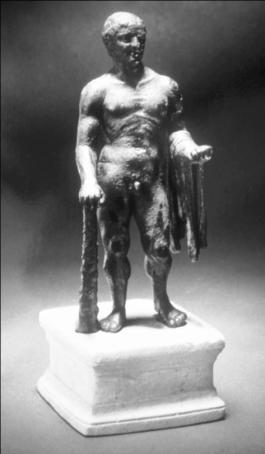
Bronge Statue of Heracles.
A characteristic example is the many statues of Hercules since the splendid gym of Ai Khanoum was dedicated in the Greek hero’s divine form. Such a wonderful masterpiece was sold in a bazaar of Pakistan in 2002.

Macedonian finding in Aphaganian currency.
Thousands of old coins were sold and auctioned in sacks (!) and the massive amount of discoveries that really proves the multiannual presence of Kings of the Baktrian and their popularity causes feelings of awe. Temples, gyms, states all buried in the semidarkness of tradition before the irreparably covering from the dark of domination and religious fanaticism.

Macedonian coins weight 50 kilos.
Now, Afghan scientists try to recover the lost cultural wealth. Unfortunately they were forced to ask the help of Unesco and the “civilized” West. The West that from the center of the “Afghan studies” in the university of Nebraska, supplied CIA and other secret services with information concerning the moves of the Soviets, the interactions of various sects and the attribution of nominations Talibans. In this ‘’at euphemism’’ university the times that “terrorists” were called in the university in order to met with American dignitaries were very not few at all. With the ‘’assistance’’ of USAID of course. These were the meetings that every effort of every organisation and movements for the rights of women of Afghanistan were demolished for good.
The despicable child books of USAID that portrayed the use of rockets, bombs and arms with verses from the Koran entered in the foresight afterwards the failure of arrangement that had been made with Taliban. It was straightly asked for the replacement of violent pictures and verses of Jihad. The answer of Bush? ‘We can deprive from the Afghans their Islamic heritage (!!!)
They could however eradicate their Greek one.
Translation from Ariadni_Nefeli
Original article written from http://olympia.gr
The truth is hidden in these phrases for the unrooting of Greek past that the Afghans consider their national heritage. USAID used a large sum of money in order to transmute the cultural background of Afghans, eradicate the “Soviet education” and make a nest of Moutzaheadin in Islamic schools in the borders with Pakistan where the Afghans were arriving in order to acquire bread and hate. Inhuman moulads undertook the propaganda of Islamic sariah law and Soviet books became holy books for children (only for the boys of course), children that learn not to count with cute little sheeps, but with bombs that with ‘’eradicate’’ the ‘’infidels’’. The same USAID that now finances the educational books of Cyprus in order to ‘’reconciles’’ the two communities!!
And the rage of Afghan scientists overflows when they explain that the Americans sent metal detectors with the pretext of demining, but in the substance were useful in order to are located the Ancient Greek Macedonian Graves and the precious relics they were hiding! The American intermediaries waited for the merchandise in order to sell them in museums and private collections. Extensive use of explosives destroyed many temples and monuments in order to make the illegal excavations easier. Pillagers encouraged the moulads to ‘’get rid of anything that was ‘’pagan’’. Anything that could not be transported was simply turned in ruins from hate and greed. The Greek treasures were stolen by the museum of Kabul despite the desparate calls of workers that saw their culture lost in the dark. The fact that they felt proud for their Greek Macedonian origin of Alexander was obvious in the all of their newer history, a fact that even the Soviets respected in the education system they had established in the past. And the Afghan land always gave its treasures generously and willingly since their craftsmen maintained the knowledge alive even after the arrival of Buddhism.
Bronge Statue of Heracles.
A characteristic example is the many statues of Hercules since the splendid gym of Ai Khanoum was dedicated in the Greek hero’s divine form. Such a wonderful masterpiece was sold in a bazaar of Pakistan in 2002.
Macedonian finding in Aphaganian currency.
Thousands of old coins were sold and auctioned in sacks (!) and the massive amount of discoveries that really proves the multiannual presence of Kings of the Baktrian and their popularity causes feelings of awe. Temples, gyms, states all buried in the semidarkness of tradition before the irreparably covering from the dark of domination and religious fanaticism.
Macedonian coins weight 50 kilos.
Now, Afghan scientists try to recover the lost cultural wealth. Unfortunately they were forced to ask the help of Unesco and the “civilized” West. The West that from the center of the “Afghan studies” in the university of Nebraska, supplied CIA and other secret services with information concerning the moves of the Soviets, the interactions of various sects and the attribution of nominations Talibans. In this ‘’at euphemism’’ university the times that “terrorists” were called in the university in order to met with American dignitaries were very not few at all. With the ‘’assistance’’ of USAID of course. These were the meetings that every effort of every organisation and movements for the rights of women of Afghanistan were demolished for good.
The despicable child books of USAID that portrayed the use of rockets, bombs and arms with verses from the Koran entered in the foresight afterwards the failure of arrangement that had been made with Taliban. It was straightly asked for the replacement of violent pictures and verses of Jihad. The answer of Bush? ‘We can deprive from the Afghans their Islamic heritage (!!!)
They could however eradicate their Greek one.
Translation from Ariadni_Nefeli
Original article written from http://olympia.gr
Sunday, March 22, 2009
Alexander Mania Grips FYROM
The following is an interesting article that describes how the government of the Former Yugoslav Republic of Macedonia (F.Y.R.O.M) is constructing a mythical historiography in order to appeal to the masses. The Gruevski administration is promoting the notions that the Slavic population of F.Y.R.O.M are descendants of the ancient Macedonians and are the originators of the "White Race". The notions being promoted by F.Y.R.O.M's government hint of the ideologies that were exhibited by the likes of Mussolini and Hitler who appealed to ideals involving genealogical lineages and 'pristine' genetic bloodlines. The F.Y.R.O.M government looks akward using the 19th century nation building tactic of promoting a mythical national historiography in the context of 21st century Europe
Read the whole article here: http://www.csmonitor.com/2009/0321/p01s01-wogn.html
Some of the more telling excerpts from the article are:
The following is an excerpt from the TV ad that the article describes. This TV ad appeared on state sponsored television. This 1930's style fascist ideology does not belong in 21st century free and progressive Europe.
by Chris Phillipou in maktruth blog
Read the whole article here: http://www.csmonitor.com/2009/0321/p01s01-wogn.html
Some of the more telling excerpts from the article are:
In an intense media campaign, locals are told that ethnic Macedonians are the proud direct descendants of Alexander, and thus a people responsible for spawning the white race of planet Earth, from the Caucasus "to the seas off Japan," according to a public service spot on national TV.
Even "God" has gotten involved. A nine-minute TV ad starts with a petition from Macedonia to the heavens: "Our neighbors distributed thousands of books across the world, containing false history and portraying a wrong picture about Macedonia. ... Only you know our pain." The Almighty then responds: "From you, Macedonians, descendants of Macedon, I conceived the white race. All that stretches to the seas off Japan is conceived from your genes."
The following is an excerpt from the TV ad that the article describes. This TV ad appeared on state sponsored television. This 1930's style fascist ideology does not belong in 21st century free and progressive Europe.
Beyond theatrics, the program deeply troubles many scholars and intellectuals here– who are being sidelined – for its promulgation of myth as truth. The new taxpayer funded Alexander ideology has no serious texts
Unlike Serbia's Kosovo story, based on centuries of poetry and legend,the Macedonian ideology is being both invented and presented at the same time. There is no outside scholarly consensus, no textual tradition; the result is a kind of history-free history. The top-down, debate-free imposition of the new history is itself seen as illiberal and authoritarian.
by Chris Phillipou in maktruth blog
Thursday, March 19, 2009
Alexander the Great Marathon 2009

The Organising Committee of the Alexander the Great Marathon welcomes you to the official site of the event.
The 4th International Marathon "Alexander the Great" will take place during the 12th of April, 2009 in the course from Pella to Thessaloniki. At the same time 5Km and 10Km Health Road Races will take place.
Visit our pages to receive information concerning:- The history of the race- The Latest news - The city of Thessaloniki- Your registration to the race (until Thursday, April 9, 2009)
We shall be waiting to welcome you in the start area of the Marathon, 10Km and 5Km Road Races on April 12, 2009. We wish you to enjoy your Navigation!!!
More informations in alexanderthegreatmarathon.org
Sunday, March 15, 2009
Arsinoe IV was probably of mixed race ?

Some archaelogists and forensic experts believe they have identified the skeleton of Cleopatra’s younger sister called Arsinoe.
Arsinoe murdered more than 2,000 years ago on the orders of the Egyptian queen. The remains of Princess Arsinoe, put to death in 41BC on the orders of Cleopatra and her Roman lover Mark Antony to eliminate her as a rival, are the first relics of the Ptolemaic dynasty to be identified.
The breakthrough, by an Austrian team, has provided pointers to Cleopatra’s true ethnicity. Scholars have long debated whether she was Greek like her ancestor the original Ptolemy, a Macedonian general who was made ruler of Egypt by Alexander the Great, or whether she was north African. Austrian Academy of Sciences claim that evidence obtained by studying the dimensions of Arsinoe’s skull shows she had some of the characteristics of white Europeans, ancient Egyptians and black Africans, indicating that Cleopatra was probably of mixed race, too.
They were daughters of Ptolemy XII by different wives.
Dont confuse the most known previous Arsinoe I and II that were born in Macedonia in 305 and 316 BC. Arsinoe IV was the youngest daughter of Ptolemy XII Auletes, sister of Ptolemy XIII and Cleopatra VII, and one of the last rulers of the Ptolemaic dynasty of ancient Egypt. When their father died, he left Ptolemy and Cleopatra as joint rulers of Egypt, but Ptolemy soon dethroned Cleopatra and forced her to flee Alexandria.
Sunday, March 01, 2009
Letter from American Professor S. Miller to "Archaeology Magazine" as regards an article with subject the ancient Macedonian history
January 22, 2009
Editor, Archaeology Magazine
36-36
33rd Street Long Island City,
NY 11106 U.S.A.
Dear Sir,
I opened the January/February issue of Archaeology today and eagerly turned to “A Letter from Macedonia” only to discover that it was actually a letter from ancient Paionia – the land north of Mt. Barmous and Mt. Orbelos. Livy’s account of the creation of the Roman province of Macedonia (45.29.7 and 12) makes clear that the Paionians lived north of those mountains (which form today the geographically natural northern limits of Greece) and south of the Dardanians who were in today’s Kosovo. Strabo (7. frag 4) is even more succinct in saying that Paionia was north of Macedonia and the only connection from one to the other was (and is today) through the narrow gorge of the Axios (or Vardar) River. In other words, the land which is described by Matthew Brunwasser in his “Owning Alexander” was Paionia in antiquity.
While it is true that those people were subdued by Philip II, father of Alexander, in 359 B.C. (Diodorus Siculus 16.4.2), they were never Macedonians and never lived in Macedonia. Indeed, Demosthenes (Olynthian 1.23) tells us that they were “enslaved” by the Macedonian Philip and clearly, therefore, not Macedonians. Isokrates (5.23) makes the same point. Likewise, for example, the Egyptians who were subdued by Alexander may have been ruled by Macedonians, including the famous Cleopatra, but they were never Macedonians themselves, and Egypt was never called Macedonia (and so far as I can tell does not seek that name today).
Certainly, as Thucydides (2.99) tells us, the Macedonians had taken over “a narrow strip of Paionia extending along the Axios river from the interior to Pella and the sea”. One might therefore understand if the people in the modern republic centered at Skopje called themselves Paionians and claimed as theirs the land described by Thucydides.
But why, instead, would the modern people of ancient Paionia try to call themselves Macedonians and their land Macedonia? Mr. Brunwasser (p. 55) touches on the Greek claims “that it implies ambitions over Greek territory” and he notes that “the northern province of Greece is also called Macedonia.” Leaving aside the fact that the area of that northern province of modern Greece has been called Macedonia for more than 2,500 years (see, inter alios, Herodotus 5.17; 7.128, et alibi), more recent history shows that the Greek concerns are legitimate. For example, a map produced in Skopje in 1992 (Figure 1) shows clearly the claim that Macedonia extends from there to Mt. Olympus in the south; that is, combining the ancient regions of Paionia and Macedonia into a single entity. The same claim is explicit on a pseudo-bank note of the Republic of Macedonia which shows, as one of its monuments, the White Tower of Thessalonike, in Greece (Figure 2). There are many more examples of calendars, Christmas cards, bumper-stickers, etc., that all make the same claim.
Further, Mr. Brunwasser has reported with approval (International Herald Tribune 10/1/08) the work of the “Macedonian Institute for Strategic Research 16:9”, the name of which refers “to Acts 16:9, a verse in the New Testament in which a Macedonian man appears to the Apostle Paul begging him: ‘Come over into Macedonia, and help us.’" But where did Paul go in Macedonia? Neapolis (Kavala), Philippi, Amphipolis, Apollonia, Thessaloniki, and Veroia (Acts 16:11-17:10) all of which are in the historic Macedonia, none in Paionia. What claim is being made by an Institute based in Skopje that names itself for a trip through what was Macedonia in antiquity and what is the northern province of Greece today?
I wonder what we would conclude if a certain large island off the southeast coast of the United States started to call itself Florida, and emblazoned its currency with images of Disney World and distributed maps showing the Greater Florida.
Certainly there was no doubt of the underlying point of “Macedonia” in the mind of U.S. Secretary of State Edward Stettinius on December 26, 1944, when he wrote:
Mr. Brunwasser (a resident of Bulgaria), however, goes on to state, with apparent distain, that Greece claims “Alexander III of Macedon (Alexander the Great) . . . as Greek.”
This attitude mystifies me. What is there to “claim”? Alexander’s great-great-great grandfather, Alexander I, was certified as Greek at Olympia and, in the words of the father of history “I happen to know that [the forefathers of Alexander] are Greek” (Herodotus 5.22). Alexander’s father, Philip, won several equestrian victories at Olympia and Delphi (Plutarch, Alexander 4.9; Moralia 105A), the two most Hellenic of all the sanctuaries in ancient Greece where non-Greeks were not allowed to compete. If Philip was Greek, wasn’t his son also Greek?
When Euripides – who died and was buried in Macedonia (Thucydides apud Pal. Anth. 7.45; Pausanias 1.2.2; Diodorus Siculus 13.103) – wrote his play Archelaos in honor of the great-uncle of Alexander, did he write it in Slavic? When he wrote the Bacchai while at the court of Archelaos did he not write it in Greek even as it has survived to us? Or should we imagine that Euripides was a “Macedonian” who wrote in Slavic (at a date when that language is not attested) which was translated into Greek?
What was the language of instruction when Aristotle taught Alexander? What language was carried by Alexander with him on his expedition to the East? Why do we have ancient inscriptions in Greek in settlements established by Alexander as far away as Afghanistan, and none in Slavic? Why did Greek become the lingua franca in Alexander’s empire if he was actually a “Macedonian”? Why was the New Testament written in Greek rather than Slavic?
On page 57 of the so-called “Letter from Macedonia” there is a photograph of the author standing “before a bronze statue of Alexander the Great in the city of Prilep.” The statue is patently modern, but the question is whether the real historic Alexander could have read the Slavic inscription beneath his feet. Given the known historic posterity of Slavic to Greek, the answer is obvious.
While Mr. Brunwasser’s reporting of the archaeological work in Paionia is welcome, his adoption and promotion of the modern political stance of its people about the use of the name Macedonia is not only unwelcome, it is a disservice to the readers of Archaeology who are, I imagine, interested in historic fact. But then, the decision to propagate this historical nonsense by Archaeology – a publication of the Archaeological Institute of America - is a disservice to its own reputation.
Let it be said once more: the region of ancient Paionia was a part of the Macedonian empire. So were Ephesos and Tyre and Palestine and Memphis and Babylon and Taxila and dozens more. They may thus have become “Macedonian” temporarily, but none was ever “Macedonia”. Allow me to end this exegesis by making a suggestion to resolve the question of the modern use of the name “Macedonia.” Greece should annex Paionia – that is what Philip II did in 359 B.C. And that would appear to be acceptable to the modern residents of that area since they claim to be Greek by appropriating the name Macedonia and its most famous man. Then the modern people of this new Greek province could work on learning to speak and read and write Greek, hopefully even as well as Alexander did.
Sincerely,
Stephen G. Miller
Professor Emeritus,
University of California,
Berkeley
PS: For a more complete examination of the ancient evidence regarding Paionia, see I. L. Merker, “The Ancient Kingdom of Paionia,” Balkan Studies 6 (1965) 35-54
cc: C. Brian Rose, President, Archaeological Institute of America
Hillary Rodham Clinton, Secretary of State of the United States of America
Dora Bakoyiannis, Minister of Foreign Affairs of Greece
Antonis Samaras, Minister of Culture of Greece
Olli Rehn, European Commissioner for Enlargement
Erik Meijer, Member, European Parliament
Editor, Archaeology Magazine
36-36
33rd Street Long Island City,
NY 11106 U.S.A.
Dear Sir,
I opened the January/February issue of Archaeology today and eagerly turned to “A Letter from Macedonia” only to discover that it was actually a letter from ancient Paionia – the land north of Mt. Barmous and Mt. Orbelos. Livy’s account of the creation of the Roman province of Macedonia (45.29.7 and 12) makes clear that the Paionians lived north of those mountains (which form today the geographically natural northern limits of Greece) and south of the Dardanians who were in today’s Kosovo. Strabo (7. frag 4) is even more succinct in saying that Paionia was north of Macedonia and the only connection from one to the other was (and is today) through the narrow gorge of the Axios (or Vardar) River. In other words, the land which is described by Matthew Brunwasser in his “Owning Alexander” was Paionia in antiquity.
While it is true that those people were subdued by Philip II, father of Alexander, in 359 B.C. (Diodorus Siculus 16.4.2), they were never Macedonians and never lived in Macedonia. Indeed, Demosthenes (Olynthian 1.23) tells us that they were “enslaved” by the Macedonian Philip and clearly, therefore, not Macedonians. Isokrates (5.23) makes the same point. Likewise, for example, the Egyptians who were subdued by Alexander may have been ruled by Macedonians, including the famous Cleopatra, but they were never Macedonians themselves, and Egypt was never called Macedonia (and so far as I can tell does not seek that name today).
Certainly, as Thucydides (2.99) tells us, the Macedonians had taken over “a narrow strip of Paionia extending along the Axios river from the interior to Pella and the sea”. One might therefore understand if the people in the modern republic centered at Skopje called themselves Paionians and claimed as theirs the land described by Thucydides.
But why, instead, would the modern people of ancient Paionia try to call themselves Macedonians and their land Macedonia? Mr. Brunwasser (p. 55) touches on the Greek claims “that it implies ambitions over Greek territory” and he notes that “the northern province of Greece is also called Macedonia.” Leaving aside the fact that the area of that northern province of modern Greece has been called Macedonia for more than 2,500 years (see, inter alios, Herodotus 5.17; 7.128, et alibi), more recent history shows that the Greek concerns are legitimate. For example, a map produced in Skopje in 1992 (Figure 1) shows clearly the claim that Macedonia extends from there to Mt. Olympus in the south; that is, combining the ancient regions of Paionia and Macedonia into a single entity. The same claim is explicit on a pseudo-bank note of the Republic of Macedonia which shows, as one of its monuments, the White Tower of Thessalonike, in Greece (Figure 2). There are many more examples of calendars, Christmas cards, bumper-stickers, etc., that all make the same claim.
Further, Mr. Brunwasser has reported with approval (International Herald Tribune 10/1/08) the work of the “Macedonian Institute for Strategic Research 16:9”, the name of which refers “to Acts 16:9, a verse in the New Testament in which a Macedonian man appears to the Apostle Paul begging him: ‘Come over into Macedonia, and help us.’" But where did Paul go in Macedonia? Neapolis (Kavala), Philippi, Amphipolis, Apollonia, Thessaloniki, and Veroia (Acts 16:11-17:10) all of which are in the historic Macedonia, none in Paionia. What claim is being made by an Institute based in Skopje that names itself for a trip through what was Macedonia in antiquity and what is the northern province of Greece today?
I wonder what we would conclude if a certain large island off the southeast coast of the United States started to call itself Florida, and emblazoned its currency with images of Disney World and distributed maps showing the Greater Florida.
Certainly there was no doubt of the underlying point of “Macedonia” in the mind of U.S. Secretary of State Edward Stettinius on December 26, 1944, when he wrote:
“The Department [of State] has noted with considerable apprehension increasing propaganda rumors and semi-official statements in favor of an autonomous Macedonia, emanating principally from Bulgaria, but also from Yugoslav Partisan and other sources, with the implication that Greek territory would be included in the projected state. This government considers talk of Macedonian ”nation”, Macedonian “Fatherland”, or Macedonian “national consciousness” to be unjustified demagoguery representing no ethnic nor political reality, and sees in its present revival a possible cloak for aggressive intentions against Greece.” [Source: U.S. State Department, Foreign Relations vol viii, Washington, D.C., Circular Airgram (868.014/26Dec1944)]
Mr. Brunwasser (a resident of Bulgaria), however, goes on to state, with apparent distain, that Greece claims “Alexander III of Macedon (Alexander the Great) . . . as Greek.”
This attitude mystifies me. What is there to “claim”? Alexander’s great-great-great grandfather, Alexander I, was certified as Greek at Olympia and, in the words of the father of history “I happen to know that [the forefathers of Alexander] are Greek” (Herodotus 5.22). Alexander’s father, Philip, won several equestrian victories at Olympia and Delphi (Plutarch, Alexander 4.9; Moralia 105A), the two most Hellenic of all the sanctuaries in ancient Greece where non-Greeks were not allowed to compete. If Philip was Greek, wasn’t his son also Greek?
When Euripides – who died and was buried in Macedonia (Thucydides apud Pal. Anth. 7.45; Pausanias 1.2.2; Diodorus Siculus 13.103) – wrote his play Archelaos in honor of the great-uncle of Alexander, did he write it in Slavic? When he wrote the Bacchai while at the court of Archelaos did he not write it in Greek even as it has survived to us? Or should we imagine that Euripides was a “Macedonian” who wrote in Slavic (at a date when that language is not attested) which was translated into Greek?
What was the language of instruction when Aristotle taught Alexander? What language was carried by Alexander with him on his expedition to the East? Why do we have ancient inscriptions in Greek in settlements established by Alexander as far away as Afghanistan, and none in Slavic? Why did Greek become the lingua franca in Alexander’s empire if he was actually a “Macedonian”? Why was the New Testament written in Greek rather than Slavic?
On page 57 of the so-called “Letter from Macedonia” there is a photograph of the author standing “before a bronze statue of Alexander the Great in the city of Prilep.” The statue is patently modern, but the question is whether the real historic Alexander could have read the Slavic inscription beneath his feet. Given the known historic posterity of Slavic to Greek, the answer is obvious.
While Mr. Brunwasser’s reporting of the archaeological work in Paionia is welcome, his adoption and promotion of the modern political stance of its people about the use of the name Macedonia is not only unwelcome, it is a disservice to the readers of Archaeology who are, I imagine, interested in historic fact. But then, the decision to propagate this historical nonsense by Archaeology – a publication of the Archaeological Institute of America - is a disservice to its own reputation.
Let it be said once more: the region of ancient Paionia was a part of the Macedonian empire. So were Ephesos and Tyre and Palestine and Memphis and Babylon and Taxila and dozens more. They may thus have become “Macedonian” temporarily, but none was ever “Macedonia”. Allow me to end this exegesis by making a suggestion to resolve the question of the modern use of the name “Macedonia.” Greece should annex Paionia – that is what Philip II did in 359 B.C. And that would appear to be acceptable to the modern residents of that area since they claim to be Greek by appropriating the name Macedonia and its most famous man. Then the modern people of this new Greek province could work on learning to speak and read and write Greek, hopefully even as well as Alexander did.
Sincerely,
Stephen G. Miller
Professor Emeritus,
University of California,
Berkeley
PS: For a more complete examination of the ancient evidence regarding Paionia, see I. L. Merker, “The Ancient Kingdom of Paionia,” Balkan Studies 6 (1965) 35-54
cc: C. Brian Rose, President, Archaeological Institute of America
Hillary Rodham Clinton, Secretary of State of the United States of America
Dora Bakoyiannis, Minister of Foreign Affairs of Greece
Antonis Samaras, Minister of Culture of Greece
Olli Rehn, European Commissioner for Enlargement
Erik Meijer, Member, European Parliament
Saturday, February 28, 2009
Macedonia currency from the collection of Alpha Bank
Exhibition of ancient coins from the coins collection of Alpha Bank, which is characterized as one of the largest collections worldwide will open its doors in the 27 th of February 2009 and will remain open until the 8 th of June 2009 at the Thessaloniki Archaeological Museum, Greece. The exhibition will focus to the history of mintage in Macedonia and held in collaboration with the Archaeological Museum of Thessaloniki.
It will present 270 gold and silver coins of Macedonia, dating from the 6 th to the 1 st century B.C., divided into five thematic sections.
The exhibition’s organization and structure has been undertaken by the curator of the coin collection of Alpha Bank Dr Dimitra Tsagaris and the Head of Public Relations, Publications and Documentation of Archaeological Museum of Thessaloniki, Christos Gkatzolis.
The exhibition will be accompanying a catalog and an album in Greek and English language, with texts by Dr Dimitra Tsagaris and plenty of photos.
During the duration of the exhibition will be carried out a number of educational programs for students of Primary and Secondary Education, and some additional events will also take place.
Duration:
27 February 2009 — 8 June 2009
Venue:
Thessaloniki Archaeological Museum, M. Andronikos 6Thessaloniki, Greece
Opening Hours:
Winter hours (November 1 — March 31)
Monday: 10.30-17.00
Tuesday-Sunday: 08.30-15.00
Summer hours (April 1-October 31)
Monday: 13.00-19.30
Tuesday-Sunday: 08.00-19.30
For more info visit the Thessaloniki Archaeological Museum and the Alpha Bank Numismatics.
source :Journal of Ancient Sparta and Greek history
by Spartan300 (Macedonian forums)
Monday, February 23, 2009
Thursday, February 19, 2009
Pr Richard Stoneman regarding the ancient Macedonian background

The kingdom of Macedon to which Alexander succeeded in 336 was an
oddity in the Greek world.
oddity in the Greek world.
[Alexander the Great, Routlege, 1997, page 10]
Were the Macedonians Greeks?
Scholarly opinion remains divided over the issue, and there is little enough direct evidence to draw on. Against the Greek identity of Macedonians is the Greek prejudice described above, and best-evinced by Demosthenes’ invectives against Philip in the course of the latter’s conquests; but Demosthenes, seeing himself as a defender of Athenian liberty, had an axe to grind. The other piece of evidence is the complaint made by Alexander against Philotas in the course of his trial for conspiracy: that he did not deign to address the court ‘in Macedonian’ but insisted on showing off in Greek. And Alexander is at least once said to have addressed his troops ‘in Macedonian’.
Those who favour the view that the Macedonians were Greeks regard this as evidence, not for a separate Macedonian language, but for the use of dialect in certain circumstances, comparable to the use of Scots in a British regiment consisting largely of Scots.
In favour of the Greek identity of the Macedonians is what we know of their language: the place names, names of the months and personal names, which are without exception Greek in roots and form. This suggests that they did not merely use Greek as a lingua franca, but spoke it as natives (though with a local accent which turned Philip into Bilip, for example).
The Macedonians’ own traditions derived their royal house from one Argeas, son of Macedon, son of Zeus, and asserted that a new dynasty, the Temenids, had its origin in the sixth century from emigrants from Argos in Greece, the first of these kings being Perdiccas. This tradition became a most important part of the cultural identity of Macedon. It enabled Alexander I (d.452) to compete at the Olympic Games (which only true Hellenes were allowed to do); and it was embedded in the policy of Archelaus (d.399) who invited Euripides from Athens to his court, where Euripides wrote not only the Bacchae but also a lost play called Archelaus. (Socrates was also invited, but declined.) It was in keeping with this background that Philip employed Aristotle – who had until then been helping Hermias of Atarneus in the Troad to rule as a Platonic ‘philosopher-king’ – as tutor to his son, and that Alexander grew up with a devotion to Homer and the Homeric world which his own kingship so much recalled, and slept every night with the Iliad under his pillow.
The Macedonians, then, were racially Greek. The relation might be not so much that of British and Scots as of Germans and Austrians; but in the case of Macedon it was the smaller partner which effected the Anschluss, as Philip’s reign was devoted to gaining control not only of the northern Aegean but of the city-states of mainland Greece, too.
[Alexander the Great, Routlege, 1997, page 11-12]
Saturday, February 14, 2009
The Greeks of Macedonia in Slavic Sources
One of the common Myths of FYROM’s propaganda imposed on their population is the notion that there were NO Greeks prior to the establisment of the Kingdom of Greece (Βασίλειο των Ελλήνων) in the aftermath of the Greek revolution of 1821. More absurb theories emanating mostly by the radical groups of FYROM’s diaspora claim that Greeks were NEVER found in Macedonia prior to 1913. Here is a little reminder to the Slavic falsifiers history taken from… their own sources.
1. In the second half of 14th century, monk Isaiah said that Ugljesha has risen Serbian and Greek army (Srbskija i Grchskiija voiska) and his brother Vukashin,and with that army they confronted the invading Turks.
Novakovich,S. “Srbi i Turci XIV i XV veka , 1893,pp.184,
Mikloshich ,F. “S.Joannis Chrystostomi homilia in ramos palmarum”, 1845, pp.71
Mikloshich,F. “Chrestomatia Paleoslovenica”, 1861, pp 41
2. Archbishop of Ohrid Avram in 1634 arrived in Russia with escort. When asked,they said they were Greeks from the Serbian land of Ohrid (Grechane Serpskie zemli iz Ahridona Goroda) .
Archive of the Russian Ministry Of Foreign Affairs, Year 7142,No 8
3. In 1667 Emperor Leopold gave some privileges to the Greeks (Graeci) and Serbs (Rasciani) who emigrated toward Northern Hungary and most of them arrived from Macedonia
(Praesertim autem ex Macedonia adventum) . Vitkovich,G “Glasnik Srpskog uchenog rushtva”,67,1887,pp.128;pp.131
4. In 1680 Archbishop of Skoplje writes about Serbia and says that Skoplje is capital city in Serbia (Scopia….metropolli di Servia) . Further,He mentions that Orthodox houses in Skoplje are Greek and Serbian (Case Greche e Serviane) .
Theiner,A. ibidem, pp. 220
5. Canonical Visit by Archbishop of Skoplje Peter Bogdani in 1680 indicated that inhabitans of Skoplje are “Greeks, Serbs, Jews, Armenians”.
“Scritture orig. rif. nelle. congr. gen. vol. 482 ad congr. die 5 maii 1681 Nro 24″
6. Catholic Archbishop of Skoplje Matija Masarek, an Albanian, reported that the city as inhabited with “Grece, scismatici Serviani, Ebrei et Armeni” in a report written c.1770.
In 1790 he mentioned in his report that Turks are suspicious of Greeks and Serbs of Skoplje because they have sent letters to Russia.
“Scritture rif. nei congressi - Servia. Vol. III”, marzo 1790
Patriarch Euthymius of Turnovo (Patriarch of Bulgaria between 1375 and 1393) in his “Hagiography of St. Ilarion Maglenski” wrote about the Bulgarian Char Kaloyan:

Translation in English:
“He was very brave, then, conquered a large part of the Greek land, namely Thrace and Macedonia, the Tribalia and Dalmatia, in those added Neada (sic) and Ellada and still Aitolia.”
From the above it is clear that the Patriarch Euthymius, reflecting a general perception, recognizes Macedonia as part of Greek land.
Source: E. Kaluzniacki, Werke Des Patriachen von Bulgarien Euthymius (1375-1393),. Nach den besten Handschriften, Wien 1901.
In an Anonymous Bulgarian Chronicle of early 15th century, we have the description of the Turkish invation in Balkans. There we read:

Translation in English:
”
Then Katakouzinos came to agreement with Mourat and they gave oaths and exchanged written agreements which apply even today that Turks wont harm the Greeks, neither in Romania, nor in Macedonia in the century, and when Turks promised things will be like that, Kantakozinos left to the Turks the passage from Kallipolis.”
Source: J. Bogdan, “Ein Beitrag zur Bulgarischen und Serbischen Geschichtscheribung”, Archiv fur Slavische Plilologie, v. 13 (1891), 527
So even in Medieval Bulgarian sources it was well known in Macedonia were living Greeks. However Turks didnt keep their promises for long.

Translation in English:
When Kaloyan was a king at that time, in Constantinople, Palaiologos, then Turks broke the oaths which they had agreed with the Greeks, and conquered the city of Kallipolis and the surrounding villages, took Macedonia and they started conflicts everywhere, and in the passage they look to exist their own ships in order to guard it, after they pushed and sent away the Greeks from the area.”
From the old-Bulgarian translation of Manasses Chronicle, a translation dating back in the first years of the Ivan Alexander’s reign (1331-1340) we find:

Translation in English:
During the reign of Anastasius, Bulgarians started to conquer this land, they passed to Bidynio and firstly begun to conquer the Lower land of Ochrid and later all of it.
Source: Die Slavische Manasses-Chronik. Ach der Ausgabe von oan Bogdan. Muncen, Wilhelm Fink Verlag 1966, page 115.
The Bulgarian character of Samuil’s state, contrary to the illusions of t FYROM’s pseudohistorians is proved undoubtedly here. Similarly we can find again in the same source a little later:

Translation in English:
“This King Vasileios crashed Samouil, Char of Bulgars, twice and conquered Bidynio and PLiska, and the Great Preslava and the Small one, and many other cities [..]“
Similar references can be also found in Serbian Medieval Sources:
From the “Bios of St Savva“ written by Teodosie Hilandara (mid 13th cent)

Translation in English:
“This Kaloyan, Czar of Zagorion moved and destroyed many Greek cities in the entire Thrace and in the entire Macedonia [..]“
Source: Teodosije Hilandarac, Zivot Svetoga Save.Izdanje Dure Danicica priredio i predgovor napisao Dorde Trifunovic, Beograd, 1973 (first publ. 1860), p. 103
Therefore we learn that even Serbs knew Macedonia and Thrace consisted of Greek cities.
By Nicholas M. in history-of-macedonia.com
Tuesday, January 27, 2009
Quintus Curtius Rufus and Macedonia

Quintus Curtius Rufus was a Roman historian. It is generally thought that he has written his works during the reign of the Emperor Claudius (41-54 AD) or Vespasian. His only surviving work, Historiae Alexandri Magni, is a biography of Alexander the Great in Latin in ten books, of which the first two are lost, and the remaining eight are incomplete. His work is fluidly written, but reveals ignorance of geography, chronology and technical military knowledge, focusing instead on character.
“They recalled that at the start of his reign Darius had issued orders for the shape of the scabbard of the Persian scimitar to be altered to the shape used by the Greeks, and that the Chaldeans had immediately interpreted this as meaning that rule over the Persians would pass to those people whose arms Darius had copied.“
(Quintus Curtius Rufus 3.3.6)
“and he [alexander] demonstrated the strength of his contempt for the barbarians by celebrating games in honour of Aesclepius and Athena.”
(Curtius Rufus 3, 7, 3)
“About this time there took place the traditional Isthmian games, which the whole of Greece gathers to celebrate. At this assembly the Greeks - political trimmers by temperament - determined that fifteen ambassadors be sent to the king to offer him a victory-gift of a golden crown in honour of his achievements on behalf of the security and freedom of Greece.”
(Curtius Rufus 4, 5, 11)
“they also occupied Tenedos and had decided to seize Chios at the invitation of its inhabitants.”
(Curtius Rufus 4, 5, 14)
“Then Alexander’s horses dragged him around the city while the king gloated at having followed the example of his ancestor Achilles in punishing his enemy.”
(Curtius Rufus 4,6.29)
” Moreover, as a reward for their exceptional loyalty to him, Alexander reimbursed the people of Mitylene for their war expenses and also added a large area to their territories.”
(Curtius Rufus 4.8.13)
” Furthemore, appropriate honours were accorded the kings of Cyprus who had defected to him from Darius and sent him a fleet during his assault on Tyre.”
(Curtius Rufus 4.8.14)
“Amphoterus, the admiral of the fleet, was then sent to liberate Crete, most of which was occupied by both Persian and Spartan armies”
(Curtius Rufus 4.8. 15)
“For his part Alexander responded much like this:‘His majesty Alexander to Darius: Greetings. The Darius whose name you have assumed wrought much destruction upon the Greek inhabitants of the Hellespontine coast and upon the Greek colonies of Ionia, and the crossed the sea with a mighty army, bringing the war to Macedonia and Greece. On another occasion Xerxes, a member of the same family, came with his savage barbarian troops, and even when beaten in a naval engagement he still left Mardonius in Greece so that he could destroy our cities and burn our fields though absent himself.”
(Quintus Curtius Rufus 4.1.10)
“Mutiny was but a step away when, unperturbed by all this, Alexander summoned a full meeting of his generals and officers in his tent and ordered the Egyptian seers to give their opinion. They were well aware that the annual cycle follows a pattern of changes, that the moon is eclipsed when it passes behind the earth or is blocked by the sun, but they did not give this explanation, which they themselves knew, to the common soldiers. Instead, they declared that the sun represented the Greeks and the moon the Persians, and that an eclipse of the moon predicted disaster and slaughter for those nations.”
(Quintus Curtius Rufus 4.10.1)
“Alexander called a meeting of his generals the next day. He told them that no city was more hateful to the Greeks than Persepolis, the capital of the old kings of Persia, the city from which troops without number had poured forth, from which first Darius and then Xerxes had waged an unholy war on Europe. To appease the spirits of their forefathers they should wipe it out, he said.”
(Quintus Curtius Rufus 5.6.1)
“One of the latter was Thais. She too had had too much to drink, when she claimed that, if Alexander gave the order to burn the Persian palace, he would earn the deepest gratitude among all the Greeks. This was what the people whose cities the Persians had destroyed were expecting she said. As the drunken whore gave her opinion on a matter of extreme importance, one or two who were themselves the worse for drink agreed with her. the king, too, was enthusiastic rather than acquiescent.“Why do we not avenge Greece, then and put the city to the torch?” he asked.”
(Quintus Curtius Rufus 5. 7. 3)
“From here he now moved into Media, where he was met by fresh reinforcement from Cilicia: 5,000 infantry and 1,000 cavalry, both under the command of the Athenian Plato. His forces thus augmented. Alexander determined to pursue Darius”
(Quintus Curtius Rufus 5. 7. )
As for Alexander, it is generally agreed that, when sleep had brought him back to his senses after his drunken bout, he regretted his actions and said that the Persians would have suffered a more grievous punishment at the hands of the Greeks had they been forced to see him on Xerxes’ throne and in his palace.”
(Quintus Curtius Rufus 5.7.11)
“He did not want her tainting the character and civilized temperament of the Greeks with this example of barbarian lawlessness“ “Alexander advanced from there to the river Tanais, where Bessus was brought to him, not only in irons but entirely stripped of his clothes. Spitamenes held him with a chain around his neck, a sight that afforded as much pleasure to the barbarians as to the Macedonians.”
(Curtius Rufus 7.5.36)
” Meanwhile a group of Macedonians had gone off to forage out of formation and were suprised by some Barbarians who came rushing down on them from the neighbouring mountains.”
(Curtius Rufus 7.6.1)
“Menedemus himself, riding an extremely powerful horse, had repeatedly charged at full gallop into the barbarians’ wedge-shaped contingents, scattering them with great carnage.”
(Curtius Rufus 7.6.35)
“In pursuit of Bessus the Macedonians had arrived at a small town inhabited by the Branchidae who, on the orders of Xerxes, when he was returning from Greece, had emigrated from Miletus and settled in this spot. This was necessary because, to please Xerxes, they had violated the temple called the Didymeon. The culture of their forebears had not yet disappeared thought they were now bilingual and the foreign tongue was gradually eroding their own. So it was with great joy that they welcomed Alexander, to whom they surrendered themselves and their city. Alexander called a meeting of the Milesians in his force, for the Milesians bore a long-standing grudge against the Branchidae as a clan. Since they were the people betrayed by the Branchidae, Alexander let them decide freely on their case, asking if they preferred to remember their injury or their common origins. But when there was a difference of opinion over this, he declared that he would himself consider the best course of action. When the Branchidae met him the next day, he told them to accompany him. On reaching the city, he himself entered through the gate with a unit of light-armed troops.
The phalanx had been ordered to surround the city walls and, when the signal was given, to sack this city which provided refuge for traitors, killing the inhabitants to a man. The Branchidae, who were unarmed, were butchered throughout the city, and neither community of language nor the olive-branches and entreaties of the suppliants could curb the savagery. Finally the Macedonians dug down to the foundations of the city walls in order to demolish them and leave not a single trace of the city.”
“The gist of the passage was that the Greeks had established a bad practice in inscribing their trophies with only their kings’ names, for the kings’ were thus appropriating to themselves glory that was won by the blood of others.”
(Quintus Curtius Rufus 8.1.29)
Thursday, January 15, 2009
The most known Pan–Hellenic Symbols of the Macedonian Kingdom.
 Parts of the Phillip ivory shield that found in Vergina Tomb. You can see clearly the two Pan-Hellenic symbols: The 16th Sun/Star(Vergina Sun) and the Meander(Greek key). The shield itself can be found in the museum of Vergina in Central Macedonia of Greece.
Greek Sun/Star or Vergina Sun/Star
There are many other symbols with the Rayed Star as an ancient Greek symbols in all centuries. The ancient Greek stars has presented from 3-rays up to 24-rays. And all rays have many shapes according to the inner meaning of it in archaeological monuments. Many ancient archaeological foundlings exists today, such as ancient Greek coins, texts, icons, emblems, tituli, ostraca, fragments, epigrammata, papyrorum, tablettes, recensios, sculpures, vases, monuments etc which has the Rayed Star symbol of the ancient Greeks on them.

Even Achilles has the rayed star on his armory and many of the ancient Greek Gods and Goddesses.

Achilles and Ajax playing dice, 6th cent, BC amphora
The symbol is the continuation of the oldest ancient Greek symbol of the Sun, which also predominated on the Acropolis of Athens.


Inside the outer wall of columns of the Parthenon in Nashville, Tennessee. This «Parthenon» is a full-scale replica of the original Parthenon in Athens. It was built in 1897 as part of the Tennessee Centennial Exposition.
The Sun was also the most important symbol of the origin and continuation of all Hellenes: Arcadians, Athenians, Thessalians, Macedonians - their first God, before the Olympian Gods. The choice of this symbol was obvious and natural: one of the most vital elements on earth is the Sun - the source of life.
Many people call it “the Sun of Vergina” or the “Macedonian Star” but this is only a partial truth. This symbol has a history of more than three thousand years. It was the original logo or sign which the Proto- Hellenes used as their emblem for many centuries. The Macedonians simply continued the ancient Proto-Hellenic (Homeric) heritage or tradition of their forefathers.
From the late 17th century AD, and in particular the 18th century, classical Greek civilization began to attract the ever-growing interest, curiosity and imagination of western Europeans. One manifestation of this was the numerous “journeys of discovery” undertaken by various scholars to the soil of “rediscovered Hellas” itself, which was then still part of the Ottoman Empire. Two such individuals were the young architects James Stuart and Nicholas Revett, who in 1751 arrived in Attica and immediately set about accurately recording the architectural details of surviving buildings of classical Athens and its surroundings.
The most known Rayed Star is the ancient Greek Macedonian symbol of Vergina. The “Vergina Sun”, “Star of Vergina” or “Argead Star” is the name given to a symbol of a stylised star or sun with sixteen rays. It was unearthed in 1977 during archaeological excavations in Vergina, in the northern Greek province of Macedonia.

The star is also in tombs of the kings of the ancient kingdom of Macedon and described as the symbol variously as a "star", a "starburst" or as a "sunburst". In the well know larnax on which it appears belonged to Greek King Philip II of Macedon, the father of the Greek Alexander the Great III. The larnax is on display at the archaeological museum in Vergina, where it was found. Another version of the Vergina Sun, with 12 rays, was found on the larnax of Olympias, the mother of Alexander the Great. Only the Greeks can understand the inner esoteric hidden ancient meaning of the Rayed symbol and, in this movie a hit of it, is presented.

The Macedonian Tomb of Lyson and Kallikles at Leucadia. The tomb is dated to ca. 200 B.C. The tomb was accidentally discovered in 1942 at Leucadia Emathias and subsequently excavated by Ch. Macaronas. The results of the investigation were published in a book by his collaborator, Stella Miller, in 1993.
Depictions of Macedonian shields prove that their surface was decorated in relief. This is the case, for example, with the shields carved on the balustrade of the Alhena temple al Pergamon, where the central convex part of the shield was covered with concentric circles with patterns and an eight-ray star in the middle. One of two shields shown on the walls of the tomb of Lyson and Collides is decorated with a sixteen- raystar and similar shields occur on the walls of the Agios Athanasios tumulus (Thessaloniki) excavated in 1994 .
There is a surviving fragmentary Macedonian shield with a twelve-ray star in the centre and elements of an arch-shaped ornament and eight-ray stars around the edge ; a similarly designed silver circular applique with an eight-ray star in the middle and seven arch-shaped elements around the edge was found in tomb A at Derveni .
Meander or Greek Key
A Greek key pattern or meander, symbolizing the flow of a river, often is found in stylized form as a border decoration on rugs, ceramics, and walls. A meander is similar to the Chinese sign for "returning," thus it is also a symbol of rebirth and eternity.

About 900 B.C. a geometric rectilinear decorative style of triangles, chequers, and meanders began to dominate. These elements were organized in rows of separate bands, encircling the vase. During this period in Geometric Greece, the meander became the dominating motif on the vases. From its origin in the Palaeolithic onward the meander, a rectilinear geometric design, was symbolic of water, perhaps because of its resemblance to waves, lightening, and rivers. The meander was adapted, or perhaps reinvented and made more complex by the vase painters of Athens. Rectilinear decorations of meanders, triangles, and rectangles, soon covered the vase, like a mesh or mosaic design, becoming one with the vase itself. The shape of the vase was influenced by the design and became more sculptural and architectonic.
Archaeologists have found what we have come to call the Greek key pattern on artifacts whose dates preceded ancient Greece by thousands of years. Anthropologist Marija Gimbutas found a meander pattern on a figurine in the Ukraine that dates from 18,000 to 15,000 BCE. Many believe the root of the labyrinth pattern derives from the shifting, twisting path of the Meander River of Phrygia in the Mediterranean region of present-day Turkey.
One of the most important finds made during the Vergina excavations is the splendid Hellenistic Palace, which dates from the last 3rd of the 4th c. or the beginning of the 3rd c. BC

The enormous peristyle, which formed four great porticoes around the courtyard, consisted of 60 Doric columns. In the round chamber which Heuzey named the 'tholos') to the east of the propylon was found a dedicatory. The 5 rooms on the south side had mosaic floors, one of which - executed in pebbles - survives in excellent condition. You can see one from them with the Greek key pattern surrounding.
Finally the most important archaeological found that combine Greek Key/Meander and Sun/Star is the Ivory Shield that was found in pieces in Philip’s tomb at Vergina archaeological site. The arduous process of restoration took several years. It is a unique masterpiece of the 4th century. You can see clearly these pan–Hellenic symbols in the picture at the beginning.
References
1- Times of Remedies and Moon Phases by C. M. Boger, page 132
2- Sally Hutchison Ceely-Geometric Style in Art, Wisconsin Academy oj Sciences, Arts and Leiters,Vol. 71, Part 2, 1983, page 3
3- Vergina by Konstantinos Faridis, pages 33-34
4- The Way of the Labyrinth by Helen Curry, pages 21-23
5- "Vergina Sun" or the "Rays of the Sun God" ?[ http://ancient-medieval-macedonian-history.blogspot.com/2008/12/vergina-sun-or-rays-of-sun-god.html]
6- Vergina Sun, a Pan-Hellenic Symbol [http://ancient-medieval-macedonian-history.blogspot.com/2008/07/vergina-suna-pan-hellenic-symbol.html]
7- Macedonia, Stavros Theofanides, 2006
8- Andronikos, Discover the Vergina,1984
Wednesday, January 14, 2009
Eugene Borza as regards Slav Macedonian and Ancient Macedonian connection.


From the book "The Eye Expanded Life and the Arts in Greco-Roman Antiquity" and the article "Macedonia Redux"
Great Alexander's dedication to Athena Polias

In 334 BC Alexander crossed the Hellespont, the narrow strait separating Europe and Asia, and went first to Troy. There he dedicated his armour to Athena and laid a wreath at the tomb of Achilles, the legendary hero and champion of the Greeks in the Trojan War. This act prefigured Alexander's role as a new Achilles liberating the Greek cities of Asia Minor from Persian rule.
Alexander the Great made a more imposing dedication to the goddess Athena, an entire temple at Priene in Asia Minor. The first part of his long journey of conquest took him through Asia Minor, where he liberated the Greek cities from Persian rule. The historian Strabo records that Alexander offered to defray the entire cost of rebuilding the Temple of Artemis at Ephesus, which had been burnt down in 356 bc, on condition that the gift should be recorded by an inscription on the Temple.
There was a precedent for this since King Croesus had dedicated many of the columns of the previous temple. The Ephesians, however, declined Alexander's offer on the grounds that it was not fitting for one god to dedicate a temple to another. No ancient historian records that Alexander made a similar offer to the people of Priene, but the dedicatory inscription on the temple indicates that the offer was both made and accepted;
Βασιλεύς Αλέξανδρος \ ανέβηκε τον ναόν \ Άθηναίηι Πολιάδι
King Alexander dedicated the temple to Athena Polias
After the temple was excavated in 1869-70 by the architect-archaeologist Richard Pullan leading an expedition on behalf of the Society of Dilettanti, this block and several others from the adjacent wall were removed to London. Immediately below the dedication was inscribed a letter from Alexander granting Priene various privileges including exemption from taxes, while the rest of the wall was used for other records, forming a kind of permanent civic archive.
The inscription located in the British Museum and displayed in Room 78.
References
britishmuseum.org
B.F. Cook, Greek inscriptions (London, The British Museum Press, 1987)
Friday, January 09, 2009
The Hellenicity of the “barbarian” Macedonians

Parts of the Phillip ivory shield that found in Vergina Tomb. You can see clearly the two Pan-Hellenic symbols in ancient Greece: The 16th Sun/Star(Vergina Sun) and the Meander(Greek key). The shield itself can be found in the museum of Vergina in Central Macedonia of Greece
DEFINITION OF THE “HELLENICITY” AND “BARBARIAN”
The invention of a barbarian antitype provided a completely new mechanism for defining the Hellenic identity. During the Archaic period, Hellenic self-definition was ”aggregative”. That is to say, it was constructed by evoking similarities with peer groups which were then cast in terms of ficticious kin relationships within the 'Hellenic Genealogy'. Hellenicity was defined contrary through differential comparison with a barbarian out-group. At this point, however, some qualification is necessary. By oppositional self-definition, Jonathan Hall means simply that perceived differences served as a basis for the construction of a specifically Hellenic identity. [1]
Hall argues at greater length in his books and articles in the 5th century, mainly as a consequence of the Persian Wars, the definition of Greek identity evolved from an “aggregative” no inclusive conception based on fictitious descent from the eponymous Hellen and expressed in forged genealogies (which may leave outside not only Macedonians and Magnetes, but also other goups such as Arcadians or Aitolians) into an “oppositional” one, turned against out-groups, relegating thus (fictitious) community of blood to the same level –if not to an inferior one (vide infra)– as linguistic, religious and cultural criteria. (In this perspective there is not much sense in opposing a putative compact, homogeneous and immutable “Greekness” to the contested identities of groups such as the Aitolians, Locrians, Acarnanians, Thesprotians, Molossians, Chaones, Atintanias, Parauaians Orestians, Macedonians)
The Greek tribes quickly noticed that they did not speak the same tongue as their neighbours, and used the term "βάρβαρος" ("barbarian") for them, with the meanings "uncultured", "uncivilized" or "speaker of a foreign language". The term βάρβαρος is thought to be onomatopoeic in origin: "bar-bar"—i.e. stammering—may have been how the speech of foreign peoples sounded to Greek speakers. [2]
BARBARIAN IDENTIFICATION FROM THE ANCIENT GREEKS
According to several ancient writers named as barbarians all those who spoke a different tongue [Polybius, "History", 9-38-5; Strabo, "Geographica", 7-7-4; Herodotus, "Histories", book I, 56 and II, 158]
Discrimination between Hellenes and barbarians lasted until the 4th century BC. Euripides thought it plausible that Hellenes should rule over barbarians, because the first were destined for freedom and the other for slavery.[ Iphigeneia at
Aristotle came to the conclusion that "the nature of a barbarian and a slave is one and the same".[Republic,I,5]
Aristophanes calls the illiterate supervisor a "barbarian" who nevertheless taught the birds how to talk.["The Birds", 199] The term eventually picked up a derogatory use and was extended to indicate the entire lifestyle of foreigners, and finally coming to mean "illiterate" or "uncivilized" in general. Thus "an illiterate man is also a barbarian".[The Clouds, 492 ]
According to Dionysius of Halicarnassus (1st cent BC), a Hellene differed from a barbarian in four ways: refined language, education, religion, and the rule of law. In more detailing defined Hellenicity yas speaking the Greek language, having a Greek way of life, acknowledging the same gods and having fitting, reasonable laws. [Roman Antiquities, 1, 89, 4]
Isocrates declared in his speech Panegyricus: "So far has Athens left the rest of mankind behind in thought and expression that her pupils have become the teachers of the world, and she has made the name of Hellas distinctive no longer of race but of intellect, and the title of Hellene a badge of education rather than of common descent."[Panegyricus, 50]
Racial differentiation faded away through the teachings of Stoics, who distinguished between nature and convention and taught that all men have equal claim before God and thus by nature cannot be unequal to each other. In time, Hellene, to use the words of Isocrates, became a trait of intellect, not race.
Alexander the Great's conquests consolidated Greek influence in the East by exporting Greek culture into Asia and permanently transformed education and society in the region.
Greek education became identified with noble upbringing. Paul of Tarsus (a non Greek) considered it his obligation to preach the Gospel to all men, "Hellenes and barbarians, both wise and foolish".[Epistle to the Romans, 1, 14 ]
THE MACEDONIANS
The beginnings of Macedonian history are shrouded in complete darkness. There is keen controversy on the ethnological problem, whether the Macedonians were Greeks [3] or not [4]. Linguistic science has at its disposal a very limited quantity of Macedonian words, and the archaeological exploration of Macedonia has hardly begun. And yet when we take into account the political conditions, religion and morals of the Macedonians, our conviction is strengthened that they were a Greek race and akin to the Dorians. Having stayed behind in the extreme north, they were unable to participate in the progressive civilization of the tribes which went further south, and so, when in the time of the Persian Wars they emerged on the horizon of the other Greeks, they appeared to them as non-Greeks, as barbarians.
When Alexander I of Macedon, who, though a vassal of Xerxes, had in the Persian War given many proofs of his sympathy with the Greek cause, desired to take part in the Olympic Games, to which only Hellenes had access, he was at first refused as a barbarian, and it was only when by a bold fiction he traced back the pedigree of his house, the Argeadae, to the Heraclid Temenus of Argos, that he was admitted as a competitor. Since then the kings of Macedonia passed with the Greeks as Hellenes, and as descendants of Heracles; but, as before, so afterwards, the people were regarded as barbarians—even by Isocrates in his 'Philip'—though in the meantime many kings had done much for the introduction of Greek culture into their country. Even in Philip's day the Greeks saw in the Macedonians a non-Greek foreign people, and we must remember this if we are to understand the history of Philip and Alexander, and especially the resistance and obstacles which met them from the Greeks. The point is much more important than our modern conviction that Greeks and Macedonians were brethren; this was equally unknown to both, and therefore could have no political effect. [5]
Quite apart from the local separation of the two peoples, the barbaric impression which the Macedonians made on the Greeks is explained by the close relationship in which the Macedonians lived for centuries with their barbarian neighbours, the Illyrians in the West, and the Thracians in the East. A strong Illyrian and Thracian influence can thus be recognized in Macedonian speech and manners. These however are only trifles compared with the Greek character of the Macedonian nationality; for example, the names of the true full-blooded Macedonians, especially of the princes and nobles, are purely Greek in their formation and sounds. [6]
Above all, the fundamental features of Macedonian political institutions are not only Greek but primitive Greek, a Homeric Greek. The old patriarchal monarchy over people and army lasted here down to the days of Philip and Alexander, a monarchy such as had once existed in all Greek tribes, until it had to give way to aristocratic forms of government under the dissolving influence of the Polis. One of the factors which explain the tenacious retention of the old monarchy is that the progressive idea of the Polis had not entered Macedonia. Another point is that the power of the king, who was supreme general, judge and priest, was tempered by the fact that the old Greek community in arms, in whose eyes the king was primus inter pares—which had once existed in primitive times among the Greeks—maintained itself down to Alexander's day, and beyond, in the assembly of the army, which was possessed of definite privileges. But the Argeads were not at first lords of the whole Macedonian nation. Originally the tribes of Upper Macedonia, the Lyncestae, Orestae and Elimiotae had their own princes or kings. Tedious struggles were necessary to incorporate them into the Macedonian state, and it is likely that the mediatisation of these princely houses was only completed under Philip, by whose hand the unified Macedonian state was thus constituted. [7]
THE HELLENICITY OF THE MACEDONIANS
Jonathan Hall proceeds to a penetrating analysis of the shifting definitions of Hellenicity in Herodotus, Thucydides and Isocrates, our main sources for the evolution of the concept in the Classical period. About Thucydides in particular he writes that, contrary to Herodotus, he did not view Greeks and barbarians “as mutually exclusive categories” but as “opposite poles of a single, linear continuum”. Thus, the inhabitants of north-western Greece “are ‘barbarian’ not in the sense that their cultures, customs, or behavior are in direct, diametrical opposition to Greek norms but rather in the sense that their seemingly more primitive way of life makes them “Hellènes manqués”. [8] [9]
Hall challenges the view that Macedonia was marginal or peripheral in respect to a Greek centre or core, for the simple reason that such a Greek hard core never existed, since “‘Greekness’ is constituted by the totality of multifocal, situationally bound, and self-conscious negotiations of identity not only between poleis and ethne but also within them”, and because a view such as this “assumes a transhistorically static definition of Greekness” [10]
Jonathan Hall in his conclusions affirm the doubts about the possibility of answering the question concerning the “nationality” of the ancient Macedonians. “To ask whether the Macedonians ‘really were’ Greek or not in antiquity“, he writes, “is ultimately a redundant question given the shifting semantics of Greekness between the sixth and fourth centuries B.C. What cannot be denied, however, is that the cultural commodification of Hellenic identity that emerged in the fourth century might have remained a provincial artifact, confined to the Balkan peninsula, had it not been for the Macedonians” [11]
There is also one more element which confirms the Hellenicity of the Macedonians. The epigraphic evidence of recent decades has also yielded a vast number of personal names. These are not only purely Greek from the very start, but also have a distinct local character which precludes the possibility of their being borrowed from the colonies on the coast. Epigraphic data of capital linguistic interest which have become available only after the Center of Hellenic Studies Colloquium of 1997 from Professor Miltiadis Hatzopoulos and important recent monographs and articles which seem not to have been accessible in the United States, if known, would have provided additional arguments and prevented some minor inaccuracies. [12]
Other epigraphic unique evidence are the “theorodokoi” catalogues which precisely list the Greek states (among them and Macedonia) visited by the theoroi, the sacred envoys, of the Pan-Hellenic sanctuaries and invited to participate through official delegations in sacrifices and contests celebrated in those sanctuaries. [13]
CONCLUSION
The question “Had the Macedonians an Hellenic consciousness ?” or "Were the Macedonians Greeks ?" perhaps needs to be chopped up further. The Macedonian kings emerge as Greeks by namely shared blood, and personal names indicate that Macedonians generally moved north from Greece. The kings, the elite, and the generality of the Macedonians were Greeks by criteria of religion and language. Macedonian customs were in certain respects unlike those of a normal polis, but they were compatible with Greekness, apart, perhaps, from the institutions which I have characterized as feudal. The crude one-word answer to the question has to be "yes."
[1]- Jonathan Hall, Hellenicity, 2002, page 179
[2]- Oxford English Dictionary, 2nd Edition, 1989, "barbarous"
[3]- Ulrich Wilcken in “ Ancient Greek History” and in “Alexander The Great” - N.G.L. Hammond, Wallbank and Errington in three volumes “History of Macedonia”- Ian Worthington in his last book “Philip of Macedonia” e.t.c.
[4]- E. Badian, “Greeks and Macedonians”, in Beryl Bar-Sharrar – E. N. Borza (eds.), Macedonia and Greece in Late Classical and Early Hellenistic Times and in “Herodotus on Alexander I of Macedon: A Study in some Subtle Silences”, in S. Hornblower (ed.), Greek Historiography,-E. N. Borza, in “the Shadow of Olympus” and in “The Emergence of Macedon”.
[5]- Volume “Macedonia: 4000 years of Greek History”, article from Sakellariou
[6]- Jean Kalleris, Les Anciens Macedoniens. Etude linguistique et historique
[7]- Ulrich Wilcken in “Ancient Greek History”, Greek edition, page 213
[8]- Irad Malkin (editor), Ancient Perceptions of Greek Ethnicity, Harvard Univeristy 2001, Contested Ethnicities: Perceptions of Macedonia within Evolving Definitions of Greek Ethnicity, page 169-172
[9]- Miltiadis Hatzopoulos, Macedonian Identities, Patakis publishing, 2008, Contested Ethnicities: Perception of the self and the other: the case of Macedon, page 51
[10]- Irad Malkin (editor), Ancient Perceptions of Greek Ethnicity, Cambridge, Mass. and London 2001, Contested Ethnicities: Perceptions of Macedonia within Evolving Definitions of Greek Ethnicity, page 166
[11]- Irad Malkin (editor), Ancient Perceptions of Greek Ethnicity, Cambridge, Mass. and London 2001, Contested Ethnicities: Perceptions of Macedonia within Evolving Definitions of Greek Ethnicity, page 172
[12]- Miltiadis Hatzopoulos in “Macedonian institutions under the kings,1996” and Giannis Xydopoulos “ Social and cultural relations of Macedonians and the other Greeks, 2006”
[13]- Miltiadis Hatzopoulos, Macedonian Identities, Patakis publishing, 2008, Contested Ethnicities: Perception of the self and the other: the case of Macedon, page 55
Subscribe to:
Posts (Atom)

