Monday, January 05, 2009

Ancient Macedonian coins

Below you will find a small collection of ancient Macedonian coins, where you can see the Greek names clearly printed on them, in Greek characters, proving that the Greek language was the official language used in the area of Makedonia :

1.
Statiras of Archelaos (412-399BC).
On the one side is a rider and on the other side the symbol of the Macedonian kingdom, the goat (aega). On the same side you can see the name Archelaos printed in Greek characters ().
(British Museum of London)
2.
Statiras of Amyntas III (392-370BC).
On the one side is the head of Hercules, the mythical ancestor of the Argeades dynasty and on the other side a horse and the name Amyntas printed in Greek characters ().
(British Museum of London)
3.
Statiras of Perdikkas III (365-359BC).
On the one side is the head of Hercules, the mythical ancestor of the Argeades dynasty and on the other side a horse and the name Perdikkas printed in Greek characters (). Note the small club under the horse, which is the symbol of Hercules.
4.
Statiras of Philippos II (359-336BC).
On the one side is the head of god Apollo and on the other side a 2-horse carriage and the name Philippos printed in Greek characters ().
(Numismatic Museum of Athens)
5.
Silver 4-drachma-coin of Philippos II (359-336BC).
On the one side is the king Philippos II riding a horse and the name Philippos printed in Greek characters ().
6.
Coins of Philippos II and Alexandros III (330BC).
The treasure of golden Macedonian coins of Philippos II and Alexandros III. The coins were found in ancient Korinthos under the floor of the temple of Apollon. They were probably hidden there after 330BC.
(Numismatic Museum of Athens)
7.
Coin of Philippos III (323-317BC).
On the one side you can clearly read the name Philippos printed in Greek characters ().
Click here for comments...
8.
Kyrinic statiras (323-313BC).
Probably issued when Kyrini was annexed to the Ptolemy kingdom. On the one side is a 4-horse chariot with the name Kyrinaion printed in Greek characters ().
9.
4-drachma-coin of Antigonos I (319-301BC).
On the one side is the head of Alexander the Great, and on the other side the image of Antigonos I and the words King Antigonos printed in Greek characters ().
10.
4-drachma-coin of Ptolemaios I (305-285BC).
On the one side is the head of Ptolemaios I Sotir, and on the other side the image of an eagle, symbol of the Ptolemy kingdom and the words King Ptolemaios printed in Greek characters ().
11.
4-drachma-coin of Lysimachos (287-279BC).
On the one side is the head of Alexander the Great, and on the other side the image of godess Athena and the words King Lysimachos printed in Greek characters ().
12.
Coin of Dimitrios Poliorkitis (306-288BC).
Coin of Dimitrios where on the one side is the head of Dimitrios and on the other side is god Poseidon and you can see the words King Dimitrios printed in Greek characters ().
13.
4-drachma-coin of Dimitrios Poliorkitis (294-288BC).
Coin of Dimitrios where on the one side is the head of Dimitrios and on the other side is god Poseidon and you can see the words King Dimitrios printed in Greek characters ().
14.
Coin of Antigonos (319-301BC).
Coin of Antigonos where on the one side you can see the words King Antigonos printed in Greek characters ().
15.
4-ovoloi-coin of Philippos V and Perseus(185-168BC).
Coin where on the one side you can see a shield with the word MAKE(Makedonia) printed in Greek characters ().
(Archaeological Museum of Thessaloniki)
16.
4-drachma-coin of Perseus (179-168BC).
Coin of Perseus where on the one side you can see the words King Perseas printed in Greek characters ().
(Numismatic Museum of Athens)
17.
Statiras of the First Merida of Macedonia (168-148BC).
Coin where you can see on the one side the club, symbol of Hercules and the words Makedonon First printed in Greek characters ().
(Archaeological Museum of Athens)
18.
Silver 4-drachma coin of the Second Merida of Macedonia (168-148BC).
Coin where you can see on the one side the club, symbol of Hercules and the words Makedonon Second printed in Greek characters ().
(Numismatic Museum of Athens)
19.
Coin of Thessaloniki (2nd century AD).
Coin of Thessaloniki where on the one side you can see the image of Thessaloniki and the words Thessalonikeon (meaning the residents of Thessaloniki) printed in Greek characters () and on the other side the image of the god Kaviros (prochristianic protector of Thessaloniki) with the word Kaviros printed in Greek characters ().
(Athens, Numismatic Collection of Alpha-Credit Bank)
20.
Coin of Koinon Makedonon (3rd century AD).
Coin of Koinon Makedonon (Spiritual Union of Macedonian cities with Veroia as capital) where on the one side you can see the image of Alexandros the Great with the word Alexandros printed in Greek characters () and on the other side two neokoria temples with the words Koinon Makedonon Neokoron printed in Greek characters ().
(Numismatic Museum of Athens)

source :the falsification of the history of the Macedonia

Sunday, January 04, 2009

When Paul Stephenson met Slav Macedonism.

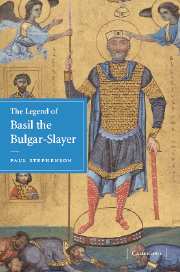
Paul Stephenson is the known writer of the famous book "The Legend of Basil the Bulgar-Slayer " that publish from the Cambridge(ISBN-13: 9780521815307 ISBN-10: 0521815304) . In the page 134 describes two incidents that had with the Slav Macedonians regarding the history of this Greek Byzantine Leader.

In July 1998 1 was sitting in front of the Church of Sv. Klimcnt (St. Clement), a thirteenth-century foundation on a hill which overlooks Ohrid in the Republic of Macedonia. The crest of the hill on the opposite side of the town is dominated by the ruins of an eleventh-century citadel, which Brailsford called “The Bulgarian Tsar’s fortress,” and modern tourist maps call more simply Samuil s Fortress. As I sat a local tour guide explained how this came to be. He told a version of the story of the battle of Kicidion, after which the blinded troops marched back to Samuel’s fortress, and the crud Greek king” Basil ever after was known as the “Macedonian-slayer.”

A similar account is included in a recent national history, compiled by two journalists from Skopje, which includes a translation into Macedonian Slavic of Skylitzes’ account of the battle of Kleidion, with all references to Bulgaria and Bulgarians excised.”

This was my reason for beginning this study, and so here also it will end.

Slav-Macedonism is the political idea prevailing in the Former Yugoslav Republic of Macedonia (FYROM) which utilises historical revisionism to establish links between an ethnic group that formed in the 20th century - ethnic 'Macedonians' - and historical events and figures of the 19th century and Middle Ages. The fYROMacedonian historiography basing her “stealing process” via the Historical revisionism. Historical revisionism is the attempt to change commonly held ideas about the past. In its legitimate form (see historical revisionism) it is the reexamination of historical facts, with an eye towards updating historical narratives with newly discovered, more accurate, or less biased information, acknowledging that history of an event, as it has been traditionally told, may not be entirely accurate. Historical revisionism can be used as a label to describe the views of self-taught historians who publish articles that deliberately misrepresent and manipulate historical evidence.

Paul Stephenson met this kind of historiography. As we know, the main characteristics of a nation are unity of country (with the meaning of common fatherland) and of political organisation, language, religion and heritage, which are joined by a common past, common consciousness - characteristics which alone are not enough or indeed necessary but which in combination create the separate identity of a nation. They tried to keep these characteristics to the new "republic of Macedonia". They wanted, in other words, to fabricate a nation. By means of their studies and publications they attemped to reconstruct and re-interpret historical data in order to fulfil their objectives.

Thanks to the Slav Macedonists of the FYROM we have now an amazing book of Paul Stephenson as regards the life of this Greek Byzantine leader.


World Museums and Ancient Macedonia

Nationalists from the Former Yugoslav Republic of Macedonia (F.Y.R.O.M) and her diaspora constantly allege that only Greek historians and institutions subscribe to the notion that the ancient Macedonians, including the Hellenistic successors of Alexander, belonged within the sphere of the ancient Greek world. The nationalists from F.Y.R.O.M claim that the notion that the ancient Macedonians were a Greek tribe is an assertion largely motivated by propaganda efforts of the Greek state. According to nationalists from F.Y.R.O.M and her diaspora the ancient Macedonians were a proto-Slavic tribe who spoke a proto-Slavic language. These same nationalists, along with the Gruevski administration, claim that the ancient Macedonians are the ancestors of the Slavic population of F.Y.R.O.M. No credible and objective historian in the world supports this far fetched claim. Unfortunately for the nationalists from F.Y.R.O.M and her diaspora the ancestors of the Slavs of F.Y.R.O.M were almost universally regarded as Bulgarians up until the early 20th century.

A quick survey of international museums, and their descriptions of ancient Macedonia and ancient Macedonian artificats, shows that many of the most reputable and respected international institutions regard the ancient Macedonians as an ancient Greek tribe. The following examples, taken from websites of various museums, expose the nationalists from F.Y.R.O.M as liars when they claim that only Greeks relate ancient Macedonians with ancient Greeks.

While reading the follwing excerpts from international Museums the readers should ask themselves who to believe: The likes of the British Museum or nationalists from F.Y.R.O.M who have constructed a mythical pedigree for themselves, that no reputable historian supports, in order to lend legitimacy to their new Balkan state.


[Credit goes to Georox for compiling this information]

1. The Metropolitan Museum of Art. New York.

Photobucket

http://www.metmuseum.org/toah/hd/gkru/hd_gkru.htm#mace

Photobucket

http://www.metmuseum.org/toah/hd/tacg/hd_tacg.htm

Photobucket

http://www.metmuseum.org/toah/hd/alex/ho_52.127.4.htm

Photobucket

http://www.metmuseum.org/toah/hd/angk/hd_angk.htm

Photobucket

http://www.metmuseum.org/toah/hd/haht/ho_2002.66.htm

Photobucket

2. The British Museum. London.

Photobucket

http://www.britishmuseum.org/explore/world_cultures/europe/ancient_greece.aspx

Photobucket

http://www.britishmuseum.org/explore/highlights/highlight_objects/gr/m/portrait_alexander_the_great.aspx

Photobucket

http://www.britishmuseum.org/explore/highlights/highlight_objects/gr/d/dedication_by_alexander.aspx

Photobucket

http://www.britishmuseum.org/explore/highlights/highlight_objects/gr/b/bronze_mask_of_dionysos.aspx

Photobucket

3. The Louvre. Paris.

Photobucket

Photobucket

Photobucket

Photobucket

Photobucket

4. The Getty. Los Angeles.

Photobucket

http://www.getty.edu/art/gettyguide/artObjectDetails?artobj=8128

Photobucket

http://www.getty.edu/art/gettyguide/artObjectDetails?artobj=8239

Photobucket

http://www.getty.edu/art/gettyguide/artObjectDetails?artobj=35555

Photobucket

http://www.getty.edu/art/gettyguide/artObjectDetails?artobj=109801

Photobucket

http://www.getty.edu/art/gettyguide/artObjectDetails?artobj=35552

Photobucket

http://www.getty.edu/art/gettyguide/artObjectDetails?artobj=248738

Photobucket

5. The Hermitage. St. Petersburg Russia

Photobucket


http://hermitagemuseum.org/html_En/03/hm3_7_1_1b.html

Photobucket

6. The Fitzwilliam Museum. Cambridge

Photobucket

http://www-cm.fitzmuseum.cam.ac.uk/gallery/east-west/

Photobucket

7. The Philadelphia Museum of Art.

Photobucket

http://www.philamuseum.org/collections/permanent/40363.html?mulR=4756

Photobucket

Saturday, January 03, 2009

The Hellenism of the Ancient Macedonians

Papercover: 294 pages
Publisher: Institute For Balkan Studies, Thessaloniki, 1965
Author: Apostolos Daskalakis, Member of the Greek Academy
Status: Rare and Out of print book

The present work represents the fruit of research into the Hellenism of an­cient Macedonia spread over many years, coupled with careful review and interpretation of all the ancient sources dealing with the subject. From the outset its planned aim has been not so much the writing of a history of Macedonia in ancient times, as the collection, critical study and evaluation of any material capable of serving to ascertain the Hellenic identity of the Macedonians and in general to examine their life, set within the range of Greek antiquity.

Admittedly, many of these facts have not been ignored in the views expressed or the conclusions already reached concerning the ancient Macedonians. Distinguished scholars and historians, both Greek and foreign, have made praise­worthy efforts to elucidate many facets of the country's past and their contribu­tions are far from negligible. Despite this, many subjects bearing not only on the language and make up of the nation, but also on the life in general of the old Macedonians, have hitherto remained unexplored, or at any rate not fully stud­ied; and there are many historical problems, particularly concerning the early history of Macedonia, yet to be solved. The partial or imperfect investigation of these problems has often led to faulty interpretations giving rise in their turn to contradictory judgements and questionable reasoning accompanied by violent disputes.

In this study I have examined all historical facts available in the sources of antiquity and have based my treatment and thinking in general about the Hel­lenism of ancient Macedonia on these alone. Wherever it has been possible or helpful to do so, some linguistic or archaeological material has been used. The work is above all historical, written by a historian and supported by data drawn from the sifting and checking of ancient sources.

The book is divided into five sections in each of which one of the principal subjects giving rise to controversy, or creating problems in history with regard to the Hellenism of Macedonia, has been dealt with by itself.

These are :
  1. Origin of the ancient Macedonians: in this for purposes of research all information derived from ancient sources is recorded and also any geographical data found in the ancient authors, to corroborate conclusions reached.
  2. The language of the Macedonians according to historical sources; here all ancient information concerning the language they spoke is cited and examined interpretatively.
  3. The descent of the Arsead-Temenid Royal house of Macedonia, which ruled the country from unrecorded times down to Alexander the Great, a subject closely tied up with the national origin of the Macedonians and the foundation of the State.
  4. Life of Alexandre the Philhellene, a man specially honoured by the Greeks, a subject of wider interest, dealing as it does with the first of Macedonian kings to lead his country into the Greek political horizon and lay the foundations of a Macedonian way of life on Greek lines, a topic which also offers a chance for a fuller historical study of the situation in Macedonia and the Greek wars of liberation against the Persians, as well as for the solution of many problems relating to Macedonia at that time.
  5. The Athenian orators and what was said about Macedonian barbarism, a study refuting by means of historical research many existing misinterpret­ations of ancient texts concerning the conceptions of the Hellenism of the Macedon­ians held principally in Greece during antiquity.

These five sections of the present work, though written as separate studies, combine to give a general picture of the Hellenism of ancient Macedonia.

The book was first published in Greek and each of the five sections had a special bibliographical introduction, giving both the ancient sources on which my opinions were based and my conclusions regarding them. In the present Eng­lish edition, instead of these there is a general bibliography. The ancient texts, which would present a mass of material if quoted in full, have only been retai­ned in certain instances.

Below is a Review of the particular book fron N.G.L. Hammond (The Classical Review, New mSeries, Vol. 12, No. 3 (Dec., 1962), pp. 270-271 , Cambridge University Press on behalf of The Classical) that conserns the Greek edition.

The Professor of History in the University of Athens has in the past written a number of articles on aspects of Macedonian history, and he is now publishing some volumes on the subject, of which this is the first. It contains five parts; each is a separate study, complete with its own introduction, and they are connected with one another only by their bearing on the 'Greekness' of Macedonia. This system leads inevitably to much repetition, and this repetition combined with the very full, and sometimes verbose, style of Professor Daska-akis makes a very long book of the five topics. He writes with rhetorical power and conviction. At times he seems to protest too much, and he piles up all variety of arguments on the head of his reader. He tilts vigorously against his 'Slav' opponents, whose views, he asserts, are coloured by modern political prejudices. Absit omen! For there was nothing in Russian policy in the last war which the Greeks hated more than the proposal to set up an autonomous Macedonia as a Russian satellite.

The first part, 'The Origin of the Macedonians', begins well with its introduc­tion and sections on geography, and then the author takes the archaeological bull by the horns and hurls it to the ground. 'The archaeological excavations', he asserts, 'assure us in a manner which permits no doubt that Greek elements existed in Macedonia from prehistoric times and subsequently.' He is equally confident that archaeology has revealed Greeks in prehistoric Epirus. But in neither case does he discuss the evidence or say what objects he considers to have been specifically Greek (or in his terminology Achaean and Dorian) at Servia or Armenohori or Dodona. He seems to equate traces of Mycenaean civilization (or Achaean civilization as he calls it on p. 60) with the presence of Greek peoples, although he accepts Homer's placing of Paeonians in much of Macedonia at the time of the Trojan War and although Mycenaean remains are very rare in Epirus; and he sees in the Mycenaean-like style of the treasures found at Trebenishte, near Lake Ochrid, evidence of the survival there of 'the first Indo-European Greeks of the Mycenaean period, the Achaeans' into the latter part of the sixth century b.c. He may well be correct in his general views about the origin of the Macedonians, but he fails to carry conviction in
his use of archaeological evidence. He is much stronger on the literary sources, and he comments well on the famous passage in Herodotus i. 56, where a wandering tribe was called Makednon during its residence in the Pindus area and Dorikon on
entering the Peloponnese. He suggests that the tribesmen were tall (μακεδνοί) and the country was tall, i.e. mountainous, so that the tribe was called Makednon on two counts, and he holds the classical Macedonians to have been descended from the Dorians.

The second part deals with the language. Here the conclusions of Galleris are used, but his valuable glossary is not cited often (Les anciens Macedoniens, 1954). Inscriptions too are rarely used throughout the book. Professor Daska-lakis concentrates more on the literary sources and the names of persons and places, which go some way to support his positive conclusion that the Mace­donians spoke a dialect of Doric Greek. However, he makes too little of the difficulties. For example, Alexander the Great shouted out Μακεδονιστί (Plut. Alex. 51. 4), and he offered Philotas the chance of speaking patrio ser-mone (Q,. Gurt. vi. 9. 34 f.); later the Macedonians are said to have greeted Eumenes Μακ&ονιστΙ rfj φωντ\ (Plut. Eumen. 14. 4), and they were themselves recognized as different from the Spartans ck re των οπλών καΐ τής φωνής (Paus. iv. 29. 1). These passages are submitted to full discussion and some demolition, but they leave a suspicion that the Macedonians did speak a patois which was not recognizable at once as normal Doric Greek but may have been a north­west-Greek dialect of a primitive kind.

The third part, 'Argeadae-Temenidae', is the most convincing, because Professor Daskalakis goes very thoroughly into the literary sources, the names of the Macedonian kings, and the signs of Greek culture at the Macedonian court. This is a large task, well executed, and most readers will agree that the royal house was Greek in origin. The conclusion, which Professor Daskalakis draws, that their subjects were also Greeks of Dorian stock who had stayed in the Pindus area and were led in the early eighth century by the founders of the royal house into central
Macedonia, rests mainly on arguments of probability and will meet with conflicting views.

The fourth part, 'Alexander I the Phil-hellene', is a more straightforward piece of historical study. He puts his birth between 530 and 527 b.c., his competing at the Olympic Games in 496 b.c., and his death c. 454 b.c.; and he attributes to him the institution of the Pezetairoi and other administrative developments which are normally dated to the reign of Archelaus or to the fourth century.

The last part, 'The Athenian Orators and Charges of Macedonians being Barbarians', has a lighter theme but is thoroughly set forth. No doubt Demosthenes called Philip 4 a barbarian* and Aeschines called Demosthenes a barbarian and a Scythian', just as their modern counterparts might call their opponents 'Albanians' or 'Bulgars'. The interesting sentences in Herodes' πολιτείας and in the fragment of Thrasymachus are fully discussed, but I find it hard to believe with Professor Daskalakis that 'Isocrates indubitably . . . believed in the Greekness of the Macedonians' when I read chapters 105-8 and 154 of his Philippus. Isocrates thought the Macedonians to be un-Greek in accepting the rule of a king and probably he thought them un-Greek in blood (ούχ ομοφύλου γένους, in chapter 108). And this brings us back to a definition of Greekness, which must rest partly on archaeological evidence for the early period and on linguistic evidence for the fifth century.

This book is a valuable contribution to the study of an important area. We wish Professor Daskalakis success in carrying on the good work in his later volumes. The print is clear (I noted half a dozen misprints only); there is a full index of proper names; and the book ends with a hand-drawn map, which could be given clearer definition in a later volume.

University of
Bristol
N. G. L. HAMMOND

Friday, January 02, 2009

100 Modern historians verify the Hellenicity of the ancient Macedonians


Modern historians about Macedonia - N.G.L Hammond
Modern historians about Macedonia - R. Malcolm Errington
Modern historians about Macedonia - Robin Lane Fox
Modern historians about Macedonia - Richard Stoneman
Modern historians about Macedonia - Ulrich Wilcken
Modern historians about Macedonia - Eugene Borza
Modern historians about Macedonia - Ernst Badian
Modern historians about Macedonia - Charles Edson
Modern historians about Macedonia - John Maxwell O’Brien
Modern historians about Macedonia - Bernard Randall
Modern historians about Macedonia - Thomas R Martin
Modern historians about Macedonia - M. Cary
Modern historians about Macedonia - A.J.Toynbee
Modern historians about Macedonia - Robin W Winks
Modern historians about Macedonia - Agnes Savill
Modern historians about Macedonia - Kenneth Meyer Setton
Modern historians about Macedonia - Peter Green
Modern historians about Macedonia - A. R. Burn
Modern historians about Macedonia - Jonathan M. Hall
Modern historians about Macedonia - Richard Stoneman
Modern historians about Macedonia - M. E. Thalheimer
Modern historians about Macedonia - J. E. G. Whitehorne
Modern historians about Macedonia - Anthony E. David
Modern historians about Macedonia - George Cawkwell
Modern historians about Macedonia - Fergus Millar
Modern historians about Macedonia - Chester G. Starr
Modern historians about Macedonia - Lewis Vance Cummings
Modern historians about Macedonia - Victor Ehrenberg
Modern historians about Macedonia - D. G. Hogarth
Modern historians about Macedonia - James S. Romm
Modern historians about Macedonia - Hilding Thylander
Modern Historians about Macedonia - Graham Shipley
Modern historians about Macedonia - P. M. Fraser
Modern Historians about Macedonia - Robin Osborne
Modern Historians about Macedonia - Jacques Pirenne
Modern Historians about Macedonia - M. C. Howatson
Modern Historians about Macedonia - William Pinnock
Modern Historians about Macedonia - Ernst Curtius
Modern Historians about Macedonia - J. C. Stobart
Modern Historians about Macedonia - Walter M. Ellis
Modern Historians about Macedonia - Eric Carlton
Modern Historians about Macedonia - Irad Malkin
Modern Historians about Macedonia - Carl J. Richard
Modern Historians about Macedonia - Alan Fildes
Modern Historians about Macedonia - John Anthony Crame
Modern Historians about Macedonia - Donald P. Ryan
Modern Historians about Macedonia - Charles Gates
Modern Historians about Macedonia - J. D. Fage
Modern Historians about Macedonia - Theodor Mommsen
Modern Historians about Macedonia - Donald R. Dudley
Modern Historians about Macedonia - Anthony E. David
Modern Historians about Macedonia - René Grousset
Modern Historians about Macedonia - Samouel Eddy
Modern Historians about Macedonia - David Sacks
Modern Historians about Macedonia - Richard Gabriel
Modern Historians about Macedonia - Martin Sicker
Modern Historians about Macedonia - L.S. Stavrianos
Modern Historians about Macedonia - Peter Tsouras
Modern Historians about Macedonia - E. Bevan
Modern Historians about Macedonia - Katja Mueller
Modern Historians about Macedonia - Francois Chamoux
Modern Historians about Macedonia - Philip Hughes
Modern Historians about Macedonia - R.M. Cook
Modern Historians about Macedonia - J. M. Roberts
Modern Historians about Macedonia - Mary Renault
Modern Historians about Macedonia - Bernard Randall
Modern Historians about Macedonia - Paul Cartledge
Modern Historians about Macedonia - Hermann Bengtson
Modern Historians about Macedonia - Mortimer Chambers
Modern Historians about Macedonia - Jacob Abbott
Modern Historians about Macedonia - A. B. Bossworth
Modern Historians about Macedonia - John A. Fine
Modern Historians about Macedonia - Rene Guerdan
Modern Historians about Macedonia - David H. Levinson
Modern Historians about Macedonia - Bim Sherman
Modern Historians about Macedonia - Katheryn A. Bard
Modern Historians about Macedonia - Ernest Barker
Modern Historians about Macedonia - Henri-Daniel Rops
Modern Historians about Macedonia - Archaeological Institute of America
Modern historians about Macedonia - Francis S. Marvin
Modern historians about Macedonia - Nigel Cawthorne
Modern Historians about Macedonia - Stella Myller-Collet
Modern historians about Macedonia - Louis- Pierre Anquetil
Modern Historians about Macedonia - George Rawlinson
Modern Historians about Macedonia - Michael Wood
Modern historians about Macedonia - John Pentland Mahaffy
Modern historians about Macedonia - John B. Teeple
Modern historians about Macedonia - Elisabeth Gaynor Ellis
Modern historians about Macedonia - John Mounteney
Modern historians about Macedonia - John Lewis Burckhardt
Modern historians about Macedonia - Benjamin Ide Wheeler
Modern historians about Macedonia - Norman Karol Gottwald
Modern historians about Macedonia - Nigel Guy Wilson