Wednesday, June 16, 2010

Slavs in the South Greece

The first appearance of the Slavs in the Byzantine Empire can be dated no earlier than the 6th century. Throughout this century, beginning with the reign of Justinian, Slavs repeatedly invaded the Balkan possessions of the Byzantine Empire. Not until the reign of Maurice, however, did any Slavs settle in these territories. Between the years 579-587 there took place the irruption of several barbarian waves led by the Avars, but consisting mostlyof Slavs. The latter came in great numbers, and, as the troops of the Empire were engaged in the war with Persia, they roamed the country at will.

Slavs devastated Illyricum and Thrace, penetrated deep into Greece and the Peloponnesus, helped the Avars to take numerous cities, including Singidunum, Viminacium (Kostolac), Durostorum (Silistria), Marcianopolis, Anchialus, and Corinth, and in 586 laid siege to the city of Thessalonica, the first of a series of great sieges which that city was destined to undergo at their handss What is more, they came to stay.

"The Slavonians," wrote John of Ephesus in 584, "still encamp and dwell in the Roman territories and live in peace there, free from anxiety and fear, and lead captives and slay and burn." The counter offensive launched by Maurice after 591, following the successful termination of the Persian war, had the effect, on the whole, of checking the repeated incursions of the Avars, who then seem to have transferred their operations farther west beyond the limits of Byzantine territory. The treaty of peace which the Empire concluded with them in possibly in 601, fixed the Danube as the boundary line between the two powers, but left the way open for the Byzantines to cross that river and chastise any Slavs that might appear dangerous.80 There is no indication, however, that the Slavs who had penetrated into the Empire were forced to retire beyond the Danube, or that they did so of their own accord.

Settlement of the Slavs in the Balkan Peninsula occurred mainly in the....

Saturday, May 15, 2010

Dr. Frank Holt regarding Macedonian History and FYROM

The following text, written by Dr. Frank Holt Professor of Ancient History at the University of Houston, will be the prologue of a book published by the Macedonian Studies Center.
The book will include the letter by world known archeologists, historians and researchers from various academic institutions in the world to President Barack Obama regarding the Greekness of Macedonia. http://macedonia-evidence.org/

PROLOGUE
The documents comprising this book speak forcefully for the proposition that the history of ancient Macedonia, including the brilliant reigns of Philip and his son Alexander, belongs squarely in the cultural, economic, political, religious, and military history of Hellenism.
The cultural milieu of the Macedonian court was Greek.
The texts that Alexander studied as a youth were Greek.
The books he read while in Asia were Greek.
The heroes he emulated, the gods he worshipped, the temples he built were Greek.
The coins he minted in the millions were Greek.
The legacy he left behind from Anatolia to India was as Greek as his settlers could make it, right down to a theater, gymnasium, and inscribed copy of the Delphic maxims in a far corner of Afghanistan. To say that Alexander’s kingdom was......

Thursday, April 22, 2010

Protecting the brand name Macedonia - lessons from Byzantine Diplomacy

by Miltiades Bolaris
macedonianissues.blogspot.com
americanchronicle.com

A 2007 article by the Greek political scientist Constantinos Holevas, originally published in Antibaro, a Greek magazine made its re-appearance in the Akritas Macedonian blog recently. http://akritas-history-of-makedonia.blogspot.com/
It is titled "The importance of the name and Byzantine Diplomacy".

Professor Holevas reminded us in this article that the Byzantines never called their state Byzantium. They called themselves Romaioi/Ρωμαίοι (Romans) and their state Romania/Ρωμανία (State of the Romans). They were in full conscience of their Greek language descent and culture, yet they did not consider their state simply a kingdom of the Greeks but an ecumenical empire, a representation of Christ's kingdom on earth, a continuation of the Roman empire of the Caesars, aspiring to govern the whole known world. Constantinos Holevas reminded us that even in the bleakest moments of the empire, when, after the fall of Constantinople to the Franks of the Fourth Crusade in 1204 a Latin king was sitting on the throne of Constantinople the Eastern Romans, the Byzantines, never relented on their title. John III Doukas Vatatzes / Ιωάννης Γ΄Δούκας Βατάτζης (1222-1254) the Greek king of the tiny Byzantine kingdom of Nicaea (modern Iznik in Asia Minor-Turkey), replying to the Caesaropapist demand of Pope Gregory 8th (1227-1241) that he recognizes the Latin king of conquered Constantinople as the a legitimate Roman Emperor, he refused. He reminded the Pope that all his predecessors called themselves Emperors of the Romans / Ρωμαίων Aυτοκράτορες and that he would not give up his title to a forger who simply happened to be sitting on some of his lands. To the Pope's claims that he is simply a king of the Greeks, and not a Roman Emperor, John III Doukas Vatatzes replied, that.....

Friday, April 09, 2010

Alexander I at Olympia (Olympic Games)

Old king Amyntas was a conservative obliged to carry on his traditional local policy and consumed with fear of a new Persian onslaught. While he was alive, his heir Alexander spent his youth more or less in the background. But from the time when he ascended the throne on his father's death he was not slow in showing his deep felt convictions and opening up Greek horizons to Macedonia for the first time by means of direct contact with the Hellenes. The erstwhile youth who had slain the Persian nobles was still apparently alive in him and his heart had not ceased responding to the lure of legends and poetic traditions from his Hellenic schooling as a boy. Despite the fact that his sister lived at the Persian court as wife of a powerful Persian grandee, he felt himself a Greek to the core and was burning with desire to bring Macedonia actively into the orbit of Hellenic life and even more so, to exhibit his pan-Hellenic schoiling. The ambition to visit Olympia and take part in the games is also explained by his family traditions. As a Heracleid he would go on a pilgrimage to the all-Greek sanctuary which, according to the belief of all Greece, Heracles himself had founded. By gaining victories there and receiving a branch of the sacred olive his illustrious ancestor had planted, he would be acclaimed by all the Hellenes and show himself a worthy scion of the legendary hero.

So very shortly after his accession he determined to do what no Macedonian king before him and very few after him until Philip's day had contemplated doing. He made up his mind to visit Greece, to make personal acquaintance with the political and social life of the Greek cities, to sacrifice at the pan-Hellenic shrines and take part in the pan-Hellenic games. History tells us nothing of Alexander I's journey to Greece apart from his.......

Friday, March 12, 2010

Afrocentrism and the distortion of Greek history

Ioannis Kotoulas
Historian
(Translation into English by Athan).

On February 1993 in the College Wellesley of Massachusetts a lecture was given regarding the ancient Egyptian civilization. The speaker, Yosef A. A. Ben Jochannan was presented by the event organizers as a “distinguished Egyptologist”. During his lecture Jochannan more or less supported that the ancient Greeks practically stole their civilization from Egypt, that philosopher Aristotle went to Alexandria along with Alexander the Great to visit the library which Aristotle eventually sacked in order to write his works.

During questions, a professor of classical studies named Mary Lefkowitz asked the lecturer why he would claim something like that when Alexandria acquired its great library well after the death of Aristotle, and moreover, the Greek philosopher never visited Egypt. Jochannan refused to answer, accusing Lefkowitz for empathy and negative stance towards the opinions of the black population. After the lecture many students accused Lefkowitz for racism and a one way comprehension of history. Indeed, what is happening in the American universities?

Afrocentrism is an ideological movement with historical and political extensions, which has spread through many universities across the Atlantic especially during the 90s. It is a branch of a new wave of political correctness that swept the American society during the last decade.

The supposed basic core of the beliefs of afrocentrism is shaped as thus: Mother of civilization – especially of Western civilization – is .....

Thursday, March 04, 2010

Hellenistic coins dating back Alexander the Great’s era found in northern Syria

Washington, March 3 : Reports indicate that a collection of Hellenistic coins dating back to the era of Alexander the Great in northern Syria have been found by a local man


According to a report in Global Arab Network, a local man found the coins near Najm Castle in the Manbej area in Aleppo governorate, as he was preparing his land for construction, uncovering a bronze box that contained around 250 coins.


He promptly delivered the coins to the authorities who in turn delivered them to Aleppo Department of Archaeology and Museum.


Yousef Kanjo, the director of archaeological excavations at Aleppo Department of Archaeology and Museum, said that the box contained two groups of silver Hellenistic coins: 137 tetra drachma (four drachmas) coins and 115 drachma coins.


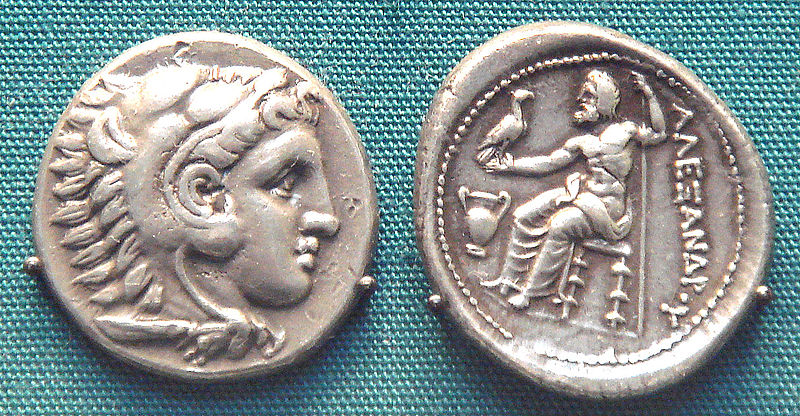
One side of the tetra drachma coins depicts Alexander the Great, while the other side depicts the Greek god Zeus sitting on a throne with an eagle on his outstretched right arm.


34 of these coins bear the inscription “King Alexander” in Greek, while 81 coins bear the inscription “Alexander” and 22 coins bear “King Phillip.”


The drachma coins bear the same images as the tetra drachma, with “Alexander” inscribed on 100 of them and “Philip” on 15 of them.

http://newstiger.in/?p=12300

Wednesday, February 24, 2010

Laminated Linen Protected Alexander the Great

Alexander's men wore linothorax, a highly effective type of body armor created by laminating together layers of linen, research finds.

A Kevlar-like armor might have helped Alexander the Great (356–323 B.C.) conquer nearly the entirety of the known world in little more than two decades, according to new reconstructive archaeology research.

Presented at the annual meeting of the Archaeological Institute of America in Anaheim, Calif., the study suggests that Alexander and his soldiers protected themselves with linothorax, a type of body armor made by laminating together layers of linen.

"While we know quite a lot about ancient armor made from metal, linothorax remains something of a mystery since no examples have survived, due to the perishable nature of the material," Gregory Aldrete, professor of history and humanistic studies at the University of Wisconsin-Green Bay, told Discovery News.

"Nevertheless, we have managed to show that this linen armor thrived as a form of body protection for nearly 1,000 years, and was used by a wide variety of ancient Mediterranean civilizations," Aldrete said.

Indeed, Aldrede and co-investigator Scott Bartell discovered that linothorax was......

Monday, February 01, 2010

Falsifying History - Fabricating a Fake Identity: Skopjan pseudo-Makedonism on MACEDONIAN THEATER

Miltiades Elia Bolaris
January 25, 2010

δῆλον δὲ πρῶτον μὲν ὁρισαμένοις τί τὸ ἀληθὲς καὶ ψεῦδος. τὸ μὲν γὰρ λέγειν τὸ ὂν μὴ εἶναι ἢ τὸ μὴ ὂν εἶναι ψεῦδος, τὸ δὲ τὸ ὂν εἶναι καὶ τὸ μὴ ὂν μὴ εἶναι ἀληθές, ὥστε καὶ ὁ λέγων εἶναι ἢ μὴ ἀληθεύσει ἢ ψεύσεται (Αριστοτέλης, Μεταφυσικά)

This will be plain if we first define truth and falsehood. To say that what is is not, or that what is not is, is false; but to say that what is is, and what is not is not, is true; and therefore also he who says that a thing is or is not will say either what is true or what is false. (Aristotle, Metaphysics)

Once someone rejects truth and accepts falsehood, the search for explanations to cover the tracks of his falsehood becomes essential. This inevitably leads to the creation of an alternate reality that attempts to explain the unexplainable. The pseudo-Makedonist regime in Skopje has elevated fraud to the level of science, and it has correspondingly reduced science to being the contemptible paramour of their repulsive politics of hatred, ultra-nationalist bigotry and ethnic intolerance.

The Skopjan blog http://my.opera.com/ancientmacedonia/blog is one of the numerous ......

Thursday, January 21, 2010

Alexander the Great - Dr.Tellenbach interview


Dr.Tellenbach gives an interview about Alexander the Great and the Opening of the World, the museum exhibition. Related articles and information at http://macedonia-evidence.org/museum-exhibition.html.

Sunday, January 10, 2010

Introduction to Ancient Greek History from the Yale University


In this lecture, Professor Kagan tells the story of the rise of Philip and describes his early actions: unifying Macedon, defeating barbarian armies, and creating a new, professional, national army. According to Professor Kagan, through these actions, Philip was able to make inroads into the Greek world. What made these inroads more effective was Philip's uncanny talent for diplomacy and the fighting between the various poleis. Eventually, the Greeks under the efforts of Athens and Demosthenes decided to face Philip in the battle of Chaeronea. The battle, though close, was won by Philip and his Macedonian forces. Finally, Professor Kagan evaluates the actions of Demosthenes and concludes that his actions should be judged as a noble endeavor of one who loved freedom.

Complete course materials are available at the Open Yale Courses website: http://open.yale.edu/courses

This course was recorded in Fall 2007.

Thursday, January 07, 2010

Thursday, December 31, 2009

Tuesday, December 29, 2009

Macedonian names and makeDonski pseudo-linguistics: The case of the name Pyrrias


by Miltiades Elia Bolaris

Balkan Illusion - phantasia archaica:

"...it is very interesting to note that many of the authentic ancient Macedonian words, according to their etymology and pronunciation, have a striking resemblance to the appropriate words used in the modern Macedonian language (and other so called "Slav"[sic] languages). "Pyri(as). The root of this name could be connected to the noun "pir" (merriment). The name Piri is present in todays' Macedonian onomasticon." Quote taken from: "Similarities between ancient Macedonian and today's' Macedonian Culture (Linguistics and Onomastics)" by Aleksandar Donski, celebrity historian from FYROM./ Πυρίας/Pyrrias/Πυρρίας

In his "Dictionary of Classical Mythology", Sorbonne professor Pierre Grimal gives us a beautiful story from the Greek Mythology. It is an ancient myth about a boatman, named Pyrias/
Πυριας:


"Pyrias was a boatman from Ithaca who took pity on an old man captured by pirates. The old man was carrying vessels full, apparently of pitch. These jars later came into the possession of Pyrias who realized that under the pitch they contained jewels and treasures. In his gratitude Pyrias sacrificed an ox to his unknown benefactor. From this came the proverb : "Pyrias is the only man to have sacrificed an ox to his benefactor.""
 Pyrrias was not a very common Greek name, but at the same time it was not exclusive to any part of Greece either. We find this name from Peloponnesus to Macedonia and from Sicily to the Hellenistic East.


Pyrias of the aforementioned myth was from Ithaca, Ulysses' island, but a more flesh and bone Pyrrias appears in the historical record. It was in the year 401BC, right after the battle of Cunaxa. He was an Arcadian from central Peloponnese. He was stranded, like all the other myriad (10 thousand) Greek mercenaries, in the midst of Mesopotamia (modern Iraq) then part of the huge and powerful Persian Empire. The Greek Mercenaries had been in the pay of Cyrus who had revolted against his brother, the king of Persia, Artaxarxes. In the Cunaxa battle Cyrus was killed, leaving his Greek mercenaries stranded deep inside enemy territory. When their military leaders from their Spartan general Clearchos down to the most junior officers were massacred in a treacherous banquet plot where king Artaxerxes had invited them the situation for the Greek rank and file hoplites became desperate.


In the midst of the night, with Persian arrows harassing them on top of the hill where they had gathered to defend themselves, they started to .....

Thursday, December 24, 2009

Saturday, December 19, 2009

THUCYDIDES AND THE MACEDONIANS


by Ioannis Xydopoylos
abstract from the book "Communities in European history: representations, jurisdictions, conflicts", pages 7-9

In 2006  I published a study of the representation of the Macedonians and their country by the historian of die Peloponnesian War (431-404 BC)[23] In it I suggested that Thucydides references to the Macedonian people and their country have a clearly circumstantial character. Furthermore they arc informed by the Poteidaea incident (432/1), the intervention of the Thracian king Sitalkes (429) and the military operations the Spartan general Brasidas undertook in the area (424/3). Thucydides frames his representation of die Macedonians with the Spartan general Brasidas reference to them in the speech he made to his troops. In his harangue Brasidas clearly classified them as barbarians:” you should learn about these barbarians whom now you are afraid of, a part of them you have already fought against, the Macedonians among them, that, from my own estimate of them, and what 1 have heard from others, they arc notstrong”(IV,126.3)[24] Thucydides further establishes this view in his narrative of Brasidas and Perdikkas campaign in Lynkestis in 42V3 B.C. when he wrote that "the Chalkidians and Macedonian cavalry [came to] nearly a thousand, and there was also a large mass of barbarians[25]. These passages have provoked considerable discussion, especially during die late 20th century. Regarding the question of ethnicity, the question is: ..........

Sunday, December 13, 2009

Some intresting quotes from Plutarch regarding Demosthenes and his policy towards Macedonians and Persians.

Demosthenis letters in the Persian Royal Court.......
The fame of it also reached even to the court of Persia, and the king sent letters to his lieutenants commanding them to supply Demosthenes with money, and to pay every attention to him, as the only man of all the Grecians who was able to give Philip occupation and find employment for his forces near home, in the troubles of Greece. This, afterwards came to the knowledge of Alexander, by certain letters of Demosthenes which he found at Sardis, and by other papers of the Persian officers, stating the large sums which had been given him.
[Plutarch's Life of Demosthenis,20,4-5]

Arpalos money.......
[25].It was not long after that Harpalus fled from Alexander, and came to Athens out of Asia; knowing himself guilty of many misdeeds into which his love of luxury had led him, and fearing the king, who was now grown terrible even to his best friends. Yet this man had no sooner addressed himself to the people, and delivered up his goods, his ships, and himself to their disposal, but the other orators of the town had their eyes quickly fixed upon his money, and came in to his assistance, persuading the Athenians to receive and protect their suppliant. Demosthenes at first gave advice to chase him out of the country, and to beware lest they involved their city in a war upon an unnecessary and unjust occasion. But some few days after, as they were taking an account of the treasure, Harpalus, perceiving how much he was pleased with a cup of Persian manufacture, and how curiously he surveyed the sculpture and fashion of it, desired him to poise it in his hand, and consider the weight of the gold. Demosthenes, being amazed to feel how heavy it was, asked him what weight it came to. "To you," said Harpalus, smiling, "it shall come with twenty talents." And presently after, when night drew on, he sent him the cup with so many talents. Harpalus, it seems, was a person of singular skill to discern a man's covetousness by the air of his countenance, and the look and movements of his eyes. For Demosthenes could not resist the temptation, but admitting the present, like an armed garrison, into the citadel of his house, he surrendered himself up to the interest of Harpalus. The next day, he came into the assembly with his neck swathed about with wool and rollers, and when they called on him to rise up and speak, he made signs as if he had lost his voice. But the wits, turning the matter to ridicule, said that certainly the orator had been seized that night with no other than a silver quinsy. And soon after, the people, becoming aware of the bribery, grew angry, and would not suffer him to speak, or make any apology for himself, but ran him down with noise; and one man stood up, and cried out, "What, ye men of Athens, will you not hear the cup-bearer?" So at length they banished Harpalus out of the city; and fearing lest they should be called to account for the treasure which the orators had purloined, they made a strict inquiry, going from house to house; only Callicles, the son of Arrhenidas, who was newly married, they would not suffer to be searched, out of respects, as Theopompus writes, to the bride, who was within.

[26]. Demosthenes resisted the inquisition, and proposed a decree to refer the business to the court of Areopagus, and to punish those whom that court should find guilty. But being himself one of the first whom the court condemned, when he came to the bar, he was fined fifty talents, and committed to prison; where, out of shame of the crime for which he was condemned, and through the weakness of his body, growing incapable of supporting the confinement, he made his escape, by the carelessness of some and by the contrivance of others of the citizens. We are told, at least, that he had not fled far from the city when, finding that he was pursued by some of those who had been his adversaries, he endeavoured to hide himself. But when they called him by his name, and coming up nearer to him, desired he would accept from them some money which they had brought from home as a provision for his journey, and to that purpose only had followed him, when they entreated him to take courage, and to bear up against his misfortune, he burst out into much greater lamentation, saying, "But how is it possible to support myself under so heavy an affliction, since I leave a city in which I have such enemies, as in any other it is not easy to find friends." He did not show much fortitude in his banishment, spending his time for the most part in Aegina and Troezen, and, with tears in his eyes, looking towards the country of Attica. And there remain upon record some sayings of his, little resembling those sentiments of generosity and bravery which he used to express when he had the management of the commonwealth. For, as he was departing out of the city, it is reported, he lifted up his hands towards the Acropolis, and said, "O Lady Minerva, how is it that thou takest delight in three such fierce untractable beasts, the owl, the snake, and the people?" The young men that came to visit and converse with him, he deterred from meddling with state affairs, telling them, that if at first two ways had been proposed to him, the one leading to the speaker's stand and the assembly, the other going direct to destruction, and he could have foreseen the many evils which attend those who deal in public business, such as fears, envies, calumnies, and contentions, he would certainly have taken that which led straight on to his death.

Monday, November 23, 2009

Before and the Arrival of the Proto-Greeks in Macedonia(3000 b.c.-2300 b.c.)


BEFORE THE ARRIVAL OF THE PROTO-GREEKS

For certain areas of the Greek mainland and many of the islands the names of some fifteen pre-Greek peoples are preserved in ancient traditions, together with a number of other references; information of this quantity or importance is wanting in the case of the inhabitants of Macedonia, however, not only for the period prior to the advent of the Proto-Greeks, but even before the end of the Bronze Age. This deficiency can be remedied to some extent by recourse to indirect evidence.

Firstly, it is a safe assumption that during the Stone and Bronze Ages, Macedonia was not settled by people very different from the population of southern Greece and the rest of the Balkan peninsula (or of Asia Minor, Italy and the Iberian peninsula). These regions are known to have been inhabited at an early date by pre-Indo-European (or Mediterranean) peoples and subsequently by Indo-Europeans. South of Olympos, the first Indo-Europeans made their appearance towards the end of the Neolithic and the beginning of the Chalcolithic periods (about 3000 B.C.)[1].

Archaeological evidence may be used to add details to this broad picture; there is, however, no agreement amongst the experts as to its interpretation.[2]

In southern Greece, the traditions concerning the pre-Greek Pelasgians coincide to a remarkable degree with certain innovations in the pottery that had made their ap¬pearance slightly earlier in western Macedonia, central Macedonia, Chalkidike, eastern Macedonia and further to the east and north.[3] This suggests that Macedonia was in¬habited by Pelasgians at the end of the Neolithic period.[4] The Pelasgians were one of the pre-Greek Indo-European peoples,[5] as were the Dryopes,[6] a section of whom remained in the valley of the Erigon (Crna) and survived into the historical period, when they were known by the name Derriopes, or Deuriopes or Douriopes: Dry-, Derr-, Deur- and Dour- are all the evolved form or rendering of the same root, the original meaning of which was 'tree' and which later came to mean oak tree.[7]

The features of the 'Tumulus Culture' that appeared in southern Macedonia towards the end of the Neolithic period and somewhat later in the Chalkidike and eastern Macedonia, suggest the arrival of a number of Indo-European groups that cannot be identified.[8]


THE PROTO-GREEKS IN MACEDONIA (2300/2200-1900 B.C.)

The language and religion of the ancient Greeks contain features derived from a variety of different sources. They are predominantly Indo-European, but the non - Indo-European, or 'Mediterranean' features are by no means in¬significant. The Indo-European elements may in turn be divided into a main and a secondary group; the latter are connected with a variety of Indo-European peoples that had been absorbed by the dominant group, which had also absorbed the remnants of 'Mediterranean' peoples. The main ancestors of the ancient Greeks are usually also described as Greeks. This term, however, obscures the fact that the ancient Greeks also had other forebears, both Indo-European and 'Mediterranean'. In order to dis¬tinguish the historical Greeks from the main group of their prehistoric ancestors, the term Proto-Greeks has recently come to be applied to the latter.[9]

Study of the interrelations between the various Indo-European languages has shown that the Proto-Greek tongue had its closest and longest contact with Proto-Aryan (the forerunner of Indian and Iranian languages); that these two languages took shape in the centre of the area occupied by the Indo-European peoples (from the Ukraine to east of the Caspian); and that they separated out after the dispersal of the Indo-European peoples sur¬rounding the Proto-Greeks and Proto-Aryans.[10] A variety of archaeological evidence has demonstrated that the fragmentation of the main mass of the Indo-Europeans was already completed by the beginning of the fourth phase of the 'Tumulus Culture' of the Eurasian steppes (c. 2500 B.C.). Some features of this culture make their ap¬pearance on the Greek mainland and on adjacent islands, under conditions that suggest they were brought by im¬migrants, at the beginning of Early Helladic III (c. 2100 B.C.), though the main immigration dates to the beginning of the Middle Helladic period (1900 B.C.).[11] From that time to the end of the Late Helladic period (c. 1125 B.C.) there is no trace of any migration to Greece. These con¬siderations, combined with the circumstance that the Greek mainland and adjacent islands were undoubtedly occupied by Greeks during the Late Helladic period, clearly indicate that the immigrants of Early Helladic III and the Middle Helladic period were Proto-Greeks.[12]

The Proto-Greek settlements on the mainland during the Early Helladic period were few in number and were either on coastal sites or a short distance inland. It seems, therefore, that their founders arrived by sea, setting out either from Chalkidike or from the coast of eastern Macedonia. By contrast, the Proto-Greek settlements of the Middle Helladic period were much greater in number and extended over the area from north-east Thessaly to the southern Peloponnese. This suggests that the immigrants of the second wave were significantly more numerous and travelled overland. Their point of departure may be located in north-east Thessaly and western Macedonia.[13] Other evidence indicates that between 2100 (and possibly as early as 2300) and 1900 B.C. the main body of the Proto-Greeks was concentrated in these two areas, and also further west.[14]

NOTES
[1]- Sakellariou, Peoples, 137-49,246-47,294-306.
[2]- See above
[3]- Sakellariou, Peoples, 138-44, 158-61.
[4]- Ibid., 158-61
[5]- Ibid., 81-137.
[6]- Ibid., 255-64.
[7]- Ibid., 258, 260.
[8]- Sakellariou, Proto-Grecs, 160.
[9]- Ibid., 9.
[10]- Ibid., 61-68, for earlier bibliography.
[11]- Ibid., 159-82, for earlier bibliography.
[12]- Ibid., 30-52.
[13]- Ibid., 162-71.
[14]- Sakellariou, IEE, 364-65.

Source:  Macedonia 4000 years of Greek History and Civilization,pages 46-47

Wednesday, November 11, 2009

Hellenic Migrations and Katadesmos:A Paradigm of Macedonian Speech by M.A. Templar

Secondary sources have informed us that a comedy, “Macedonians,” written by Strattis circa 410 BC contained a piece of conversation between an Attican and a Macedonian, each speaking in his own dialect. From the few saved words and other lexical evidence, Hoffman and Ahrens had identified the Macedonian speech as Aeolic, similar to Thessalian and Lesbian. Romiopoulou (1980) thought that Doric might have been a second dialect in pre-Hellenistic Macedon in addition to a Macedonian dialect.

The lead scroll known as the Pella katadesmos, dating to first half of the 4th century BC, which was found in Pella (at the time the capital of Macedon) in 1986, and published in the Hellenic Dialectology Journal in 1993, changed this view. Based on this scroll, Olivier Masson expressed his opinion in the Oxford Classical Dictionary that the Macedonian dialect was one of the northwestern dialects, an opinion that is echoed by Emmanuel Voutyras (cf. the Bulletin Epigraphique in Revue des Etudes Grecques 1994, no. 413). Brixhe and Panayotou (1994: 209) agree, although they have not ascertained whether it was the dialect of the whole kingdom. James L. O'Neil (2005) categorized the dialect as 4th century BC Northwestern, whereas Prof. Edmonds of Bryn Mawr College suggests a 3rd century BC date.

On the historical side, Hammond has expressed the view that Upper Macedonians, being Molossian (Epirotan) tribes, spoke a northwestern dialect while Lower Macedonians spoke Aeolic. He based his opinion on archeological and literary evidence of ancient sources referring to Hellenic migrations before and after the Trojan War. Heurtley (BSA 28 (1926), 159-194), also basing his theory on archeological evidence, cites the specific migration of the Macedonians through the Pindus mountain range to Pieria as ending by the mid-11th century BC.

Katadesmos proves to be a challenge due to the deteriorated condition of the scroll, the vocabulary, grammar, and syntax of its dialectal form, as well as the location in which it was discovered. Nevertheless, the fourth century BC spell written in a Northwest Hellenic dialect reinforces Livius' statement in the History of Rome that “Aetolians, Acarnanians and Macedonians [were] men of the same speech.” In this paper, I will appraise the scroll, analyze the script from a linguistic standpoint, and compare and contrast it with other Hellenic dialects, while stressing the significance of the Dorian migrations in the Hellenic dialectology.


Hellenic Migrations and Katadesmos:A Paradigm of Macedonian Speech by M.A. Templar