
Showing posts with label Modern sources about ancient Macedonia. Show all posts
Showing posts with label Modern sources about ancient Macedonia. Show all posts
Wednesday, October 12, 2011

Monday, August 08, 2011
Pr. Johannes Engels as regards the ancient Macedonian language

Source: " Companion to Ancient Macedonia", page 95
Saturday, November 27, 2010
Greece: Birthplace of the modern world?
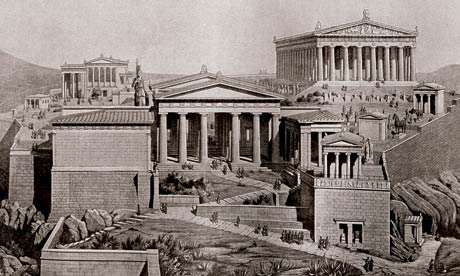
guardian.co.uk
E pluribus unum: "out of many – one". The one-time motto of the US reminds us that, much like most of the larger nation states today, ancient Greece was a mosaic of very different components: about 1,000 of them at any one time between c600BC and AD330. That is, there were a thousand or so separate, often radically self-differentiated political entities, most of which went by the title of polis, or citizen-state. Our term "Greece" is derived from the Romans' Latin name, Graecia, whereas the ancient Greeks spoke of Hellas – meaning sometimes the Aegean Greek heartland, at other times the entire, hypertrophied Hellenic world – and referred to themselves as "Hellenes".
In the foundational epics attributed to Homer, however, you won't find Greeks referred to as "Hellenes" but as "Achaeans", "Danaans", or "Argives". That was because the epics are set in a period before "Hellas" and "Hellenes" had become common currency – before, that is, the eighth century BC, when Greeks first started emigrating permanently from the Aegean basin and settling around the Mediterranean and Black Seas. By the time of Plato, around 400BC, Hellas stretched from the Pillars of Heracles (straits of Gibraltar) in the west to Phasis in Colchis (in modern Georgia) in the far east. Later, following the conquests of Alexander the Great, the pale of Hellenic settlement was extended even further eastwards, as far as Afghanistan and the Indus Valley of Pakistan.
Everyone who was not a Hellene by birth, language or culture was labelled a barbaros. Originally an......
Tuesday, September 21, 2010
Friday, July 02, 2010
Saturday, May 15, 2010
Dr. Frank Holt regarding Macedonian History and FYROM

The book will include the letter by world known archeologists, historians and researchers from various academic institutions in the world to President Barack Obama regarding the Greekness of Macedonia. http://macedonia-evidence.org/
PROLOGUE
The documents comprising this book speak forcefully for the proposition that the history of ancient Macedonia, including the brilliant reigns of Philip and his son Alexander, belongs squarely in the cultural, economic, political, religious, and military history of Hellenism.
The cultural milieu of the Macedonian court was Greek.
The texts that Alexander studied as a youth were Greek.
The books he read while in Asia were Greek.
The heroes he emulated, the gods he worshipped, the temples he built were Greek.
The coins he minted in the millions were Greek.
The legacy he left behind from Anatolia to India was as Greek as his settlers could make it, right down to a theater, gymnasium, and inscribed copy of the Delphic maxims in a far corner of Afghanistan. To say that Alexander’s kingdom was......
Saturday, December 19, 2009
THUCYDIDES AND THE MACEDONIANS

abstract from the book "Communities in European history: representations, jurisdictions, conflicts", pages 7-9
In 2006 I published a study of the representation of the Macedonians and their country by the historian of die Peloponnesian War (431-404 BC)[23] In it I suggested that Thucydides references to the Macedonian people and their country have a clearly circumstantial character. Furthermore they arc informed by the Poteidaea incident (432/1), the intervention of the Thracian king Sitalkes (429) and the military operations the Spartan general Brasidas undertook in the area (424/3). Thucydides frames his representation of die Macedonians with the Spartan general Brasidas reference to them in the speech he made to his troops. In his harangue Brasidas clearly classified them as barbarians:” you should learn about these barbarians whom now you are afraid of, a part of them you have already fought against, the Macedonians among them, that, from my own estimate of them, and what 1 have heard from others, they arc notstrong”(IV,126.3)[24] Thucydides further establishes this view in his narrative of Brasidas and Perdikkas campaign in Lynkestis in 42V3 B.C. when he wrote that "the Chalkidians and Macedonian cavalry [came to] nearly a thousand, and there was also a large mass of barbarians[25]. These passages have provoked considerable discussion, especially during die late 20th century. Regarding the question of ethnicity, the question is: ..........
Friday, November 13, 2009
Pr. Ian Worthington regarding the ancient Macedonian background

Source: "Philip the Macedon", page 219
Thursday, November 05, 2009
The nationality of the ancient Macedonians

by Michalis Sakellariou,
Abstract from the book...
Macedonia: 4000 Years of Greek History and Civilization,
pages 44-63, 1983, Ekdotike Athinon
Many passages in ancient authors record echoes of the traditions, testimonia and opinions regarding the nationality of the Macedonians, or, more narrowly, of the Macedonian royal family. We shall first examine what these passages have to say. After completing this review, we shall proceed to an assessment of their content and arrive at definitive conclusions derived from this kind of evidence.
a) Concerning the Macedonian people
It is convenient to refer separately to the passages (1) that support the idea that the Macedonians were Greeks; (2) that are opposed to this idea; and (3) that can be used to argue either case, or that are inconclusive. We shall also (4) deal with the hypotheses put forward by modern historians on the view held by Philip and Alexander as to the nationality of their subjects.
1) Reference has been made above (see page 46) to an ancient tradition, according to which the Dorians were descended from a section of the Makednoi or Makedones. This tradition came down to Herodotos either through information he himself gathered in some Doric city,52 or through a very ancient epic poem, the Aigimios.53 The sur¬viving fragments of this poem, together with other sources, reveal more precisely that the Dorians were formed by the union of some Macedonians with other tribes. The Dorians were pure Greeks. Various attempts to derive one section of them from Illyrian origins have been unsuccessful. In any case, these attempts were concerned with the Doric tribe the Hylleis, which was certainly not identical with the Makednoi.54 The fact that the Dorians were Greek naturally presupposes that the tribes of which they were composed were also Greek, and these include the Makednoi or Makedones, at a date earlier than the fourteenth cen¬tury (see page 46).
A Persian inscription dating from 513 B.C. records the European peoples who were at that date subject to the Great King. One of these is described as Yauna Takabara - 'Ionians whose head-dress is like a shield'. The Persians, like the other eastern peoples of antiquity, are known to have applied the term 'Ionians' to all the Greeks; on the other hand the head-dress resembling a shield has been rightly recognized as that depicted on Macedonian coins. The people called by the Persians 'Greeks whose head¬dress is like a shield' are therefore identified with the Macedonians. The identification is supported by the fact that, in another Persian inscription, of 479 or 478, also listing the peoples of Europe subject to the Great King, this name is missing; at this date, it is known that the Macedonians were fighting the Persians. This Persian name for the Macedonians is the earliest piece of direct evidence available so far for the nationality of the Macedonians.55
In a fragment of Hellanikos (fifth century B.C.), Makedon, the mythical founder of the Macedonians, appears as the son of Aiolos.56 This genealogical relationship reflects the idea that the Macedonians were a section of the Aiolians, a sub-division of the Greek race.
After the battle of Issos, Alexander the Great sent a let¬ter to Darius that began as follows: 'Your ancestors came to Macedonia and the rest of Greece and did us much harm though we had done them no prior injury; I have been appointed commander-in-chief of the Greeks and in¬vaded Asia in the desire to take vengeance on Persia for your aggressions.'57 From this extract it emerges clearly that Alexander regarded Macedonia as a Greek country, identified the sufferings of Macedonia at the hands of the Persians with the destruction they had wrought in southern Greece, and represented himself as the avenger of all these wrongs.
The formulation 'Macedonia and the rest of Greece' also occurs in the treaty of alliance between Philip V of Macedonia and Hannibal.58 In the same text the phrase 'the Macedonians and the rest of the Greeks' occurs twice. The ambassador of this same king, in his address to the Aitolians in 200 B.C., ranged the Macedonians with the Greeks and not with the 'foreigners' (αλλοεθνείς) and 'barbarians' (βάρβαροι).59
Other passages demonstrate that non-Macedonian Greeks also thought of the Macedonians as their kindred, and of Macedonia as a Greek country. In 217 B.C. Agelaos of Naupaktos, speaking to a gathering at which Philip V and representatives of his allies were present, prayed that internecine wars between the Greeks would cease.60 In 211 B.C., Lykiskos, representative of the Akarnanians, described the Macedonians as kinsfolk of the Achaeans.61 Macedonia is accounted part of Greece by various authors.62 As late as the second century A.D., the Ephesians referred in a decree to 'the Macedonians and the other Greek peoples'.63
2) The general sense of a passage in Thucydides gives the impression that the historian considered the Macedo¬nians barbarians.64 The Macedonians are also distinguished from the Greeks and classified with the barbarians in the Peri Politeias, an anonymous work written about the end of the fifth or the beginning of the fourth cen¬tury B.C.65 Various ancient geographers and historians of the classical and post-classical periods, such as Ephoros, Pseudo-Skylax, Dionysios son of Kalliphon and Dionysios Periegetes, put the northern borders of Greece at the line from the Ambrakian Gulf to the Peneios.66 Isokrates places Macedonia outside the boundaries of Greece and describes the Macedonians as ούχ όμόφυλον γένος ('an unrelated race').67 Medeios of Larisa, who accompanied Alexander on his campaign in Asia, calls the Thessalians 'the most northerly of the Greeks'.68
3) In contrast with the genealogy of the mythical foun¬der of the Macedonians to be found in Hellanikos (see above), there are three other genealogies of Makedon in which he is not included in the stemma of Hellen. About 700 B.C., Hesiod refers to Makedon as the son of Zeus and Thyia.69 Pseudo-Skymnos calls him γηγενής, that is, born from the earth.70 Pseudo-Apollodoros and Aelian reflect a tradition according to which Makedon was the son of Lykaon.71 However, the lack of any genealogical connection between Makedon and Hellen does not imply that the Macedonians were not Greeks. These three genealogies were not concerned with the question of the nationality of the Macedonians, as was that preserved by Hellanikos, but had different sources and different con¬cerns. This also happens with many other genealogies of the mythical founders of Greek tribes. I shall refer here to only two examples: in the same fragment of Hesiod, Zeus and Thyia are said to be the parents not only of Makedon, but also of Magnes, the eponymous hero of the Greek tribe the Magnetes. Arkas, founder of another Greek tribe, is usually said to be the offspring of Zeus and the nymph Kallisto. Although the three genealogies of Makedon referred to above do not indicate that the Macedonians were distinct from the Greeks, we cannot deduce from this negative conclusion its opposite — that they support the view that the Macedonians were Greeks. The fragment of Hesiod, on the other hand, does reflect a knowledge of Magnetes, who were Greeks. It also portrays the mother of Makedon as the sister of Hellen.
When Alexander I, king of the Macedonians, wanted to compete at Olympia (possibly in 496 B.C.),71 his prospec¬tive opponents attempted to exclude him by arguing that only Greeks, and not barbarians, could take part in the Olympic games. Alexander proved that he was a Greek and was therefore allowed to compete.72 We may safely conclude from this episode that the Greeks who attended the Olympic games had no reason, at the beginning of the fifth century B.C., to know the nationality of the Macedo¬nians. It is also certain that when Alexander I submitted to the Hellanodikai proofs of his own, but not of his subjects' Greek descent, he left the question open. But this was not the question that had been posed. Thus it cannot be argued that Alexander I considered the Macedonians to be Greeks; but neither can the reverse. These same considera¬tions hold good in a number of other cases: when, for example, Alexander I, speaking only of himself, says 'for I am a Greek by race'73 or when other kings, or the Macedo¬nian royal family in general, are described as Greek.74 One further point should be added: the application of the term 'philhellene' to Alexander I does not imply that the king was not a Greek. Jason of Pherai was also so called,75 and a number of other passages demonstrate that this epithet was also applied to Greeks in antiquity, in which cases it was equivalent to 'patriotic'.76
The distinction is made in a passage of Isokrates bet¬ween Greeks, Macedonians and barbarians.77 Those who believe that the Macedonians were not Greeks concentrate on the distinction between Greeks and Macedonians rather than that between Macedonians and barbarians. From the context, it emerges clearly that the basis used by the author to distinguish between the Greeks and the Macedonians was the difference in their political relationship to Philip.
4) Those who believe that the Macedonians were not Greek have used the argument that the term Makedones is never employed in negotiations, treaties and other political actions in which the Macedonian state was involved, as was the Greek custom (cf. the use of Athenaioi, Lakedaimonioi, Korinthioi)™ but that it was always represented by its king. Even Philip did not admit his subjects to the Delphic Amphiktyony in 346 B.C. nor to the confederation Of the Greeks' in 338/337 B.C. This argu¬ment, however, does not take account of the fact that those ancient Greek states that were ruled by monarchs entered into agreements and negotiated alliances through the agency and in the name of their rulers. It was thus perfectly normal practice for Philip, but not the Macedonians, to become a member of the Delphic Amphiktyony. As for the confederation 'of the Greeks', even Philip himself did not become a member, but rather assumed the titles and responsibilities of its 'leader' and of commander-in-chief of its military forces.
The same scholars argue that Alexander the Great did not believe that the Macedonians were Greeks, supporting their case by reference to the fact that when he sent spoils to Athens, he accompanied them with the inscription 'Alexander and the Greeks with the exception of the Lacedaemonians....' and that in many passages of Arrian he addresses his soldiers as 'Macedonians and Greeks'. In both cases, however, the term 'Greeks' is used to indicate the soldiers of the confederation of the 'Greeks' of 338/337, which was renewed after the death of Philip and which bestowed upon Alexander the same powers and offices it had given to his father. Thus, in the inscription, Alexander uses his own name to include his subjects and the term 'Greeks' to cover the soldiers of the allied cities. In his speeches, 'Macedonians and Greeks' is addressed to the two component parts of his army with each of which he had a different relationship: to the Macedonians he was king, to the 'Greeks' commander-in-chief. In any event, Alexander's letter to Darius, referred to above (see page 49) leaves no doubt that Alexander considered his Macedonians to be Greeks.
5) Lastly, on the following grounds, it has been main¬tained that Macedonians no more felt like Greeks than Greeks recognized them as compatriots: a) many thou sands of Greek mercenaries served the Persians during Alexander's campaigns; b) others who eventually enlisted in Alexander's army revolted after his death, and seventeen thousand were butchered by Macedonians; c) as soon as the news of Alexander's death reached Greece, the main cities tried to throw off the Macedonian yoke.
These arguments are unconvincing. Let us consider how many Greek states should be discounted as Greek because they encountered Greek mercenaries on the field of battle; or because they revolted against Greek domination; or because they shed the blood of those who had revolted. In the particular connection of the Greeks of the city-states and Alexander, and indeed with Philip, it should not be ignored that these were determined, to a large extent, by fear of the popular classes, that the domination of the Macedonians would reinforce the oligarchic parties and limit the autonomy of the city states. Because the mercenaries came from the poorer classes they probably har¬boured deeper resentment of the Macedonians. Finally, it should be noted that the revolt of the Greek mercenaries in 323 B.C. was motivated by a desire to return home after long years of absence, first in the service of the Great King and then of Alexander.
b) Concerning the royal family
1) From the time that Alexander I asserted at Olympia that he was Greek, and the tradition that the Macedonian dynasty was descended from the Temenids of Argos became generally known, it was commonly accepted by the Greeks that the Macedonian royal family was part of the Greek race (see above).
2) There were exceptions, however: in a fragment of the speech 'for the people of Larisa' by the orator Thrasymachus of Chalkedon (second half of the fifth cen¬tury), Archelaos, king of the Macedonians, is described as a barbarian,79 and similar descriptions of Philip were formulated by Demosthenes80 and even by Aischines at the beginning of his political career.81
Evaluation of the categorical evidence
Thus far we have set out the evidence to be derived from ancient traditions, testimonia and opinions concerning the nationality of the Macedonians or, more specifically, of the Macedonian royal family, distinguishing between that which expresses a definite view, whether for or against the idea that they were Greeks, and that which is inconclusive or inconsistent (see page 49). We shall now attempt to evaluate the former, with a view to seeing which of it is credible and which is not.
1) Traditions. Amongst the categorical evidence, we have met one ancient tradition that connects the Macedo¬nians with the Dorians and another which traces the royal family to Argos in the Peloponnese. The former contains a kernel of truth that is a synopsis of events earlier than the middle of the thirteenth century. From this it can be deduced indirectly, but with certainty, that the Macedo¬nians, like the Dorians, were Greeks (see page 49). The opinions of historians are divided on the second tradition: some accept that it reflects a historical memory, while others believe that it arose from the circumstance that the Temenids who ruled in Macedonia had the same name as the royal house of the Argives, and explain this fact in terms of the presence of a Macedonian element amongst the Dorians. The first view founders on the phenomenon to be observed in early societies whereby the royal family emerged from within the ranks of the tribe. The second view, on the contrary, is consistent with the thesis that the Dorians were in part descended from Macedonians. The Temenids of Macedonia will have been part of that branch of the original tribe that did not move southwards, while the Temenids of Argos will have been descended from a branch that migrated from the Pindos to central Greece where, with other groups, it helped to form the Dorian peo¬ple.
2) The official Macedonian view. In official docu¬ments of Alexander the Great and Philip V, Macedonia is described as a Greek country; in the first of them, moreover, Alexander represents himself as the avenger of the evils wrought by the Persians both in Macedonia and in the rest of Greece; and an ambassador of Philip V classifies the Macedonians with the Greeks in contradistinction with 'foreigners' (αλλοεθνείς) and 'barbarians' (βάρβαροι) (see page 49). The Macedonian kings, therefore, although they believed that they had a different ancestry from their subjects, did not consider themselves to be ruling outside Greece, or over a people foreign to the Greeks.
3) External Testimonia. The rest of the evidence cited above consists of testimonia about the Macedonians deriving from external observers. By their very nature, these are less valuable as evidence than a genuine tradition recalling that a branch of the Macedonians had made its contribution to the formation of the Greek tribe of the Dorians, or the official Macedonian view. Let us examine them in their own right, however, as though we did not have more reliable evidence at our disposal.
The external testimonia fall into two conflicting groups. A Persian inscription of 513 B.C., the representation of Makedon as son of Aiolos in a fragment of Hellanikos, the speeches of Agelaos and Lykiskos, and a number of passages in other authors and a decree of the Ephesians af¬ford evidence in support of the thesis that the Macedonians were Greeks (see page 49). In contrast, Thucydides, the unknown author of the Peri Politeias, Isokrates, Medeios, Ephoros, Pseudo-Skylax, Dionysios son of Kalliphon and Dionysios Periegetes, all depict the Macedonians as non-Greeks, or Macedonia as a non-Greek country (see page 49). The passages in the orators that portray Archelaos and Philip II as barbarians point in the same direction (see page 52). In which of the two groups should we place our trust? The Persian inscription is an early and direct piece of evidence. The earliest of the authors of the first group is the sole writer who knew the Macedonians at first hand: he resided at the court of Amyntas I, some time before the middle of the fifth century B.C.82 He himself, as a native of Mytilene, spoke Aiolic, and recognized in the Macedonian language a dialect resembling his own: it was for this reason that he made Makedon son of Aiolos. On the other hand, it is interesting that one of the authors in the second group, Ephoros, refers to the Pamphylians as barbarians83 though they were in fact Greeks. This demonstrates that some Greeks came close to being thought barbarians by their fellow Greeks. The backward institutions and coarseness of the Macedonians will have been among the reasons why they seemed to other Greeks to be barbarians. The rhetorical apostrophes of Thrasymachos and Demosthenes should, a fortiori, be considered unreliable: the former was attempting to arouse the people of Larisa, the latter the Athenians, to resist the Macedonian kings, and they described them as barbarians in spite of the fact that they had officially and widely been recognized as Greeks.84 The rhetorical accusations that they were 'barbarians' made not against the Macedonians but against their kings, refer in any case to court scandals, or to the incontinence and violence of the rulers (cf. Plato on Archelaos and Theopompos85 and other authors on Philip.).
4) Conclusion. The hypothesis that the Macedonians were Greeks is supported by all the reliable evidence: the ancient tradition that the Dorians were descended from a section of the Macedonians; the view the Macedonian kings held about themselves; and the testimony of Hellanikos, who lived at the Macedonian court. All the testimonia that contradict this view are external and derive either from observers who might have been mistaken, or from enemies of the Macedonians.
FOR FAIR USE ONLY
Saturday, October 31, 2009
Oliver Masson as regards the ancient Macedonian Language

source: The Oxford Companion to Classical Civilization, Simon Hornblower & Antony Spawforth 1998 p 438
Sunday, September 27, 2009
Pr Richard A. Billows as regards the ancient Macedonian background

 Source: Antigonos the One-Eyed and the Creation of the Hellenistic State, pages 18-19
Monday, September 21, 2009
Pr. Ulrich Wilcken as regards the ancient Macedonian background


Source:Ulrich Wilcken, Alexander The Great, pages 22-23
Friday, September 11, 2009


Thursday, February 19, 2009
Pr Richard Stoneman regarding the ancient Macedonian background

The kingdom of Macedon to which Alexander succeeded in 336 was an
oddity in the Greek world.
oddity in the Greek world.
[Alexander the Great, Routlege, 1997, page 10]
Were the Macedonians Greeks?
Scholarly opinion remains divided over the issue, and there is little enough direct evidence to draw on. Against the Greek identity of Macedonians is the Greek prejudice described above, and best-evinced by Demosthenes’ invectives against Philip in the course of the latter’s conquests; but Demosthenes, seeing himself as a defender of Athenian liberty, had an axe to grind. The other piece of evidence is the complaint made by Alexander against Philotas in the course of his trial for conspiracy: that he did not deign to address the court ‘in Macedonian’ but insisted on showing off in Greek. And Alexander is at least once said to have addressed his troops ‘in Macedonian’.
Those who favour the view that the Macedonians were Greeks regard this as evidence, not for a separate Macedonian language, but for the use of dialect in certain circumstances, comparable to the use of Scots in a British regiment consisting largely of Scots.
In favour of the Greek identity of the Macedonians is what we know of their language: the place names, names of the months and personal names, which are without exception Greek in roots and form. This suggests that they did not merely use Greek as a lingua franca, but spoke it as natives (though with a local accent which turned Philip into Bilip, for example).
The Macedonians’ own traditions derived their royal house from one Argeas, son of Macedon, son of Zeus, and asserted that a new dynasty, the Temenids, had its origin in the sixth century from emigrants from Argos in Greece, the first of these kings being Perdiccas. This tradition became a most important part of the cultural identity of Macedon. It enabled Alexander I (d.452) to compete at the Olympic Games (which only true Hellenes were allowed to do); and it was embedded in the policy of Archelaus (d.399) who invited Euripides from Athens to his court, where Euripides wrote not only the Bacchae but also a lost play called Archelaus. (Socrates was also invited, but declined.) It was in keeping with this background that Philip employed Aristotle – who had until then been helping Hermias of Atarneus in the Troad to rule as a Platonic ‘philosopher-king’ – as tutor to his son, and that Alexander grew up with a devotion to Homer and the Homeric world which his own kingship so much recalled, and slept every night with the Iliad under his pillow.
The Macedonians, then, were racially Greek. The relation might be not so much that of British and Scots as of Germans and Austrians; but in the case of Macedon it was the smaller partner which effected the Anschluss, as Philip’s reign was devoted to gaining control not only of the northern Aegean but of the city-states of mainland Greece, too.
[Alexander the Great, Routlege, 1997, page 11-12]
Saturday, January 03, 2009
The Hellenism of the Ancient Macedonians
 Papercover: 294 pages
Publisher: Institute For Balkan Studies, Thessaloniki, 1965
Author: Apostolos Daskalakis, Member of the Greek Academy
Status: Rare and Out of print book
The present work represents the fruit of research into the Hellenism of ancient Macedonia spread over many years, coupled with careful review and interpretation of all the ancient sources dealing with the subject. From the outset its planned aim has been not so much the writing of a history of Macedonia in ancient times, as the collection, critical study and evaluation of any material capable of serving to ascertain the Hellenic identity of the Macedonians and in general to examine their life, set within the range of Greek antiquity.
Admittedly, many of these facts have not been ignored in the views expressed or the conclusions already reached concerning the ancient Macedonians. Distinguished scholars and historians, both Greek and foreign, have made praiseworthy efforts to elucidate many facets of the country's past and their contributions are far from negligible. Despite this, many subjects bearing not only on the language and make up of the nation, but also on the life in general of the old Macedonians, have hitherto remained unexplored, or at any rate not fully studied; and there are many historical problems, particularly concerning the early history of Macedonia, yet to be solved. The partial or imperfect investigation of these problems has often led to faulty interpretations giving rise in their turn to contradictory judgements and questionable reasoning accompanied by violent disputes.
In this study I have examined all historical facts available in the sources of antiquity and have based my treatment and thinking in general about the Hellenism of ancient Macedonia on these alone. Wherever it has been possible or helpful to do so, some linguistic or archaeological material has been used. The work is above all historical, written by a historian and supported by data drawn from the sifting and checking of ancient sources.
The book is divided into five sections in each of which one of the principal subjects giving rise to controversy, or creating problems in history with regard to the Hellenism of Macedonia, has been dealt with by itself.
These are :
- Origin of the ancient Macedonians: in this for purposes of research all information derived from ancient sources is recorded and also any geographical data found in the ancient authors, to corroborate conclusions reached.
- The language of the Macedonians according to historical sources; here all ancient information concerning the language they spoke is cited and examined interpretatively.
- The descent of the Arsead-Temenid Royal house of Macedonia, which ruled the country from unrecorded times down to Alexander the Great, a subject closely tied up with the national origin of the Macedonians and the foundation of the State.
- Life of Alexandre the Philhellene, a man specially honoured by the Greeks, a subject of wider interest, dealing as it does with the first of Macedonian kings to lead his country into the Greek political horizon and lay the foundations of a Macedonian way of life on Greek lines, a topic which also offers a chance for a fuller historical study of the situation in Macedonia and the Greek wars of liberation against the Persians, as well as for the solution of many problems relating to Macedonia at that time.
- The Athenian orators and what was said about Macedonian barbarism, a study refuting by means of historical research many existing misinterpretations of ancient texts concerning the conceptions of the Hellenism of the Macedonians held principally in Greece during antiquity.
These five sections of the present work, though written as separate studies, combine to give a general picture of the Hellenism of ancient Macedonia.
The book was first published in Greek and each of the five sections had a special bibliographical introduction, giving both the ancient sources on which my opinions were based and my conclusions regarding them. In the present English edition, instead of these there is a general bibliography. The ancient texts, which would present a mass of material if quoted in full, have only been retained in certain instances.
Below is a Review of the particular book fron N.G.L. Hammond (The Classical Review, New mSeries, Vol. 12, No. 3 (Dec., 1962), pp. 270-271 , Cambridge University Press on behalf of The Classical) that conserns the Greek edition.
The Professor of History in the University of Athens has in the past written a number of articles on aspects of Macedonian history, and he is now publishing some volumes on the subject, of which this is the first. It contains five parts; each is a separate study, complete with its own introduction, and they are connected with one another only by their bearing on the 'Greekness' of Macedonia. This system leads inevitably to much repetition, and this repetition combined with the very full, and sometimes verbose, style of Professor Daska-akis makes a very long book of the five topics. He writes with rhetorical power and conviction. At times he seems to protest too much, and he piles up all variety of arguments on the head of his reader. He tilts vigorously against his 'Slav' opponents, whose views, he asserts, are coloured by modern political prejudices. Absit omen! For there was nothing in Russian policy in the last war which the Greeks hated more than the proposal to set up an autonomous Macedonia as a Russian satellite.
The first part, 'The Origin of the Macedonians', begins well with its introduction and sections on geography, and then the author takes the archaeological bull by the horns and hurls it to the ground. 'The archaeological excavations', he asserts, 'assure us in a manner which permits no doubt that Greek elements existed in Macedonia from prehistoric times and subsequently.' He is equally confident that archaeology has revealed Greeks in prehistoric Epirus. But in neither case does he discuss the evidence or say what objects he considers to have been specifically Greek (or in his terminology Achaean and Dorian) at Servia or Armenohori or Dodona. He seems to equate traces of Mycenaean civilization (or Achaean civilization as he calls it on p. 60) with the presence of Greek peoples, although he accepts Homer's placing of Paeonians in much of Macedonia at the time of the Trojan War and although Mycenaean remains are very rare in Epirus; and he sees in the Mycenaean-like style of the treasures found at Trebenishte, near Lake Ochrid, evidence of the survival there of 'the first Indo-European Greeks of the Mycenaean period, the Achaeans' into the latter part of the sixth century b.c. He may well be correct in his general views about the origin of the Macedonians, but he fails to carry conviction in
his use of archaeological evidence. He is much stronger on the literary sources, and he comments well on the famous passage in Herodotus i. 56, where a wandering tribe was called Makednon during its residence in the Pindus area and Dorikon on
entering the Peloponnese. He suggests that the tribesmen were tall (μακεδνοί) and the country was tall, i.e. mountainous, so that the tribe was called Makednon on two counts, and he holds the classical Macedonians to have been descended from the Dorians.The second part deals with the language. Here the conclusions of Galleris are used, but his valuable glossary is not cited often (Les anciens Macedoniens, 1954). Inscriptions too are rarely used throughout the book. Professor Daska-lakis concentrates more on the literary sources and the names of persons and places, which go some way to support his positive conclusion that the Macedonians spoke a dialect of Doric Greek. However, he makes too little of the difficulties. For example, Alexander the Great shouted out Μακεδονιστί (Plut. Alex. 51. 4), and he offered Philotas the chance of speaking patrio ser-mone (Q,. Gurt. vi. 9. 34 f.); later the Macedonians are said to have greeted Eumenes Μακ&ονιστΙ rfj φωντ\ (Plut. Eumen. 14. 4), and they were themselves recognized as different from the Spartans ck re των οπλών καΐ τής φωνής (Paus. iv. 29. 1). These passages are submitted to full discussion and some demolition, but they leave a suspicion that the Macedonians did speak a patois which was not recognizable at once as normal Doric Greek but may have been a northwest-Greek dialect of a primitive kind.
The third part, 'Argeadae-Temenidae', is the most convincing, because Professor Daskalakis goes very thoroughly into the literary sources, the names of the Macedonian kings, and the signs of Greek culture at the Macedonian court. This is a large task, well executed, and most readers will agree that the royal house was Greek in origin. The conclusion, which Professor Daskalakis draws, that their subjects were also Greeks of Dorian stock who had stayed in the Pindus area and were led in the early eighth century by the founders of the royal house into central
Macedonia, rests mainly on arguments of probability and will meet with conflicting views.The fourth part, 'Alexander I the Phil-hellene', is a more straightforward piece of historical study. He puts his birth between 530 and 527 b.c., his competing at the Olympic Games in 496 b.c., and his death c. 454 b.c.; and he attributes to him the institution of the Pezetairoi and other administrative developments which are normally dated to the reign of Archelaus or to the fourth century.
The last part, 'The Athenian Orators and Charges of Macedonians being Barbarians', has a lighter theme but is thoroughly set forth. No doubt Demosthenes called Philip 4 a barbarian* and Aeschines called Demosthenes a barbarian and a Scythian', just as their modern counterparts might call their opponents 'Albanians' or 'Bulgars'. The interesting sentences in Herodes' πολιτείας and in the fragment of Thrasymachus are fully discussed, but I find it hard to believe with Professor Daskalakis that 'Isocrates indubitably . . . believed in the Greekness of the Macedonians' when I read chapters 105-8 and 154 of his Philippus. Isocrates thought the Macedonians to be un-Greek in accepting the rule of a king and probably he thought them un-Greek in blood (ούχ ομοφύλου γένους, in chapter 108). And this brings us back to a definition of Greekness, which must rest partly on archaeological evidence for the early period and on linguistic evidence for the fifth century.
This book is a valuable contribution to the study of an important area. We wish Professor Daskalakis success in carrying on the good work in his later volumes. The print is clear (I noted half a dozen misprints only); there is a full index of proper names; and the book ends with a hand-drawn map, which could be given clearer definition in a later volume.
University of
Bristol
N. G. L. HAMMOND
Friday, January 02, 2009
100 Modern historians verify the Hellenicity of the ancient Macedonians

Taken from history-of-macedonia.com
Modern historians about Macedonia - N.G.L Hammond
Modern historians about Macedonia - R. Malcolm Errington
Modern historians about Macedonia - Robin Lane Fox
Modern historians about Macedonia - Richard Stoneman
Modern historians about Macedonia - Ulrich Wilcken
Modern historians about Macedonia - Eugene Borza
Modern historians about Macedonia - Ernst Badian
Modern historians about Macedonia - Charles Edson
Modern historians about Macedonia - John Maxwell O’Brien
Modern historians about Macedonia - Bernard Randall
Modern historians about Macedonia - Thomas R Martin
Modern historians about Macedonia - M. Cary
Modern historians about Macedonia - A.J.Toynbee
Modern historians about Macedonia - Robin W Winks
Modern historians about Macedonia - Agnes Savill
Modern historians about Macedonia - Kenneth Meyer Setton
Modern historians about Macedonia - Peter Green
Modern historians about Macedonia - A. R. Burn
Modern historians about Macedonia - Jonathan M. Hall
Modern historians about Macedonia - Richard Stoneman
Modern historians about Macedonia - M. E. Thalheimer
Modern historians about Macedonia - J. E. G. Whitehorne
Modern historians about Macedonia - Anthony E. David
Modern historians about Macedonia - George Cawkwell
Modern historians about Macedonia - Fergus Millar
Modern historians about Macedonia - Chester G. Starr
Modern historians about Macedonia - Lewis Vance Cummings
Modern historians about Macedonia - Victor Ehrenberg
Modern historians about Macedonia - D. G. Hogarth
Modern historians about Macedonia - James S. Romm
Modern historians about Macedonia - Hilding Thylander
Modern Historians about Macedonia - Graham Shipley
Modern historians about Macedonia - P. M. Fraser
Modern Historians about Macedonia - Robin Osborne
Modern Historians about Macedonia - Jacques Pirenne
Modern Historians about Macedonia - M. C. Howatson
Modern Historians about Macedonia - William Pinnock
Modern Historians about Macedonia - Ernst Curtius
Modern Historians about Macedonia - J. C. Stobart
Modern Historians about Macedonia - Walter M. Ellis
Modern Historians about Macedonia - Eric Carlton
Modern Historians about Macedonia - Irad Malkin
Modern Historians about Macedonia - Carl J. Richard
Modern Historians about Macedonia - Alan Fildes
Modern Historians about Macedonia - John Anthony Crame
Modern Historians about Macedonia - Donald P. Ryan
Modern Historians about Macedonia - Charles Gates
Modern Historians about Macedonia - J. D. Fage
Modern Historians about Macedonia - Theodor Mommsen
Modern Historians about Macedonia - Donald R. Dudley
Modern Historians about Macedonia - Anthony E. David
Modern Historians about Macedonia - René Grousset
Modern Historians about Macedonia - Samouel Eddy
Modern Historians about Macedonia - David Sacks
Modern Historians about Macedonia - Richard Gabriel
Modern Historians about Macedonia - Martin Sicker
Modern Historians about Macedonia - L.S. Stavrianos
Modern Historians about Macedonia - Peter Tsouras
Modern Historians about Macedonia - E. Bevan
Modern Historians about Macedonia - Katja Mueller
Modern Historians about Macedonia - Francois Chamoux
Modern Historians about Macedonia - Philip Hughes
Modern Historians about Macedonia - R.M. Cook
Modern Historians about Macedonia - J. M. Roberts
Modern Historians about Macedonia - Mary Renault
Modern Historians about Macedonia - Bernard Randall
Modern Historians about Macedonia - Paul Cartledge
Modern Historians about Macedonia - Hermann Bengtson
Modern Historians about Macedonia - Mortimer Chambers
Modern Historians about Macedonia - Jacob Abbott
Modern Historians about Macedonia - A. B. Bossworth
Modern Historians about Macedonia - John A. Fine
Modern Historians about Macedonia - Rene Guerdan
Modern Historians about Macedonia - David H. Levinson
Modern Historians about Macedonia - Bim Sherman
Modern Historians about Macedonia - Katheryn A. Bard
Modern Historians about Macedonia - Ernest Barker
Modern Historians about Macedonia - Henri-Daniel Rops
Modern Historians about Macedonia - Archaeological Institute of America
Modern historians about Macedonia - Francis S. Marvin
Modern historians about Macedonia - Nigel Cawthorne
Modern Historians about Macedonia - Stella Myller-Collet
Modern historians about Macedonia - Louis- Pierre Anquetil
Modern Historians about Macedonia - George Rawlinson
Modern Historians about Macedonia - Michael Wood
Modern historians about Macedonia - John Pentland Mahaffy
Modern historians about Macedonia - John B. Teeple
Modern historians about Macedonia - Elisabeth Gaynor Ellis
Modern historians about Macedonia - John Mounteney
Modern historians about Macedonia - John Lewis Burckhardt
Modern historians about Macedonia - Benjamin Ide Wheeler
Modern historians about Macedonia - Norman Karol Gottwald
Modern historians about Macedonia - Nigel Guy Wilson
Subscribe to:
Posts (Atom)


