Showing posts with label Byzantine Macedonia. Show all posts

Wednesday, March 23, 2011

BYZANTINISM AND HELLENISM by Ap. Vakalopoulos

REMARKS ON THE RACIAL ORIGIN AND THE INTELLECTUAL CONTINUITY OF THE GREEK NATION

The understanding of intellectual phenomena presupposes not only an adequate stock or knowledge and possess.ion of method but also a maturity of mind, since chiefly with deep personal experience are we able to stand before the remarkable historical and sociological phenomena and try to perceive the course they take in our highly comblex life. The main reason we require much time for the consideration and understanding of phenomena is that frequendy the great changes in history come about very slowly. They unfold gradually and imperceptibly without our being aware of them. The greatest difficulty of all is in following the pattern of these phenomena through the course of the centuries. Such problems are:  the famous origin of the modern Greeks and, second, other problems bound up with this first but nonetheless still thorny and much debated. These are problems concerning the relationships and common ground between the ideas of the Ancient and Byzantine world and those of the modern Greeks.
Moreover I would like to bring to mind the establishment of Roman colonies in various parts of the Greek territory,  in Epirus and Macedonia.....

Thursday, April 22, 2010

Protecting the brand name Macedonia - lessons from Byzantine Diplomacy

by Miltiades Bolaris
macedonianissues.blogspot.com
americanchronicle.com

A 2007 article by the Greek political scientist Constantinos Holevas, originally published in Antibaro, a Greek magazine made its re-appearance in the Akritas Macedonian blog recently. http://akritas-history-of-makedonia.blogspot.com/
It is titled "The importance of the name and Byzantine Diplomacy".

Professor Holevas reminded us in this article that the Byzantines never called their state Byzantium. They called themselves Romaioi/Ρωμαίοι (Romans) and their state Romania/Ρωμανία (State of the Romans). They were in full conscience of their Greek language descent and culture, yet they did not consider their state simply a kingdom of the Greeks but an ecumenical empire, a representation of Christ's kingdom on earth, a continuation of the Roman empire of the Caesars, aspiring to govern the whole known world. Constantinos Holevas reminded us that even in the bleakest moments of the empire, when, after the fall of Constantinople to the Franks of the Fourth Crusade in 1204 a Latin king was sitting on the throne of Constantinople the Eastern Romans, the Byzantines, never relented on their title. John III Doukas Vatatzes / Ιωάννης Γ΄Δούκας Βατάτζης (1222-1254) the Greek king of the tiny Byzantine kingdom of Nicaea (modern Iznik in Asia Minor-Turkey), replying to the Caesaropapist demand of Pope Gregory 8th (1227-1241) that he recognizes the Latin king of conquered Constantinople as the a legitimate Roman Emperor, he refused. He reminded the Pope that all his predecessors called themselves Emperors of the Romans / Ρωμαίων Aυτοκράτορες and that he would not give up his title to a forger who simply happened to be sitting on some of his lands. To the Pope's claims that he is simply a king of the Greeks, and not a Roman Emperor, John III Doukas Vatatzes replied, that.....

Sunday, April 26, 2009

The Church of St. Georgios in the village of Staro Nagorichane near Kumanovo-FYROM


The Church of St. Georgios in the village of Staro Nagorichane is one of the most important 14th century Byzantine monuments, the architectural conception and fresco decoration of which tally with the latest cultural achievements of Byzantine art in Thessalonica and Constantinople. St. George church was built upon the foundations of an older building dating back to the reign of the Byzantine Emperor Roman IV Diogenes (11th century), ruined later. The church was renovated in 1313 by the Serbian king Milutin. The frescoes are one of the last works of the famous royal painters Michael and Eutychius from Thessalonica. Michael Astrapas and Eutychios (flourished 1294 to 1317) were Greek painters from Thessaloniki.

Some of their works included frescos at FYROMian churches:
Church of Saint Clement at Ohrid (1294-1295)
Church of Saint Niketas at Cucer (before 1316)
Church of Saint George at Staro Nagoricvino (1317)

by Makedonas82

Sunday, January 04, 2009

When Paul Stephenson met Slav Macedonism.

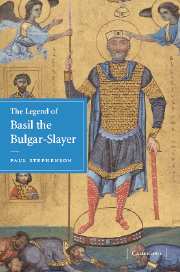
Paul Stephenson is the known writer of the famous book "The Legend of Basil the Bulgar-Slayer " that publish from the Cambridge(ISBN-13: 9780521815307 ISBN-10: 0521815304) . In the page 134 describes two incidents that had with the Slav Macedonians regarding the history of this Greek Byzantine Leader.

In July 1998 1 was sitting in front of the Church of Sv. Klimcnt (St. Clement), a thirteenth-century foundation on a hill which overlooks Ohrid in the Republic of Macedonia. The crest of the hill on the opposite side of the town is dominated by the ruins of an eleventh-century citadel, which Brailsford called “The Bulgarian Tsar’s fortress,” and modern tourist maps call more simply Samuil s Fortress. As I sat a local tour guide explained how this came to be. He told a version of the story of the battle of Kicidion, after which the blinded troops marched back to Samuel’s fortress, and the crud Greek king” Basil ever after was known as the “Macedonian-slayer.”

A similar account is included in a recent national history, compiled by two journalists from Skopje, which includes a translation into Macedonian Slavic of Skylitzes’ account of the battle of Kleidion, with all references to Bulgaria and Bulgarians excised.”

This was my reason for beginning this study, and so here also it will end.

Slav-Macedonism is the political idea prevailing in the Former Yugoslav Republic of Macedonia (FYROM) which utilises historical revisionism to establish links between an ethnic group that formed in the 20th century - ethnic 'Macedonians' - and historical events and figures of the 19th century and Middle Ages. The fYROMacedonian historiography basing her “stealing process” via the Historical revisionism. Historical revisionism is the attempt to change commonly held ideas about the past. In its legitimate form (see historical revisionism) it is the reexamination of historical facts, with an eye towards updating historical narratives with newly discovered, more accurate, or less biased information, acknowledging that history of an event, as it has been traditionally told, may not be entirely accurate. Historical revisionism can be used as a label to describe the views of self-taught historians who publish articles that deliberately misrepresent and manipulate historical evidence.

Paul Stephenson met this kind of historiography. As we know, the main characteristics of a nation are unity of country (with the meaning of common fatherland) and of political organisation, language, religion and heritage, which are joined by a common past, common consciousness - characteristics which alone are not enough or indeed necessary but which in combination create the separate identity of a nation. They tried to keep these characteristics to the new "republic of Macedonia". They wanted, in other words, to fabricate a nation. By means of their studies and publications they attemped to reconstruct and re-interpret historical data in order to fulfil their objectives.

Thanks to the Slav Macedonists of the FYROM we have now an amazing book of Paul Stephenson as regards the life of this Greek Byzantine leader.


Wednesday, July 23, 2008

Bitola Inscription in FYROM

There are many Historical and archaelogical proofs that show the Bulgarian apearance in the FYROM StateOne from the most known is the so called Bitola Inscription. It mention that the Jovan Vladislav, was the King of the supposing Macedonian State called him self as BULGARIAN EMPEROR.

The MENTIONED inscription found in the Monastirion (Bitola) at 1956 and they translated only some quotes that mention:

This inscription was engraved from the Jovan Vladislav,Bulgarian Emperor son of Aaron(brother of Samuil) his castle rebuild for the save and the life of the Bulgarians.

Who told that:
J.Zaiminov, H. Lunt and R. Mathiesen.
The only disagreement is the chronology of the inscription. The first said that estimated in 11 cent when the latter in 13 cent. But is known that the Slavmacedonians never allowed Greeks or Bulgarians in orders to make any archaeological corporation in theirs state.


The text of the inscription is partially damaged. The text in Old Bulgarian, with some conjectures made by Vladimir Moshin and Iordan Zaimov to reconstruct the damaged parts, reads as follows:


In the year 6523 (1015) since the creation of the world, this fortress, built and made by Ivan, Tsar of Bulgaria, was renewed with the help and the prayers of Our Most Holy Lady and through the intercession of her twelve supreme Apostles. The fortress was built as a haven and for the salvation of the lives of the Bulgarians. The work on the fortress of Bitola commenced on the twentieth day of October and ended on the [...] This Tsar was Bulgarian by birth, grandson of the pious Nikola and Ripsimia, son of Aaron, who was brother of Samuil, Tsar of Bulgaria, the two who routed the Greek army of Emperor Basil II at Stipone where gold was taken [...] and in [...] this Tsar was defeated by Emperor Basil in 6522 (1014) since the creation of the world in Klyutch and died at the end of the summer.


A translation of only the clearly readable parts is as follows:


“ In the year [...] since the creation of the world, this fortress, built and made by Ivan, Bulgarian autocrat, was renewed with the help and the prayers of Our Most Holy Lady and through the intercession of her twelve supreme apostles. The fortress was built as a haven and for the salvation of the lives of the Bulgarians. The work on the fortress of Bitola commenced on the twentieth day of October and ended on the [...] was Bulgarian by birth [...] pious son of Aaron [...] they both defeated [...] where was taken [...] and this Tsar [...] 6522 (1014) since the creation of the world [...] at the end."

SOURCE:
  • H.Lunt, "On the Slavic Palimpsests", American Contributions to the 4th International Congress of Slaviststs,The Hague 1958,191-209
  • R. Mathiesen, " The Importance of the Bitola Inscription for Cyrillic Palaeography", South-East European journal,21 (1977) 1-2
  • http://en.wikipedia.org/wiki/Bitola_Inscription

Tuesday, June 24, 2008

Social and Intellectual Life in Byzantine Macedonia

Social life in Macedonia was decisively influenced by Christianity which, particularly after its establishment in the first decades of the fourth century as the official religion of the empire, marked men's souls as well as their way of life and social milieu. The church and its associated buildings now became the focus of city and village alike and the heart of social and religious activities.

Yet, despite the spread of Christianity, paganism was not stamped out for a very long time, as we will see below. After the Council of Nicaea (325) the problem of dogmatic heresies also began to take on worrying dimensions, preoc­cupying clerics and laymen alike. In opposition to these two threats, the Christians of Macedonia sought to propagate their orthodox faith in all manner of ways. For example, early Christian funerary inscriptions in Macedonia make a point of emphasizing the faith of the deceased in the main dogmas of the Christian religion, and especially in the doctrine of resurrection. Moreover, the name of the deceased is almost invariably accompanied by the words 'Christian' or 'servant' of God, of Christ or of the Lord. Again, the term 'newly illuminated' that is found on many inscriptions indicates the pride felt by those who had experienced the sacrament of baptism.

The fact that Christians and pagans were for a long period compelled to live side by side, and the natural an­tagonism that they felt towards each other, led the Chris­tians to stress their special identity in various ways. Thus they made extensive use of the Christian symbol par ex­cellence, the cross, which was their main instrument of ex­orcism against paganism. We find, for example, crosses scratched on temples on the acropolis at Philippi as also on the images of Greek, Roman, Egyptian and other oriental deities. It is not unlikely that, rather than destroying pagan temples and other symbols of worship, the Christians of the region preferred simply to purify them and put them to use for Christian worship.

In this connection it is worth mentioning a discovery at the Octagon in Philippi. The small fourth century place of worship which was discovered next to the Octagon and close to a Hellenistic tomb may well have kept alive through the fourth century an older cult, possibly that of the 'heroized' occupant of the tomb, whose place was now probably taken by some local martyr. The discovery of a small column and of hundreds of fourth century copper coins around the tomb argues for the continuity of worship in this area.

The Christians of Macedonia seem to have continued their own way another ancient custom, that of the gods who guarded gateways and turned away evil (Propyla and Apotropaeic gods). There too it was the sign of cross that was most often used. The large relief cross t was found in the walls of Philippi near the western g (above which it must have been placed), is an example. Here the Cross stands for Christ, who took the place of ancient god who protected the entrance. In a Greek la such as Macedonia, pagan survivals (which, as we shall below, are more pronounced in funerary customs) are ι a strange phenomenon; their existence attests the continuity of the ancient Greek heritage. What is of interest us is the way in which the Christians of Macedoi transformed these survivals in order to adapt them to ι needs created by the new religion.

At a time when Christianity was struggling to achive final victory, the faith of the Macedonian Christians was testified by the multitude of martyrs they produced. Apart from Saint Demetrios, the inscriptions, martyrologies a synaxaria mention many other martyrs: Nestor, Dominos, Akakios, Alexander, Theodoulos, John Agathopous, Anysia, Matrona, the sisters Agape, Chioi and Irene and many more. Churches were erected memory of many of them. Thus, according to the written tradition, bishop Alexander of Thessalonike founded church in memory of St. Matrona, while another chur was dedicated to the memory of the sisters Agape, Chioi and Irene.

One of the results of the triumph of Christianity Macedonia at this period was the emergence of monastic life. Though we do not know much about it, especially about its beginnings, it is certain that monastic life w organized in Macedonia at a fairly early date. This is confirmed both by the monuments and by popular traditic Some remains of early Christian architectural complexes can be identified as monasteries, among the more certi examples being the Latomos monastery (Hosios David) Thessalonike. According to the text of Ignatios, this monastery was first built in the name of St. Zachari, soon after the Greek (pagan) mist had been dispersed and the King and Master of all had bestowed the Roman sceptre on Christian emperors'.

Yet monasticism must have existed in Macedonia long time before the foundation of the Latomos monastery at the beginning of the fifth century, especially in areas which were isolated from the great religious centres of t province, such as Thessalonike and Philippi. In a funerary inscription from Herakleia Lynkestis, one Spurcius is mentioned as a 'former soldier and holy man'. On other early funerary inscriptions from Edessa and Thessalonike, the adjectives 'brothers', 'fathers', 'holy mother' 'virgin' etc. definitely refer to the monastic vocation of the dead.

There are indications that monks occupied themselv with political affairs too. For example, according to the Life of Hosios David of Thessalonike, the holy man travelled to Constantinople at the head of an embassy order to intercede with Justinian on behalf of his city concerning an important political question.Though this source is not regarded by most scholars as being trustworthy, it is at least an indication of the way in which could intervene in politics.

As natural, funerary rites were also altered by the hristian beliefs. Under the influence of Christian teaching on resurrection and the afterlife, the dead were tried full length, with arms crossed on breast, and d pointing towards the East. Tombs became more humble and modest than before, and only the most prominent citizens were buried in small underground mausoleums, containing sarcophagi. The internal walls of the tombs were often covered with frescoes, whose subjects the Christian teaching on death, usually expressed in symbolic fashion. According to information that can be extracted from their inscriptions, tombs were privately owned, that is they were destined for the burial of the sers and their relatives, though sometimes other were buried in there as well.

Survivals of paganism, a subject already alluded to, are to be detected in funerary customs as well, especially in northern and north-western Macedonia. Many tombs from the region of Prilep, for example, offer evidence of the survival of pagan burial customs in the fourth century, such for example as the burning of the dead, the construction of cenotaphs and libations and animal or vegetable offerings. Broken fragments of glass and clay vases and plates and other offerings are often found in these tombs in fourth century. In this connection the most interesting of the region is that of an adolescent in the necropolis terica, in which, amongst other things there was a pair of gold-plated strigils and, more importantly, a silver coin placed in the mouth of the dead — clearly a reminiscence of the ancient custom of offering an obol to Charon, who led the dead to Hades.

A general trend in late Roman Macedonia is the weaking of Latin influence in general, and especially of in language, as can be shown from the evidence of inscrptions. Indeed, even in those very few areas in which Latin was strongly represented in the early imperial era, that is the Roman colonies of Macedonia (Dion or Philippi etc) number of Latin inscriptions from the early Christian Period is extremely small in comparison with the many inscriptions. This adoption of the Greek language is evidence for the assimilation of the Roman colonists by the population.

To illustrate the predominance of Greek over Latin one may mention an incident that took place during a journey by the orator Himerios to Constantinople, whither he had been invited by the emperor Julian (360-63). Stopping at Philippi , Himerios addresed the crowds which were waiting for him in Greek.This event is particularly significant, if one considers that Philippi was one of the largest Roman colonies in Macedonia.

As regards the cultural life of Macedonia and the type of entertainments which were popular in the early Christian period, our information is very limited. Such evidence as we have comes from the fourth century and shows that the basic entertainment of the inhabitants of Macedonia was watching gladiatorial combats, wild beast fights and animal hunts within the special arena-theatres.

Theatres specially adapted for these performances ex­isted in all the big cities of Macedonia, such as Thessalonike, Philippi, Stoboi and Herakleia Lynkestis. Most of them had originally been built as theatres of the traditional Greek type, but at some point in the middle or late third century they were modified to allow the perfor­mance of this kind of spectacle.

A particularly popular spectacle at this period was chariot racing. Thessalonikans gathered in the hippodrome of their city by the thousands to admire their favourite charioteers.

All the above mentioned places, destined for the enter­tainment of the masses, ceased functioning some time in the fourth century after the edicts that the emperors Con-stantine and Theodosios the Great issued in this connec­tion. The spirit and claims of the new Christian religion prevailed in this field as well.

for fair use only

Abstract from A. Tsitouridou - R. Browning in the Volume "Macedonia: 4000 years of Greek History and Civilization"

Wednesday, May 28, 2008

The Frankish states in the Aegean

Is known that in the beginning of the 13th cent Macedonia (Epirus,Thessalonike and Thrace as called during that time) was under the Frankish Control.

Even the seemingly straightforward task of listing the Frankish states in the Aegean which were established after the partition of the Byzantine empire in 1204 is not as easy as at first it might appear. For convenience I have enumerated the six territories which had some form of settled political organisation by 1210.

They were the Latin empire of Constantinople, the kingdom of Thessalonika, the lordship or megaskyrate (later duchy) of Athens and Thebes, the duchy of the Archipelago, the triarchies of the island of Euboea or Negroponte, and the principality of Achaia. In addition to these six, there were numerous family holdings like the counties of Boudonitza and Salona, which were usually dependent upon the lords of Athens and Thebes, and a variety of Italian lords installed on islands in the Cyclades, Sporades and Ionian Group who were dependent on Venice or the duke of the Archipelago on Naxos. There were in excess of 30 different dynasties of such lordlings during the period of Frankish control in the Aegean. Finally, there were a few strictly colonial territories administered by officials sent out from Venice or Genoa for fixed annual or biennial tours of duty, and taking their direction from and responsible to the home government. In this group were the two castellans of Modon and Coron, the duke of Crete, and after 1346 the representatives of the Genoese chartered company or mahona on Chios.

No short account can be entirely satisfactory, especially in a subject which sits uneasily on the edge of two great historical fields of study, the history of Byzantium and the history of the crusades. Does it belong to both or neither? Was the cultural contribution and social reaction of the Franks in the Aegean entirely negative or can positive and original responses to unique problems be identified? My own approach is to see the Frankish states as both an important part of the war against Islam and the succouring of the Holy Land and as a unique experiment in the conquest and settlement of lands which possessed their own rich cultural heritage. However, as archaeological and historical research proliferate, there is a need for an up-to-date account which provides the student with the developments and shifts in emphasis since William Miller produced his fine study, The Latins in the Levant, in 1908.

The Aegean world had an existence in the geographical terminology of the thirteenth century as 'Romania' or the 'imperium Constantinopole' and its component parts of Graecia, la tere d'Ebire (Epiros), Vlachia and la Turkie were identifiable if not precisely defined in the chronicles and letters of the time. Venetian writers of the fourteenth century frequently referred to Negroponte (Euboea), Crete, and the Peloponnese as forming part of 'Romania Bassa'. There was apparently no equivalent reference to the lands between the Isthmus of Corinth and the Bosphorus as Upper Romania.

The states founded by western Europeans in the Aegean began and ended with conquest. This gives some indication of the dogged and determined opposition of the Byzantines and of the lack of stability enjoyed by the Latin states. Their genesis was the conquest of Constantinople by the forces of the Fourth Crusade on 12 April 1204. Their end came at various points from the thirteenth to the seventeenth centuries -- Thessalonika captured by Theodore Komnenos Doukas in December 1224,

Constantinople retaken by the Byzantines on 25 July 1261, Patras, the last outpost of the Frankish Morea, recovered by the Greek despot of the Morea in 1430, and the duchy of Athens conquered by the Turks in 1450. The Venetian and Genoese colonies survived into the early modern period but these too were eventually conquered by the Turks -- Negroponte in 1470, Modon and Coron in 1500, Chios in 1566 and Crete in 1669, after the 24-year siege of Candia. The ragged nature of these beginnings and endings not only reflects the fragmented nature of the Frankish Aegean but also demonstrates that if some of the new crusader states were politically and economically unviable from the outset, the majority clearly had a fair chance of survival.

The Latin empire claimed suzerainty over the whole of the Latin Aegean, known collectively as Romania. In practice it was seldom exercised outside Thrace and more usually confined to the city of Constantinople and its hinterland. The weakness of the empire was due to a variety of factors. The greatest of these was poverty. Militarily unable to expand its frontiers or to establish any lasting peace with its enemies, its rulers could not exploit the resources of their new realm and instead became dependent on financial and military support from the west. In particular this included that of the pope and the king of France, eked out with loans from Venice and a variety of stop-gap measures involving the sale of relics and even the lead from their palace roofs. In turn this meant that its rulers were never entirely masters in their own house and never attained that status in the west to which their rank of emperor might have entitled them. With the exception of the emperor Henry ( 1206-16), the Latin emperors were a poor lot celebrated more for incompetence than strong military leadership. Henry was the only emperor to campaign in Greece and to enforce his overlordship there.

The final year of his reign has been dubbed the apogee of the Latin empire. For the rest, their suzerainty consisted in underpinning the Latin claim to the Aegean, a role which they could exercise as well in exile in Italy as they could in Constantinople. Their poverty was exacerbated by the needs of defence. In 1205-7 the Vlacho-Bulgarians under Kalojan came near to overwhelming them, and again in the 1230s the Bulgarians seemed set fair to dominate Thrace and take Constantinople. The Greeks in Epiros and in Nicaea maintained pressure on both Constantinople and Thessalonika, driven by their desire to recapture the ancient capital of Byzantium. Thessalonika fell to Theodore Doukas, the despot of Epiros, in 1224, although it was lost in turn to John III Vatatzes of Nicaea in 1246. Thereafter the Latins became resigned to the loss of Constantinople. When the city fell to the Greeks in July 1261 its loss was barely noted in western Europe.

In March 1204 the leadership of the French and Venetian crusaders had laid down guidelines for the disposal of the lands and offices of the Byzantine empire in the event that their attack on Constantinople should prove successful. By the act of partition of September 1204, some effect was given to this earlier arrangement. The Latin emperor Baldwin received one-quarter of the former Byzantine territory and the Venetians and the French three-eighths each. This land had to be conquered and in this process the neat demarcations of the partition became overridden. Boniface of Montferrat, the unsuccessful candidate for the imperial throne, gained lands around Thessalonika not registered in the partition and proceeded to direct the distribution of territory in Thrace and Boeotia which formed part of the French crusaders' condominium. The Venetians for their part received more territory than they could readily occupy. They had acquired the harbour towns of Modon and Coron in Messenia by 1209 and their colonisation of Crete began in 1211. These territories formed colonial possessions with officials sent out by and accountable to the Venetian senate. With regard to the Aegean islands, the Venetians sought to conquer and control these through the sons of their own wealthy families. One such nobleman, Marco Sanudo, conquered the Cycladic islands in 1207. Surprisingly he sought out the suzerainty of the emperor in order to establish his and his descendants claim to the Archipelago and to secure a measure of independence from Venice.

Of the French territories in Greece, the principality of the Morea was the best-documented, the richest and the most secure, cut off from the Greeks of Epiros by the Gulf of Corinth and shielded by the lordship of Athens. By 1210 the Frankish lords of Athens and Thebes had to cope with the Epirote reconquest of southern Thessaly and the temporary loss of Salona. From both these areas raids were launched on their lands culminating in a series of attacks on Thebes itself in the mid-1230s. In general until 1261 the leadership of the Franks in Greece was both active and competent. They clearly felt sufficiently secure to allow themselves to indulge in a destructive civil war in 1255-58. Thereafter, with the loss of Constantinople in 1261 and the recovery of the Peloponnesian towns of Mistra, Maina and Monemvasia by the Byzantines in 1262, the Latins in Greece lost both their security and the initiative. The defensive stance which they were now forced to adopt and which they maintained until their final loss of political control in the mid-fifteenth century involved them in seeking the military help from rulers of the west Mediterranean. The price to be paid was the acknowledgement of the suzerainty of these rulers, often expressed by marriage ties and the transfer of titles. The original Frankish ruling families had died out by 1314 and nominal rule now resided with kings in Naples, Trani and Barcelona.

The able and the ambitious like the Fadriques, the Foucherolles, the Orsini and the Acciaioli could carve out substantial lands and positions for themselves as officials of these absentee rulers. In the Aegean Catalans, Turks, Hospitallers and Venetians now took a leading role fighting and intriguing against each other either on their own account or as part of some holy war. The Aegean had become a fully integrated part of the Mediterranean world and the frontier of Christendom against the Turk.

sources
  1. The Franks in the Aegean, 1204-1500 by Peter Lock, pages 5-8
  2. R. L. Wolff, "'Romania: The Latin Empire of Constantinople'" Speculum 23 ( 1948), 1-34

Wednesday, May 21, 2008

Macedonia in the years preceeding the Turkish Occupation

PART 1

When Stephen Dušan ascended the Serbian throne in 1331, the boundary between Byzantium and Serbia in the region of Macedonia lay further north than Sérres, Melnik, Strumica, Prilep and Ohrid ; that is to say, beyond the present Greek frontier. Dušan was able to take over large portions first of Macedonia and later of Thrace, while the Byzantines were pre-occupied with the civil war between John V Palaeologus and John VI Cantacuzenus, each calling in against the other such traditional enemies of Byzantium as the Serbs, Bulgars and Turks.


The Serbian kral was able to proclaim himself ‘king and emperor of Serbia and Romania’, and in order to strengthen his military power he confiscated a good deal of ecclesiastical property in various parts of Maoedonia as well as Epirus , and assigned it to military men. The monasteries regained possesion of this property only at the end of the Serbian rule , which contemporary Byzantine documents represent as ‘illegal and tyrannical’ . Thus it was that Dušan became sovereign of a large dominion, which stretched southwards to embrace the northern regions mentioned above. Reaching almost as far as Christopolis (Kavála today), only Thessalonica and the surrounding district remained outside the Serbian domain. Athos constituted an independent state of monks under the suzerainty of the Serbian monarch , but Chalcidice generally — cut off as it was by the rugged mass of Mt. Cholomón — his power seems to have been virtually imperceptible and for all practical purposes non-existent. This immense state, however, began to disintegrate immediately after his death in 1355, and the powerful governors of the various provinces were soon coveting their independence. Finally, one of them, Vukašin, became co-regent with Dušan’s son, Stephen Uroš, and subsequently received from him the crown, to reign from 1365-1371. At the same time, Uroš himself delegated to the brother of Vukašin, John Uğlieša, the administration of north-east Macedonia with Sérres as capital, and gave him the title of ‘despot’ (1365-1371) . It is possible that under Uğlieša the boundaries of the state of Serres were expanded to the south and east for a few years (1364-1371) — after the Turks had overrun Thrace — to include Chalcidice, the Holy Mountain, and part of western Thrace as far as Lake Boroú . But these boundaries did not remain fixed and intact. Moreover, the Serbs did not succeed in establishing themselves along the coast of the Aegean either under Dušan or under his successors . Over Chalcidice in particular, Uğlieša seems to have exercised but a shadowy control, except for the Holy Mountain,with which he had close but formal relations, as suited his political designs towards the monks. Thus, after the collapse of the brief Serbian domin ation, the reactions of the monks against it as against the Slavs in general—were violently hostile, and the memories of that period remained painful to them for a long time after . It is true that during the fifteen years’ existence of the Serbian state of Sérres, there had been a steady infiltration of Serbian clergy into Athos, and the Protaton (council of igumens or abbots) was presided over by Serbs. This was the period of ‘Serboproti’ , well-known in the history of the Holy Mountain. But this does not mean that Greeks lost all control of Athos during this period of Serbian occupation. Many Macedonian cities remained in the pastoral care of Greek metropolitans . The Greeks had not yet given up the fight; several parts of Macedonia were in fact recovered from the Serbs, and the Slav conquerors could at no time feel their possessions secure.


PART 2


Cvijič recalls that Serbs from Raška were settled around Skopje, Véroia, and probably other parts of Macedonia . In fact, even Cantacuzenus records that “inVéroia there were a considerable number of Triballi settled there by the kral” . But a few years later he marched on the city, “where there had gathered a good number of those who had been settled in the villages” , and taking possession of it, he sent back the Serbian soldiery he found there to their kral and to their native land . Some of the peasants from the villages around no doubt returned to their homelands too. It is the same region where, according to Kameniates in the 10th century, there had already existed “ἀμϕίμεικτοί τινες κῶμαι”, that is to say villages with a mixed population of Greeks and Slavs: the so-called Dragouvitai and Sagoudatai. Consequently, on top of the older stratum of Slavs from the 10th century we have a fresh stratum of Serbs from the time of Dušan. But one cannot say if at that time (i.e. the 14th century) there were Greeks also living alongside Serbs; whether that handful of villages around Véroia continued to be ‘ἀμϕίμεικτα’ as Kameniates wrote; or whether the Slavs, speaking an easily assimilated idiom, had managed to absorb the Greeks. It is, moreover, possible that the Greeks, with their numerical superiority, absorbed the Slavs of those villages. An answer to this question may be discerned in what actually occurred at the end of the 19th century and at the beginning of the 20th, when north of a line Yenitsá-Pélla-Kilkís there were a number of villages of which some were Moslem, others Christian, and others again of mixed religion. Of the Christian population the majority were Bulgars , whose numbers had been swelled by a further peaceful influx of their kinfolk, when free passage had been afforded them during Turkish times. To the south, in the middle of that extensive portion of the plain of Thessalonica known as Rumluk — i.e. land of the Romans (viz. Greeks) — there were some fifty villages, many surviving to this day, which, with few exceptions, had Greek names, and which preserved a strong Greek tradition in their language and in their folk culture .


Α limited degree of colonisation by Serbs seems to have taken place also in the southern part of Eastern Macedonia. And here it is interesting to observe that Lemerle, discussing the clashes between Greeks and Serbs in Eastern Macedonia, expresses the opinion that the Serbian armies had a firm grip on the region of Philippi, and that even throughout the Greek parts (”Ρωμαίων μὲν ὄντα, ὑπήκοα δὲ Τριβαλλοῖς ἐκ πολλοῦ”, as Gregoras writes) there had been some colonisation by Serbs here and there . This is very likely, and we can reinforce his opinion by quoting as evidence the observant and trusworthy traveller Belon, who notes that even in his own day (200 years later) with the exception of Serres, both Greek and Serb was spoken in the villages there. During the Turkish occupation, however, these people had been completely hellenized, or else were absorbed by the Bulgarians who filtered down from the north in search of work. The result of this continued assimilation of one group of Slavs by another was that, taken as a whole, they gained more and more territory, until the Bulgarian element became particularly pronounced, especially with the imperceptible movement of farmers and labourers southwards. Thus, in the end, such few Serbs as had survived in that part of Eastern Macedonia were completely absorbed either by the Greeks or by the Bulgarians. Doubtless there will be instances of the deliberate conversion of Greeks into Slavs, just as there was of Bulgarians into Greeks; although such cases are very difficult for us to pinpoint and determine with absolute certainty today.


At all events, we must take it as a fact that the Serbian rulers — and Dušan in particular — greatly facilitated the influx not only of Albanians and Albano-Vlachs by employing many ot them as mercenaries, but also of fresh Slavs — Serbs and Bulgars. These intermingled with the remnants of the old Slav colonists that had remained after their rapid christianization and hellenization in the 8th century and in the first half of the 9th .


The social conditions in Macedonia were no different from the corresponding conditions in other provinces in the Byzantine empire. The Serbian rulers had not changed the regime in the least. They had already adopted from the Byzantines the institution of Pronoia and imposed it in their own country. They too, as the Byzantines, distributed land to their soldiers and to monasteries. Α host of deeds of gift whether of despots or private individuals, have been preserved in the monasteries of both Northern and Southern Macedonia, and particularly of Mount Athos; and these provide us with valuable information about the economic and social conditions of rural life: on the farms of the monasteries and churches and their dependencies, in the villages, fields, vegetable-gardens and mills; also about the tenants (πάροικοι), the state of servitude, forced labour, as well as the productions and distribution of products .


PART 3


The Greek inhabitants, not unnaturally, were on the defensive in the face of the Slav colonists in Greater Macedonia and perhaps at this point one should consider the size and the state of the Greek population within the empire of Stephen Dušan, and a little later under his successors in the Serbian state of Sérres.


If Dušan proclaimed himself ‘king and emperor of Serbia and Romania’, he had done so not only because he had the intention of extending his sway over Greek lands also, but because he was confronting in a practical way the indisputable fact that he found himself wedged between Greek populations. It is not surprising that this proclamation came after the occupation of Sérres, which he had finally succeeded in capturing after many abortive attempts . This was undoubtedly the reason why he was obliged to re-organise and split up his great dominion into two parts, as Gregoras informs us; the northern part comprised the Serbian territories over whom he ordained as governor his youngest son Uroš, while the ‘Greek lands’ of the south he governed directly in person . Α remnant of the Greek-speaking and racially Greek areas of Northern Macedonia (beyond the present Greek frontier) survived to our day in the form of Melnik, which lies isolated in the depths of a narrow ravine in the Pirin Mountains (Mt. Orvelos) surrounded by towering cliffs. The Byzantine emperors had taken an interest in this natural bulwark against invaders from the north, and had strengthened it with Greek colonists from Philippopolis. Their number was augmented by further immigrants from Crete, who found refuge on Byzantine soil after the failure of their insurrections at home against the Venetians . The Arab traveller Idris, writing in the 12th century, considered Melnik one of the principal towns in the land of the ‘Romans’, and spoke admiringly of its well-cultivated plains and the surrounding villages . The inhabitants of Melnik were pronouncedly conscious of their nationality, and for that reason in 1246, when the emperor of Nicaea, John III Ducas Vatatzes, was marching on their city, they were persuaded by Nicholas Manglavites to surrender the city to the emperor, affirming that “our land belongs to the rulers of the Romans …, we are of pure Romaic blood” exposed to the attacks of foreign peoples. After many vicissitudes it fell into the hands of kral Stephen Dušan, and on his death it passed to Uğlieša with the districts of Sérres and Nevrokop. Later on it seems to have passed into the hands of the lesser Serb rulers, Dragaš and Constantine Dejanovič; and in 1395 it fell to the Turks. Throughout the course of these centuries the people of Melnik have preserved unchanged their Greek character and their monuments of Byzantine ecclesiastical and secular architecture. It is worth the famous 14th century Byzantine house which survives to this day (fig. 1). But it is not only monuments such as these which emphasise the Byzantine character of the town; it lives on in the names of the old families: Mourtzouphlos, Ducas, Kouropalatis, Spandonis, etc..


Moreover, it is mentioned in the 14th century that Mysian (i.e. Bulgarian) settlers were dwelling along the narrows of the Strymon, in the district of Strumica beyond the present Greek frontier; but that there were also many Greeks to be found amongst them: “καὶ τοῖς ἡμῖν ὁμοϕύλοις ἀναμὶξ τὴν δίαιταν ἔχοντες” . In this connection, the charter, royal decrees (chrysobulls) and other documents of the famous monastery of Our Lady of Mercy near Strumica (founded in 1080) cite a great number of Greek names, which bear witness to the Greek character of the district. These inhabitants were mere pockets of Greek population which had survived the descent of the Slavs, and which existed in districts to the north of the present frontiers of Greece as far as the line formulated by Jireček, running beyond Štip and Sofia as far as the Balkan Range; that is to say, as far as the limits to which Greek civilization and language extended. Consequently, in those regions it was not only Illyrians and Thracians who were converted into Slavs but Greeks as well . In this context Cvijič states quite frankly: “The Byzantine cultural influences were much more powerful in the cities of the Southern Balkans, where they are preserved to this day. Here the Byzantine-Vlach culture had a firm hold on the people of the villages also; and one of the main reasons for this was that in the southern regions a far larger number of Greeks and Vlachs existed in the villages than is the case today …”


PART 4


Thus it was that the Serbian kral was forced to recognise in Macedonia just as in Thessaly the predominance of Greeks , not only in their regional distribution but in their political and social status. He was obliged to appoint Greek officers in his administration, fugitives from Byzantium during the feuds between JohnVI Cantacuzenus and Anna of Savoy. As Solovjev says, it is typical to find that the higher government offices are bestowed upon Serbs, while the posts of ‘heads’ (κεϕαλαὶ) — that is to say, the local political and social leaders — remain mostly in the hands of Greeks. In particular cases ‘heads’ bear the additional title of ‘judge general’ . This information is significant, when one bears in mind that these ‘heads’ represented the community of local inhabitants in its entirity. With the office of ‘head’ were associated certain administrative powers which connected him with the central authorities; but this link was a very loose one, as is invariably the case with popular authorities. In other words, the ‘head’ plays the same role as the elder of a Greek village.


In our discussion of the ephemeral Serbian state of Sérres, we ought to outline the system according to which the city was governed in the latter days of Byzantium. Just like Thessalonica (which we shall be dealing with later on), Sérres was administered by the most important local personages, who formed a single body referred to in Byzantine writings as the senate (σύγκλητος). And here I should like to express views differing from those of the eminent historian, Ostrogorskij. For I am of the opinion that this particular body was not instituted in Sérres between 1360 and 1365, even though there is mention of this institution for the first time in the acts of 1365 . The term ’senate’ is applied to the social authority which, especially after 1204, exercised a vigorous initiative in the larger towns of the Byzantine empire, a theme I have already touched upon in the ‘History of Modern Hellenism’. Accordingly, the term ’senate’ was the official designation of the communal authority at Sérres, and is reminiscent of the body of the same name at Constantinople, though it did not carry the same prestige. This provincial body coped with the needs of the community, and in conjunction with the community leader (i.e. the ‘head’) essentially ruled the district. Consequently, it played a leading role in the life of Sérres, especially during those troubled times; for these local officials had to make rapid decisions on matters of the moment. Sometimes, however, there is mention of several ‘heads’. It may be that the members of the senate were themselves ‘heads’ , that is to say the notables of the place. They are refered to by this name during the early years of the Turkish occupation also. The senate of Sérres, as of Thessalonica, was composed of twelve members, and this number figures likewise throughout the Turkish occupation .


The ecclesiastical courts constituted an inseparable element of Greek local self-government; and it is worth noting that it was the Greek language which predominated both in the administrative sphere and in the law-courts of the state of Sérres, which must mean that the officials were for the most part Greeks . We may assume, therefore, that the Greeks continued to play an active part in the administration of their villages after they had been taken over by Serbs. This newly established and shortlived Serbian state thus remained essentially Greek in its composition, and was destined in the years that followed to succumb to the influence of Greek cultural forces, just as did the corresponding state of Symeon Uroš Palaeologus in Thessaly.


The number of other Greek nobles and officials was undoubtedly large in Dušan’s state and that of his successors. The Greek clergy was particulany prominent, so that the strong imprint of Orthodoxy was maintained . Altogether there were more Greeks than Serbs among the more influential figures of the land. Thus, to cite an example, there is mention of an eparch, George Isares, who retained the same designation at the court of Stephen Dušan (chrysobull of Vatopediou, April 1348), and who, twenty years later at the court of Uğlieša, bears the title of Megas Primicerius (chief administrator). The son-in-law (through his daughter) of George Isares, George Stanisa, was a Serb, yet the sons of this Byzantine aristocrat were called Michael Angelos Isares and Theodore Comnenus Isares; presumably they had some relationship with the old dynasty of the Comneni. There is also mention of an Alexius Raoul, who went to the court of Dušan and most probably received from hinf the title of Megas Domesticus . We hear too of other Greeks in important posts: Megas Hetairiaches (general), Kyr-John Margarites , along with other officers of Sérres such as the Megas Primicerius Michael Avrampakas; the Megas Papias (supreme officer of the palace), Ducas Nestongos; the Katholikos Krites, Demetrius Comnenus Eudaemonoyannes; the Megas Tsaousios (commander of the bodyguard), Kyr-Kardames Palaeologus; the Katholikos Krites, Nicetas Pediasimus; and Kyr-Orestes styled Katholikos Krites and ‘ἐπὶ τοῦ στρατοῦ’, who built the tower of the castle of Sérres (see figs. 2 and 3). In fact, he figures with these two titles also under the despot Uğlieša in 1366.

It is impossible for us to be precise about the proportions of the two basic elements — Greek and Slav — which made up the population at that time; but there is no doubt that the Greeks were appreciably in the majority at least in the major towns’, as Ostrogorskij has it . We shall have an opportunity later to corroborate this fact, when we come to deal with the period of Turkish domination. Moreover, Ostrogorskij’s condescending reservation ‘at least’ may be omitted, since 200 years later, despite a continuous though nonetheless peaceful influx of Slavs in the meanwhile (especially of Bulgarians southwards), the perceptive and reliable Belon noted that in all the towns of Eastern Macedonia the Greek population was predominant. Furthermore, these Greeks spoke their own tongue, as we shall later demonstrate in the appropriate context. This predominance lasted until the beginning of the 20th century in all the towns and townlets of Macedonia, with the exception of Gevgelija where the Bulgarian element was in a slight majority, and Kilkis where it was much more so . In Sérres and the other large centres the Greek language prevailed both in the state administration and in the Church. From all this it can be seen that the brief Serbian rule did not bring any significant changes, even though the Serbs had effectively taken over control both of state and Church .


Even the mixed population of some country disctricts, which through war and other hardships had sought refuge in the towns, rapidly became thoroughly hellenized. Ostrogorskij has made a close study of the registers (πρακτικὰ) of the Byzantine census officials, who made a record of all the villages, property, names of proprietors and their families, the nature and size of their possessions, the number of beasts, the amount of tax they had to pay, etc; and he has come to the conclusion that the Slavonic names — of both individuals and families — are generally fewer in Chalcidice and the theme of Thessalonica than throughout the theme of Sérres and the Strymon (at least in the villages of the katepanikia of Zavaltía and Popolía that lie in the southern section of the Sérres-Strymon theme). For the central section of the theme we possess no praktikon, but Christian Greek names are everywhere in the vast majority , a fact which has a definite bearing on the composition of the population or, at least, on its thorough hellenization. As for the place-names, Ostrogorskij, speaking of the whole of Eastern Macedonia, asserts that Slavonic names are more common than Greek, though he admits that at that period, when nationality did not mean what it does today, Greek statesmen and writers did not change foreign place-names; and he notes that it is not certain if the inhabitants of certain districts with Slavonic place-names were in fact Slavs .


Kyriakides is quite categorical about the relationship between place-names and the composition of the population in this region of the Lower Strymon. He writes: “Leaving aside Chalcidice, about which we have, with the exception of a few place-names, no information from the writers as regards its colonisation by Slavs, I come to the Strymon, which is considered a Slavonic centre. From these documents it is quite clear that from Amphipolis to the northern end of Lake Achinós the majority of the villages on both sides of the river have Greek names …, that the names of all the inhabitants of all these villages are in every case Greek, except for a few which can be counted on the fingers of one hand” .


I think it is possible to close this chapter with the practical conclusions of Lemerle, which allow us to formulate a clear picture of the whole problem: “Eastern Macedonia was the scene of many contacts and clashes [between Slavs and Greeks] … Let us repeat that the region to the south of the great mountain chain [he means the ranges which form the present Greek-Bulgarian frontier] remained Greek, and that its role was three-fold in the Byzantine empire: it was a rampart and an outpost of Hellenism in the Balkan Peninsula, ensuring its diffusion throughout all that region; it formed a transition zone, an area where Byzantium and an important part of the Slav world interpenetrated each other, permitting a widespread assimilation of the latter by the former; and finally, it served as a link between the two largest towns of the empire, Constantinople and Thessalonica .


Thus the preservation of the old Slav colonies and the creation of new ones had been favoured first by the successive incursions of Bulgarians and more so of Serbs under Dušan and his successors, and later by their generally peaceful infiltration especially after the end of Serbian rule. But while the Greeks were engaged in their obstinate struggle to free their native land and drive out the conquerors from the north to beyond the great mountain ranges, the Ottoman Turks were making their first appearance in Europe (1354).


for fair use only


Professor Apostolos Vakalopoulos in his memorial work..... History of Macedonia 1354-1833, pages 13-26, IMXA 1973
Notes with the primary sources located in the book.

Tuesday, April 29, 2008

Episcopal Basilica ( 6th-4th cent AD), the oldest Greek Christian church in FYROM


Summary

The Episcopal Basilica is one of the greatest and most elaborate late Classical sacral buildings of the archaeological site of Stobi. It was erected on the eastern part of the main street -Via Sacra. In this location, the remains of two buildings, known as the Old and the New Basilica, built and reconstructed in several phases between the 4th and the 5th century AD, were excavated.

The Old Basilica is probably the oldest Greek Christian church discovered on the territory of the FYROM.

The basilica was constructed during the ministry of the bishop Budios, present at the First Ecumenical Council in Nicea in 325.

The Old Basilica is a three-aisled building. Fresco paintings as well as the geometric and floral pavement mosaics date from the first construction period. The second construction phase, dating back to the first half of the 5th century, corresponds to the ministry of the Bishop Eustathios.

The remains of the fresco paintings decorated with the monograms of Christ and the Bishop Eustathios, and the mosaics in the nave, date from the same period.

At the end of the 5th century, the New Basilica, significantly larger, was constructed four meters above the level of the earlier church. Parts of walls adorned with gold mosaics, the remains of a crypt in the apse, and the columns date from the first construction phase.

An inscription describing the Bishop Philippos as the patron of the church, situated above the entrance of the nave, dates back to the second construction phase, around 530 AD.

The New Basilica ceased to function in the second half of the 6th century, after a catastrophic earthquake, which destroyed the city.


Greek Fresco

Much of the fresco that stood in the northeast conch has now been mended (FIG. Below).


The later design was a Greek cross with loops at the ends of each arm on the left and a still unidentified object on the right; the cross is yellow brown. Figures of the earlier composition can be seen in the center and on the right where the later lime wash is not so fully preserved. It is of interest to note that the human (or saintly) figures seem to be related to a slightly different "vertical" than the later designs. A closer look at the earlier figures is rewarding (FIG. BELOW).


A face in three-quarters view was partially obscured on the left by a face in full-frontal position, a startling but effective method for showing perspective. We have noted elsewhere that different sizes of figures were also employed to aid perspective.
The Greek letters ΛAOC above the figures to the right also belong to the earlier composition.
They could be a complete word in themselves ("people"), or perhaps were the last letters of the name of a saint (e.g. NIKOLAOS-ΝΙΚΟΛΑΟΣ ).
Hopefully, the beginning of the text will be found preserved when we eventually remove the late coating of lime wash on the left of the conch.

Greek Inscription

The Episcopal basilica dedicated by Bishop Philippos stood above the ruined early Roman theater from which many of the marbles used in the construction of the church were taken.
Its western entrance was from a paved and colonnaded street leading into the heart of the city from the Porta Heraclea.
The irregular, almost triangular form of this end of the basilica where the atrium was located was appar- ently the result of construction within space already clearly defined, chiefly by the street itself.The name is preserved on the lintel of the central doorway between the narthex and the nave.
The inscription in Greek reads:
source
  1. Excavations at Stobi, 1970, James Wiseman and Djordje Mano-Zissi, American Journal of Archaeology, Vol. 75, No. 4, (Oct., 1971), pp. 395-411, Archaeological Institute of America
  2. Excavations at Stobi, 1973-1974 by James Wiseman and Djordje Mano-Zissi , Journal of Field Archaeology, Vol. 1, No. 1/2, (1974), pp. 117-148, Boston University


Sunday, April 20, 2008

CYRIL AND METHODIUS: THE GREEK APOSTLES OF THE SLAVS


In 826 or 827 there was born the greatest son(s) of Macedonia since Alexander the Great. Indeed if we consider the in­fluence of his work through the centuries he may be coun­ted greater than Alexander, though his weapon was the pen and not the sword. Constantine and Methodius were the sons of a military officer in the province of Thessalonike.

Methodius was born about 815, and after an education in Thessalonike he entered the civil service and was appointed governor of a district in Macedonia. The younger son Con­stantine born 826, also studied in Thessalonike. Soon, about 843, he felt the call of learning — his biographer recounts that he found the education he could obtain in Macedonia did not fit him to read Gregory of Nazianzos with full understanding — and went to the capital. There he studied under Photios and Leo the Mathematician. As Leo had been metropolitan of Thessalonike from 839 to 843, it may well have been this enlightened prelate who en­couraged the young man to move to Constantinople. He proved a brilliant scholar, and became private secretary to the patriarch and later professor in the newly founded uni­versity, teaching probably rhetoric. He had a talent for languages, and in 855 was a member of a mission to Caliph Mutawakkil to arrange an exchange of prisoners. In 860-61, he was sent, along with Methodios, who had by now become a monk, via Kherson in the Crimea to the capital of the Khazars on the Caspian Sea. There, we are told, he engaged in learned debate with the Jews of Khazaria. On the way there he had discovered at Kherson the alleged relics of St. Clement of Rome. In the year after his return from Khazaria king Rastislav of Moravia sent an urgent request to the emperor Michael III for religious teachers.

German clergy were conducting missionary work in his country, and he was anxious not to see it become a German dependency. The emperor and his advisers welcomed this opportunity to assert Byzantine prestige and authority in central Europe. It was to Constantine and Methodius that they turned. Both were by now prominent men in Byzantine life — Methodios was abbot of an impor­tant monastery — and had wide diplomatic experience. There was a further reason for the emperor's choice: the brothers knew perfect Slavonic.

Soon the brothers set out for distant Moravia. From then on their story belongs to world history. Constantine — who changed his name to Cyril on becoming a monk — and Methodios became the Apostles of the Slavs. They provided not only an alphabet and translation of the Bible and liturgical texts for their proselytes. They created for the Slavonic peoples a literary language and gave them access to the heritage of Greek and European culture.

The account given in the biographies of Cyril and Methodius cannot be wholly believed. The Slavonic alphabet was a marvel of phonological analysis, and can scarcely have been invented in a few days. And the working out of the abstract and technical vocabulary needed to translate the Bible and theological texts demand­ed many years work. It is reasonable to suppose that Cyril and Methodius had for long been consider­ing the problems of evangelization of the Slavs in their native Macedonia, and had come to the conclusion that it was possible only through the Slavonic tongue. Cyril was an accomplished linguist, and Methodius had long experience of governing a predominantly Slav population. They may also have had in mind the eventual conversion of Bulgaria, which in fact took place a few years after they left for Moravia.

A modified form of Cyril's alphabet is still in use from the Arctic Ocean to the Greek frontier and from the Baltic to the Behring Strait.

His mortal remains lay in the crypt of the Church of Saint Clement in Rome until 1975, when they were transferred to the church of Saint Demetrios, Thessalonike.

Disputes of the Saints origin

The conversion of the Slavs to the christian faith through the Greek Orthodox Church was done during the 9th century by two Greek Thessalonian monks named Cyril and Methodius. They taught the Greek based Cyrillic script to the Slavs and enlightened them regarding religion. The cultural history of the Slavs, founded on Byzantine Christiano/Hellenic culture, begins from this period. Even this event which affected almost half of the inhabitants of Europe, including the eastern and southern Slavs, owes its existence to Macedonia, to the Greek Macedonian monks and to the Byzantine Greek culture.

As Marcus Templar mention that term “Slav Apostles” or the “Apostles of the Slavs” does not mean that the two brothers were Slavs. St. Thomas is called “the Indian Apostle,” but we all know that he was not an Indian. He simply taught Christianity to the Indians. The Greek brothers from Thessaloniki taught Christianity to the Slavs, they gave them the alphabet (presently called Cyrillic), and they translated the sacred and liturgical books of Christianity into the Old Church Slavonic, otherwise known as Old Bulgarian.

Slavmcedonians of FYROM maintain a strange untruthful theory, that is, that Cyril and Methodius as Thessalonians were Slavs and consequently, the FYROM Slavs as descendants of the Macedonians enjoy the privelege of having enlightened their compatriots.These theories received a powerful slap from the Slav Pope John Paul II, who on the 31 of December 1980, and through an official apostolic cirgular ( Egregiae Virtuis ) addressed to the entire catholic church, as well as with a letter to the President of the Greek Republic, Constatine Karamnlis, proclaims that Cyril and Methodius , ' brother Greeks, born in Thessaloniki' are consecrated 'divine protectors of Europe'.

The Pope repeated his proclamation on the 14th of February 1981 in the church of Saint Celemens in Rome.The Pope apart, other Slavs, politicians and historians accept the Greekness of Methodius and Cryil. For example, the Czech Byzantinist Fr. Dvornik, the Serb historians of ancient Serbian literature, P. Popovitch, Dj. Sh. Radovich and Dj. Trijunovich.

Also the Slovenian historian and professor of the University of Ljubljana, B. Grajenauer, and the Serb Professor V. Bogdanovich who in his opus The History of Ancient Serbian Literature writes: " Cyril and Methodius were born in Thessaloniki and in their lineage they are not Slavs but Greeks."

Bulgarian Professors Ivan Lazaroff, Plamen Pavloff, Ivan Tyutyundzijeff and Milko Palangurski of the Faculty of History of Sts. Cyril and Methodius University in Veliko Tŭrnovo, Bulgaria in their book, Kratka istoriya na bŭlgarskiya narod (Short History of the Bulgarian Nation, pp 36-38), state very explicitly that the two brothers were Greeks from Thessaloniki.

The late Oscar Halecki, Professor of Eastern European History, in his book Borderlands of Western Civilization, A History of East Central Europe (chapter Moravian State and the Apostles of the Slavs) agrees with the authors of Kratka istoriya na bŭlgarskiya narod.

The falsification of Macedonian history until World War II was mainly the work of Bulgarian historians of the pre-war regime. This line was followed even after World War II by the Bulgaro-Macedonians of America, with the result of creating sharp conflicts between themselves and our compatriot immigrants of Macedonia.

sources

  1. Helen Ahrweiler in the Volume "Macedonia: 4000 years of Greek History and Civilization"
  2. The Falsification of Macedonian History by Nicholas Martis
  3. Byzantine, Slavs and Mount Athos, by Tachiaos
  4. Fallacies and facts on the Macedonian Issue by Marcus Templar

Saturday, April 12, 2008

Frequently Asked Questions on Byzantine Macedonia, Part 1

Q1 ) FYROM Skopjans accuse us Macedonians in Greece of changing the names of our cities into Greek ones some time in the 20th century instead of using the slavic names assigned to these cities since "ancient" (sic) names. They claim that Edessa for example should not be called so but VODEN instead, and Thessaloniki should be called SOLUN.

Cities in Macedonia, the ancient kingdom and the province of Greece, still have the names they had in antiquity, at least for the cities that existed at that time. The names of some of these cities may not be even of Greek origin, thus showing that Skopjan claims are not only false but at least silly or absurd.

The Skopjans claim that the Macedonian city of Edessa in the Pella prefecture of Macedonia, Greece, should not be called so but Voden instead. They also claim that we Macedonias changed the name of the city from the slavic one "VODEN" into the "greek" one EDESSA. The city of EDESSA has been called so since prehistoric times. It is amusing to point out that many believe the name Edessa is not of Greek, but possibly of phrygic origin denoting a place rich of waters. Edessa has always been famous of her waterfalls. Others may claim that the suffix "-dessa" may indicate 'water' in some prehistoric form of the greek word (GK:YDVR) for water. This connection of the name 'EDESSA' with 'water' had confused many historians until 1976. They used to believe that Edessa was ancient Aegae, the royal city of the Macedonian Kings. They thought that the word 'Aegae' was derived not from the word 'aega' (she-goat) as this is related with the myth of the creation of the Macedonian state by Karanos, but from the doric prefix Aeg- denoting 'water' (cf Edessa). In Doric, 'aegae' means '(water) waves' (The 'Aegean Sea' is an obvious example). Given that both names Edessa and Aegae have to do with 'waters' archaelogists thought that Edessa=Aegae.

This argument was put in rest by Nicholas L. G. Hammond in 1968 when he suggested that Vergina and not Edessa was the ancient Aegae, a correct assertion as it was proved in 1976 by the excavations of M. Andronikos in Vergina. Though Vergina is not on the sea shore of Thermaikos Bay it is believed that in the BC centuries the present lands separating Vergina from the sea were wetlands.

It is noted that the slavic word VODEN also denotes 'water'. It is also worth mentioning that the city of Skopje whose name is probably derives from the greek one 'Skopia', was invariably called 'Uskub', 'Skupoi', 'Skup', 'Skopje', and as of few years ago 'Skoplje'.

Another Example is the city of Kastoria in Western Macedonia, Greece. Skopjans prefer to call it Kostur and suggest that Greeks should call it so. The name of the city 'Kastoria' comes from the mythical hero Kastor (Castor) brother of Polydeukes, son of Leda and Zeus.

Regarding Thessaloniki (called Salonica or Saloniki also in English) if one opens an ancient map he will realize that the name of the city has been Thessaloniki and not Solun (as Skopjan suggest that we should call the city) since ancient times.


Q2) FYROM Skopjans claim that when Slavs descended to the Balkan peninsula, in the 7th century AD, Macedonians vanished and there was a kind of 'slavicization' of Macedonia which 'gave birth' to the "Slavic-Macedononians" as Skopjans claim they are (at least some of them), the supposedly deserved ancestors of ancient Macedonians. Are such claims true say up to 15th century AD?

The distinction between Macedonians, Thessalians, Athenians, Spartans and Lacaedemonians in antiquity which indicated among other things greek tribes of distinct customs, spoken dialects ceased to exist with the passage of time. As of the hellenistic period almost all Greeks were using the attic dialect for their communication while all the other dialects (of greek) were dropped from regular use. The rise of Christianity erased distinctions based in religious matters and the place of residence was then used distinguish say Thessalians from Macedonians and Athenians. Their common greek dialect (the attic one) though evolved differently in various regions thus giving the various dialects of modern greek.

To say that Macedonians vanished some time in the 7AD century is to claim that the Greeks (many of them ancestors of doric people called Macedonians, other possibly ancestor of other aeolic, doric or ionic people, others of mixed parentage) residing in Macedonia were all killed at that time, an absurdity.

Around 688, emperor Justinian B', after the defeat of the Bulgars and Slavs in lower Moissia transferred all the Slavs in the northern european part of his empire (that is of Macedonia and Thrace of nowadays Greece and territories covering the Rep. of Skopje, Albania and parts of Bulgaria) to Asia Minor. These were estimated to be 80,000 but probably were more than that since two years later the emperor preparing for a war against the Arabs conscripted 30,000 men from this population to his army. These Slavs subsequently switched sides and supported the Arabs. The emperor for retribution killed all the remaining Slavs in Asia Minor.

About one hundred years later, in 773AD, the Bulgarian population in the Balkans was reduced after repeated defeats in battles with the Byzantine emperors. When the Bulgars decided to strengthen their army and find new recruits they marched to Thessaly, since there were no Slavs in Macedonia, to capture a small Slavic tribe living there. On their way there they were annihilated by the Byzantine forces. In the next century forced movements of Slavic populations from Greece to Asia Minor continued.

The conclusion is that the Byzantine emperors did everything possible to clear up the northern territories (including Macedonia and Thrace of modern day Greece) of their empire of Slavs.
Various non-Greek sources indicate that not only Macedonia of modern day Greece but also Rep. of Skopje (the latter, if not entirely, at least predominantly) were Greek till the late 15th century AD.

C. Jirecek, in "Geschichte der Serben" claimed that Macedonians were always Greek and all the area south of the line defined by the cities Achris-Skopje-Nissa-Sofia-Aimos-Messimbria was greek (an assertion also confirmed by other authors such as Th. Mommsen, A. Karnach).
Hertzberg (in "Geschichte Byzantinissen") (Vol B, Book A, Chapter Gamma, page 184, 1906 edition). said that in 1282, the population below the line Euxinus Pontus-Aimos-Kustendil-Skopje-Skutari was Greek, in tongue, in customs and working for the greek interests.
One can then wonder when the Bulgarian idiom spoken by the Skopjans was in use say in the lands of nowadays Rep. of Skopje, let alone in antiquity [since Skopjans claim that the Slavic idiom spoken by the Slavs who descended to the Balkans in the 7th AD century was used by the ancient Macedonian 1000-1500 years earlier!].

The French historian Haumant, in "La formation de la Yugoslavie", mentioned that in the 13th century the area from Prisreni to Nissa was empty of people. If there were no Slavs there, then how and when the "Macedonians" of Skopjan type appeared in Macedonia and the Republic of Skopje? This is the reason Albanians (70%?) occupy the region of Cossyphopedio (Kosovo).
Hertzberg, in "Geschichte Byzantinissen", mentioned that when in the 14th century Dushan shared his kingdom with his son he kept the greek area south of Skopje and gave his son the northern Serbian areas (this is also confirmed by a Czech historian, Jirecek). All his orders were then written in Greek and not in any idiom like the onenow spoken in the Republic of Skopje. In 1350 when John Katakouzenos was in the city of Verhoia representatives of all big greek cities (Skopje included) visited him and asked for help. Jirecek mentioned in his book that at this time Skopje was a greek city inhabited mainly by Greeks despite being part of the Serbian kingdom for more than a century. Following Dushan's death around 1355 his son's empire began to collapse. Dushan's brother, Symeon, proclaimed himself an emperor and accorded himself the surname of "Palaeologos" in an attempt to gain the favor of the Greek population of his kingdom(empire). He also wrote his orders in Greek (and not in any strange called slavic idioms).
Soon the Greeks gained the control of the garrisons of various greek cities (such as Verhoia, Edessa, and Skopje). Officials in Dushan's empire quickly abandoned these greek cities and moved to Prisreni and later to Krusevach. The greek inhabitants remained in the areas they had been living for many centuries, if not millenia.

Since even in the years of Dushan, when the slavic influence and control in the areas of Macedonia(Greece), western part of Albania, Republic of Skopje and Yugoslavia (Serbia+Kosovo) was at its peak Macedonian Greeks were not "slavisized", how was that possible under the Ottoman rule, when after the defeat of Serbia by the Ottomans circa 1459, the Slavs migrated to the north and the area south of the city of Skopje was inhabited by Greeks only? If the strong presence of Slavs at that time didn't cause the Macedonians to vanish how was that possible to happen before? How come the vanished Macedonians of 7th AD survived as late as 15th AD? and later?

Q3) Was the Bulgarian King Samuel of FYROM Skopjan nationality as some Skopjans claimed he was?

Skopjans in order to by-pass the now established truths about the greekness of the ancient Macedonians and build a future for their so-called "macedonian nationality" and acquire historical rights to the Macedonian area claim that the infrastructure and population of the kingdom which Samuel established for a period of close to 18 years with the city of Achris as its capital was "Macedonian" (of the Skopjan type).

They also claim that Samuel was also a "macedonian" (of the Skopjan type) even though certain historias today believe that he was an Armenian. They also claim that Samuel as a ruler of a state that also included Macedonia was himself a Macedonian and that the state he established was the first "Macedonian state" (of the Skopjan type). Regarding Samuel, he was a Bulgarian king and not a "Macedonian" one, and the state he founded was a Bulgarian one as well. It is for this reason that the emperor Vasileios II of the Byzantine empire, who defeated Samuel, is known in history as Vasileios the Bulgar-slayer and not as Vasileios the "macedonian"-slayer.

This fact is supported by historians such as Vasiliev and Levtchenko.

There is another piece of evidence which shows that the Skopjan claims that Samuel was a "Macedonian" are ridiculous. An inscription from the city of Monastirio dated 1017 has been preserved where John, nephew of Samuel and son of his elder brother Aaron is mentioned to be of Bulgarian descent. This inscription has been published in the book written by Gordana Tomovic "Morfologija Cirilickin Natpisa na Balkann", Belgrade, 1974, page 33.

It is worth mentioning that the area of Achris ws inhabited in the Roman and Byzantine periods by Greeks. The book "The tombs of Trebenitse" by Keramopoullos (page 490) shows inscriptions from that period referring to persons with Greek names only. On one inscription the God of Lychnetis was Heracles Megistos.

Sunday, December 09, 2007

Byzantine Themes

The multilateral internal turmoil in the Byzantine empire during the 7th and 8th centuries brought about administrative changes and led to the establishment of the system of themes.The term '-thema-' (theme) originally meant the list of soldiers in a local corps. Later it was identified with the army corps itself, and finally it was associated with the place where the specific military unit was posted. In other words the theme was a military, administrative and geographical entity headed by a 'strategos' (general).

The 'strategos' was appointed by the Emperor and exercised supreme military and political authority in the region of his jurisdiction. Each theme was divided into smaller administrative districts, and its troops were mainly recruited from the local peasantry. The first themes must have been created in the provinces of the East in the 2nd half of the 7th century, in order to deal more effectively with the various problems of defence there, since under the new system the 'strategos' in charge was invested with both military and political power.

By the 9th century the system of themes had been extended to the rest of the Empire, in an endeavour by the emperors to weaken the all-powerful governors of the earlier dioceses. However, the uniting of the two authorities in the person of one 'strategos' once again created all-powerful local lords who posed a threat to the central authority.

From the second half of the 11th century the emperors tried to face this danger through the separation of political from military authority and the continuous fragmentation of the large themes into smaller administrative districts ('katepanikia'). The 'strategoi' became simple commanders of army divisions and the term "theme" now denoted only geographical regions or small fiscal departments. After the capture of Constantinople by the Crusaders (1204) the theme organization collapsed.

The term thema was first applied to the Roman legion as George Finley quoted (page 12). The military districts, garrisoned by legions, were then called themata, and ultimately the word was used merely to indicate geographical administrative divisions.-- Ducange, Glossarium med. et inf. Graecitatis.

The number of themes varied at different periods.

The Emperor Constantine Porphyrogenituswriting about the middle of the 10th century, counts 16 in the Asiatic portion of the empire, and 12 in the European. 7 great themes are particularly prominent in Asia Minor, Optimaton, Opsikion, the Thrakesian, the Anatolic, the Bukellarian, the Kibyrraiot, and the Armeniac. In each of these a large military force was permanently maintained, under the command of a general of the province and in Opsikion, the Thrakesian, and the Kibyrraiot, a naval force was likewise stationed under its own officers.

The European provinces were divided into 8 continental and 5 insular or transmarine themes, until the loss of the exarchate of Ravenna reduced the number to twelve. Venice and Naples, though they acknowledged the suzerainty of the Eastern Empire, acted generally as independent cities. Sardinia was lost about the time of Leo's accession, and the circumstances attending its conquest by the Saracens are unknown.

The twelve European themes were--

  1. Thrace.
  2. Macedonia.
  3. Strymon.
  4. Thessalonica.
  5. Hellas.
  6. Peloponnesus.
  7. Cephallenia.
  8. Nicopolis.
  9. Dyrrachium.
  10. Sicily.
  11. Longibardia (Calabria.)
  12. Cherson.

The islands of the Archipelago, which formed the 16th Asiatic theme, were the usual station of the European naval squadron, under the command of a Drungarias. They are often called Dodekannesos, and their admiral was an officer of consideration at the end of the eighth century.--Theophanes,383 . The list of the themes given by Constantine Porphyrogenitus is a traditional, not an official document. Cyprus and Sicily had been conquered by the Arabs long before he wrote.

The Asiatic themes were--

  1. Anatolikon, including parts of Phrygia, Lycaonia, Isauria, Pamphylia, and Pisidia.
  2. The Armeniac, including Pontus and Cappadocia.
  3. The Thrakesian, part of Phrygia, Lydia, and Ionia.
  4. Opsikion, Mysia, and part of Bithynia and Phrygia.
  5. Optimaton, the part of Bithynia towards the Bosphorus.
  6. Bukellarion, Galatia.
  7. Paphlagonia.
  8. Chaldia, the country about Trebizond.
  9. Mesopotamia, the trifling possessions of the empire on the Mesopotamian frontier.
  10. Koloneia, the country between Pontus and Armenia Minor, through which the Lycus flows, near Neocæsarea.
  11. Sebasteia, the second Armenia.--Scrip. post Theoph. 112.
  12. Lycandos, a theme formed by Leo VI. (the Wise) on the borders of Armenia.
  13. The Kibyrraiot, Caria, Lycia, and the coast of Cilicia.
  14. Cyprus.
  15. Samos.
  16. The Aegean. Cappadocia is mentioned as a theme.--Scrip. post. Theoph. 112; and Charsiania, Genesius, 46. They had formed part of the Armeniac theme.
Below a map that show the Byzantine Themes in 1025 AD


George Ostrogorsky in (The Byzantine Background of the Moravian Mission, pages 6-7) mention as about the European Themes and more specific in the Macedonian geographical boundaries......

At one extremity the process embraced Greek territory. Probably by the end of the eighth century the new theme of the Peloponnesus was created alongside the existing one of Hellas. The theme of Cephalonia, including the Ionian Islands, was organized in the first years of the ninth century at the latest.' At the other extremity, between 789 and 802, the theme of Macedonia was established, more or less contemporaneously the Greek themes to the south.

The Macedonian theme, however, had nothing in common with either classical Macedonia or that of modern times: this point must be made clear, particularly because the question of Macedonia is of especial importance to our problem. The Byzantine theme of Macedonia consisted of western Thrace, with its center at Adrianople. The name "Macedonia" was attached to this territory precisely because actual Macedonia was lost to Byzantium, and was occupied by Slavs and formed a conglomeration of Sclaviniae.

In the first half of the ninth century-probably in its early years-the regions of Thessalonica and Dyrrachium were organized as themes. Both, along with the themes mentioned above, are cited in Uspenskij's Tacticon, compiled between 845 and 856. On the other hand, Dvornik has pointed out that the Life of St. Gregory Decapolites, which he edited, already mentions, about 836, the strategus of Thessalonica and his protocancellarius; from which Dvornik rightly concluded that the theme of Thessalonica originated at least before 836.

The establishment of a theme in the Dyrrachium region probably took place in the first quarter of the ninth century, as was recently shown by Jadran Ferluga, who relied on an item of information in the correspondence of Theodore the Studite.ll The institution of themes in the territories of Thessalonica and Dyrrachium was a particularly important step in strengthening the Byzantine position in the Balkans, since Dyrrachium was the main base of the Empire on the Adriatic coast, and Thessalonica was both the main stronghold on the Aegean Sea and, what is of particular importance in the present context, the Empire's principal gateway to the Slavic world. Hence, on the eve of the great mission of the brothers from Thessalonica, this city became the center of the most important theme of the Empire in the Balkans.

Then Thessalonica was connected with the Thracian themes of Macedonia and Thrace by the creation of the theme of Strymon: this theme followed the coast between the rivers Strymon and Nestos, and its center was Serres. At the other extremity, the formation of the Nicopolis theme, in Epirus, completed the network of the theme system on Greek territory.

Finally, at the beginning of the reign of Basil I, the former archontia Dalmatia, which included the coastal cities and the nearby islands, acquired greater importance and was raised to the status of a theme. This was a decisive moment in the expansion of Byzantine influence in the western part of the Balkan Peninsula and in the Christianization of the Serbian lands.

sources

  1. George Ostrogorsky,The Byzantium State
  2. George Ostrogorsky,The Byzantine Background of the Moravian Mission)
  3. George Finley, History of the Byzantium
  4. Al Vasilyev, A History of the Byzantine Empire