
Showing posts with label FYROM Falsifications. Show all posts
Showing posts with label FYROM Falsifications. Show all posts
Wednesday, October 12, 2011

Monday, July 11, 2011
FYROM Statues: From ethno-cultural nationalism to National Chauvinism

The extreme nationalist hysteria that exists on these days between the Slavmacedonians, because of the erection of two statues (one is giant) at the center of Skopje is a typical example. The far-right Prime Minister Gruevski, continuing the "antiquisation policy" of the Slavic population, made the next step and the Slavmacedonism enfold the "national chauvinism".
National chauvinism breeds from a feeling of intense, even hysterical nationalist enthusiasm. The individual as a separate, rational being is swept away on a tide of patriotic emotion, expressed in the desire for aggression, expansion and war. The right-wing French nationalist Charles Maurras (1868-1952) called such intense patriotism “integral nationalism”: individuals and independent groups lose their identity within an all-powerful 'nation', which has an existence and meaning beyond the life of any single individual. (Heynwood:165) Such militant nationalism is often accompanied by...
Sunday, June 19, 2011
FYROM's 'warrior' monument infuriates Greece and shows clear the 'archaisation policy' of the Slavmacedonians

FYROM, an impoverished EU candidate country, has reportedly spent several million euros on the statue of a Hellenic warrior resembling known images of Alexander the Great, a king of Macedon from the fourth century BC who built the largest empire in ancient history. Macedon was a small empire which under Alexander's reign extended its power to the central Greek city-states and even as far as the Himalayas.
Anticipating fury from Athens, the government in Skopje dropped....
Thursday, February 17, 2011
SLAVIC HOMER IN SKOPJE & assorted Balkan fables: the case of the Slavic Trojans

FEB 15, 2011
HOCUS POCUS SLAVOMAKEDONIENSIS:
Bogus scholarly witchcraft in the age of Antikvizatsiyja
In notoriously unreliable sources, such as the "Slavic Nationalist Forum" (1) or the expatriate Skopjan misinformation website "MakNews" (2), it is naturally expected to stumble upon products of pseudo-scholarly emesis such as "A new theory about the Trojan era", by Tomáš Spevák, which in all seriousness proclaims nothing less than: "Ancient Trojans were SLAVS"!
The first question now is: Why should anybody waste their time answering such preposterous claims. The answer is clear: This text has been used in every internet posting imaginable to promote its obviously anachronistic case to unsuspecting readers that take its word at its face value. Why should it not? While the text is not backed up by any documentation to speak off, it does include some rather impressive quotes by none other than Homer, the poet of Iliad and Odyssey himself as well as by Tiberius Claudius, the Roman Emperor and by Professor Eugene Borza.
The "new theory about the Trojan era" starts with the following question:
Sunday, September 19, 2010
Writer Marko Attila Hoare fails

How a modern writer try to define the nationality in a field of the Classicism raise a lot of questions.
Hoare's article fails in two things.
First fail is to take adequately into account the important distinction, first proposed by Max Weber (1921) and since used by social anthropologists, between objective and subjective ethnicity. Objective ethnicity is a biological category which defines groups of human beings in terms of their shared physical characteristics resulting from a common gene pool. Subjective ethnicity, however, describes the ideology of an ethnic group by defining as shared its ancestors, history, language, mode of production, religion, customs, culture, etc., and is therefore a social construct, not a fact of nature (Isajiw 1974).
Objective and subjective ethnicity may and often do overlap, and the subjective, ideological boundaries between ethnic groups may be commensurate with objective ethnic boundaries (Barth 1969), especially where an ethnic group has been isolated or has rigorously avoided intermarriage.
Second fail is the...
Saturday, May 15, 2010
Dr. Frank Holt regarding Macedonian History and FYROM

The book will include the letter by world known archeologists, historians and researchers from various academic institutions in the world to President Barack Obama regarding the Greekness of Macedonia. http://macedonia-evidence.org/
PROLOGUE
The documents comprising this book speak forcefully for the proposition that the history of ancient Macedonia, including the brilliant reigns of Philip and his son Alexander, belongs squarely in the cultural, economic, political, religious, and military history of Hellenism.
The cultural milieu of the Macedonian court was Greek.
The texts that Alexander studied as a youth were Greek.
The books he read while in Asia were Greek.
The heroes he emulated, the gods he worshipped, the temples he built were Greek.
The coins he minted in the millions were Greek.
The legacy he left behind from Anatolia to India was as Greek as his settlers could make it, right down to a theater, gymnasium, and inscribed copy of the Delphic maxims in a far corner of Afghanistan. To say that Alexander’s kingdom was......
Friday, March 12, 2010
Afrocentrism and the distortion of Greek history

Historian
(Translation into English by Athan).
On February 1993 in the College Wellesley of Massachusetts a lecture was given regarding the ancient Egyptian civilization. The speaker, Yosef A. A. Ben Jochannan was presented by the event organizers as a “distinguished Egyptologist”. During his lecture Jochannan more or less supported that the ancient Greeks practically stole their civilization from Egypt, that philosopher Aristotle went to Alexandria along with Alexander the Great to visit the library which Aristotle eventually sacked in order to write his works.
During questions, a professor of classical studies named Mary Lefkowitz asked the lecturer why he would claim something like that when Alexandria acquired its great library well after the death of Aristotle, and moreover, the Greek philosopher never visited Egypt. Jochannan refused to answer, accusing Lefkowitz for empathy and negative stance towards the opinions of the black population. After the lecture many students accused Lefkowitz for racism and a one way comprehension of history. Indeed, what is happening in the American universities?
Afrocentrism is an ideological movement with historical and political extensions, which has spread through many universities across the Atlantic especially during the 90s. It is a branch of a new wave of political correctness that swept the American society during the last decade.
The supposed basic core of the beliefs of afrocentrism is shaped as thus: Mother of civilization – especially of Western civilization – is .....
Monday, February 01, 2010
Falsifying History - Fabricating a Fake Identity: Skopjan pseudo-Makedonism on MACEDONIAN THEATER

January 25, 2010
δῆλον δὲ πρῶτον μὲν ὁρισαμένοις τί τὸ ἀληθὲς καὶ ψεῦδος. τὸ μὲν γὰρ λέγειν τὸ ὂν μὴ εἶναι ἢ τὸ μὴ ὂν εἶναι ψεῦδος, τὸ δὲ τὸ ὂν εἶναι καὶ τὸ μὴ ὂν μὴ εἶναι ἀληθές, ὥστε καὶ ὁ λέγων εἶναι ἢ μὴ ἀληθεύσει ἢ ψεύσεται (Αριστοτέλης, Μεταφυσικά)
This will be plain if we first define truth and falsehood. To say that what is is not, or that what is not is, is false; but to say that what is is, and what is not is not, is true; and therefore also he who says that a thing is or is not will say either what is true or what is false. (Aristotle, Metaphysics)
Once someone rejects truth and accepts falsehood, the search for explanations to cover the tracks of his falsehood becomes essential. This inevitably leads to the creation of an alternate reality that attempts to explain the unexplainable. The pseudo-Makedonist regime in Skopje has elevated fraud to the level of science, and it has correspondingly reduced science to being the contemptible paramour of their repulsive politics of hatred, ultra-nationalist bigotry and ethnic intolerance.
The Skopjan blog http://my.opera.com/ancientmacedonia/blog is one of the numerous ......
Saturday, September 19, 2009
Greeks V Hellenes
We have heard many times from those that support the non Greekness of the Hellenic Macedonians that the ancient writers segregated them from the others Hellenes.
This is true but......
The ancient writers using to segerate them not only the Macedonians but also the Athenians, Spartans, Ionians e.t.c. Below some examples of ancient Greek tribes or cities occasionally or repeatedly juxtaposed to "the Hellenes». I don’t not include the Macedonians because the Slavmacedonians of the FYROM work "hard" for this in order to support the theory that there are descents from them.
Spartans/Lacedaimonians:
- "...the Lacedaimonians, fearful lest Themistokles should devise some great evil against them and the Hellenes, honoured him with double the numbers of gifts..." [Diodoros Sikeliotis 11.27.3]
- "In this year (475 BCE) the Lacedaimonians... were resentful; consequently they were incensed at the Hellenes who had fallen away from them and continued to threaten them with the appropriate punishment." [Diodoros Sikeliotis11.50.1]
- "In a single battle the Peloponnesians and their allies may be able to defy all the Hellenes, but they can not carry a whole war..." [Thukydides 1.141; Oration of Pericles]
- "When the Eleians not only paid no heed to them [the Lacedaimonians] but even accused them besides of enslaving the Hellenes, they dispatched Pausanias, the other of the two kings, against them with 4,000 soldiers." [Diodoros Sikeliotis 14.17.6]
- "But Pausanias, the king of the Lakedaimonians, being jealous of Lysandros and observing that Sparta was in ill repute among the Hellenes, marched forth with a strong army and on his arrival in Athens brought about a reconciliation between the men of the city and the exiles. [Diodoros Sikeliotis14.33.6]
- "He says... the Lacedaimonians... gave to the Hellenes to taste the sweet drink of freedom..." [Plutarch, Lysandros 13]
- "Agesilaos was accused... that he exposed the city (Sparta) as an accomplice in the crimes against the Hellenes." [Plutarch, Agesilaos 26]
- "...the Lacedaimonians, who were hard put to it by the double war, that against the Hellenes and that against the Persians, dispatched their admiral Antalkidas to Artaxerxes to treat for peace." [Diodoros Sikeliotis 14.110.2]
- "The Lacedaimonians... used their allies roughly and harshly, stirring up, besides, unjust and insolent wars against the Hellenes,..." [Diodoros Sikeliotis 15.1.3]
- "At this time the kings of the Lacedaimonians were at variance with each other on matters of policy. Agesipolis, who was a peaceful and just man and, furthermore, excelled in wisdom, declared that they should abide by their oaths and not enslave the Hellenes contrary to the common agreements." [Diodoros Sikeliotis 15.16.4]
- "Thus, the Hellenes were wondering what the state of the Lacedaimonian army would be had it been commanded by Agesilaos or... the old Leonidas." [Plutarch, Agis 14]
- "Even though the Lacedaimonians had combated the Hellenes many times only one of their kings had ever died in action..." [Plutarch, Agis 21]
Athenians:
- "When the estrangement which had arisen between the Athenians and the Hellenes became noised abroad, there came to Athens ambassadors from the Persians and from the Hellenes. [Diodoros Sikeliotis 11.28.1]
- "...the Hellenes gathered in congress decreed to make common cause with the Athenians and advanced to Plataia in a body..." [Diodoros Sikeliotis 11.29.1]
- "He soothed the Athenians' pride by promising them... that the Hellenes would accept their leadership..." [Plutarch, Themistokles 7]
- "...the Athenians, because of their policy of occupying with colonists the lands of those whom they subdued, had a bad reputation with the Hellenes;..." [Diodoros Sikeliotis 15.23.4]
- "And we decided upon a twofold revolt, from the Hellenes and the Athenians, not to aid the latter in harming the former... " [Thukydides, 3.13; Oration of the Mytilenaians]
- "When the Athenians attacked the Hellenes, they, the Plataians... Atticized. [Thukydides, 3.62; Theban Accusations]
- "The Athenians... by this denerous act they recovered the goodwill of the Hellenes and made their own leadership more secure." [Diodoros Sikeliotis 15.29.8]
- "And this was the first naval victory that the city (Athens) had against the Hellenes, after the destruction." [Plutarch, Phokion 6]
Hellenes of Asia Minor, the Aegean islands, Crete, Cyprus, Central Greece, the Ionian Land :
- "The Athenians... reasoned that, if the Ionians were given new homes by the Hellenes acting in common they would no longer look upon Athens as their mother-city." [Diodoros Sikeliotis 11.37.3]
- "...and as for the Hellenes, they were emboldened by the promise of the Ionians, and... came down eagerly in a body from Salamis to the shore in preparation for the sea- battle." [Diodoros Sikeliotis 11.17.4]
- "Now the Samians and Milesians had decided unanimously beforehand to support the Hellenes..." [Diodoros Sikeliotis 11.36.2]
- "...although the Ionians thought that the Hellenes would be encouraged, the result was the very opposite." [Diodoros Sikeliotis 11.36.2]
- "When the Samians and Milesians put in their appearance, the Hellenes plucked up courage,... and Aiolians participated in the battle,..." [Diodoros Sikeliotis 11.36.4-5]
- "When the Aiolians and Ionians had heard these promises, they resolved to take the advice of the Hellenes..." [Diodoros Sikeliotis 11.37.2]
- "The Cretans, when the Hellenes sent to ask aid from them... acted as follows..." [Herodotos 7.169]
- "The King (of Persia), now that his difference with the Hellenes was settled, made ready his armament for the war against Cyprus. For Evagoras had got possession of almost the whole of Cyprus and gathered strong armaments, because (king) Artaxerxes was distracted by the war against the Hellenes." [Diodoros Sikeliotis 14.110.5]
- "The Lokrians... when they learned that Leonidas had arrived at Thermopylai, changed their minds and went over to the Hellenes." [Diodoros Sikeliotis 11.4.6]
- "Now the Phokians had chosen the cause of the Hellenes, but seeing that they were unable to offer resistance... fled for safety to the rugged regions about Mount Parnassos." [Diodoros Sikeliotis 11.14.1]
- "The Thebans, anticipating the arrival of a large army from Hellas to aid the Lacedaimonians [controlling the citadel of Thebes, the Kadmeia], dispatched envoys to Athens to remind them... and to request them to come with all their forces and assist them in reducing the Kadmeia before the arrival of the Lacedaimonians." [Diodoros Sikeliotis 15.25.4]
- "All the Hellenes gladly received the proposal [of Artaxerxes, the Persian King], and all the cities agreed to a general peace except Thebes; for the Thebans alone, being engaged in bringing Boiotia under a single confederacy, were not admitted by the Hellenes because of the general determination to have the oaths and treaties made city by city." [Diodoros Sikeliotis 15.50.4]
- "Since the Lacedaimonians made peace with all the Hellenes, they were in war only with the Thebans..." [Plutarch, Pelopidas 20]
- "... the recorders of the Amphictyons [the hieromnemones] brought charges against the Phokians and... if they did not obey, they should incur the common hatred of the Hellenes." [Diodoros Sikeliotis 16.23.3]
- "And Gelon replied with vehemence: `Hellenes,... you exhort me to join in league with you against the barbarian...' [Herodotos, 7.157]
- "Gelon [the ruler of the Hellenic city of Syrakousai]... was making ready... to join the Hellenes in the war against the Persians." [Diodoros Sikeliotis 11.26.4]
- "This is how they (Kerkyraians) eluded the reproaches of the Hellenes. [Herodotos, 7.168]
Wednesday, September 02, 2009
Macedonian names and makeDonski pseudo-linguistics: The case of the name Glaukias
Miltiades Elia Bolaris
August 20, 2009
americanchronicle.com
Balkan Illusion - phantasia archaica:
"...it is very interesting to note that many of the authentic ancient Macedonian words, according to their etymology and pronunciation, have a striking resemblance to the appropriate words used in the modern Macedonian language (and other so called "Slav" languages)[sic]."..."Glaukia(s). Could this name be derived from the noun "glava" (a head)? In 19th century Macedonia one finds the male name Glavko.". From: "Similarities between ancient Macedonian and today's' Macedonian Culture (Linguistics and Onomastics)" by Aleksandar Donski, celebrity propagandist and folk "historian" from Skopje, FYROM.
There was a lot of commotion in the conservative circles of Rome, in 1901, when the Guerrieri-designed lions of the Aqua Pia fountain, in Piazza della Republica were all of a sudden replaced by four nude bronze nymphs. Commotion or not, the nymphs stayed, and to add insult to conservatism's injury, the people forgot the old Pious Water name and started calling it the Fontana delle Naiadi / the Neiads Fountain. To make things even worse, some artistically challenged Romani saw the Dolphin the Octapus and the fish in the water fountain, and the whole mix somehow reminded them of their favorite sea food dinner, hence the name "Fritto Misto / Fried (seafood) Mix", stuck for the fountain, to the dismay, I am sure of Mario Rutelli, the Sicilian sculptor who created it. Dismayed or not, Rutelli was subsequently commissioned to create yet another sculpture, for the middle of the fountain, which he called the Glaucos Group / Gruppo Glauco, which was installed ten years later, in 1911-1912.
Glaukos/Glaucos/Γλαύκος, the human-like sea deity, the sea demon who is portrayed in the middle of the Fontana delle Naiadi was a poor Boeotian fisherman of ancient times, who become immortal by eating a life-giving sea weed. He grew fins and a fish tail and became an immortal creature of the sea. He was accepted by Poseidon, Nereus and Amphitrite as their companion and became a benevolent sea demon that always run to help seamen in distress in the seas. He was occasionally metamorphosed into a female, the white faced Glauce / Γλαύκη, a mermaid.
There are many personages with the name Glauke/Glauce/Γλαύκη in Greek Mythology. One was an Amazon, also named Hipollyta, who became wife of Theseus. Another Glauce was the daughter of Kyknos (the "bright white" one) who had a child by Ajax. A woman named Glauce was one of the daughters of Danaos and Phoebe (the "illuminating" one). Another Glauce was daughter of Uranus, a nymph born of his dripping blood. A more tragic Glauke was the the daughter of Creon, the king of Corinth. Jason fell in love with her, and Media his wife, gave her a chiton as a gift, which burned her alive once she wore it on her. The fountain of Glauke, named after the tragic princess, can still be seen in the ancient ruins of the city of Corinth.
Glaucias was the name of the physician who attended Hephestion/Ἠφαιστίων on his final days, and whom Alexander had crucified for failing to save his friend's life. And Glaucias was also the name of a Macedonian cavalry companion in the battle of Gaugamela/Γαυγάμηλα.
But as we will quickly saw, Glaukos/Γλαύκος was a fairly common Greek name that is encountered throughout the Greek world.
We will start with an inscription from Thessalonike, in Macedonia:
This inscription is also from Macedonia, the kingdom (later province) of Lyncestis:
South of Macedonia, in central Greece, we read about:
In Southern Greece, in the Peloponnese, we read:
We cross the Ionian Sea and we go to the early 5th c BC Sicily where a South Italian Greek Glaucias is found in the city of Selinous/Σελινούς:
We sail south, crossing the Mediterranean, and in Hellenistic Egypt of King Ptolemaios and Queen Cleopatra , in the 1st c BC we find two persons named Glaukias, on a royal list of Greek names, one used as a proper name the other as a patronym:
Across from Cos and the Aegean, on the Asian Minor mainland, now in Turkey, we arrive to Ionia/'Ιονία and the city of Ephesos/ Έφεσος
We also find the name Glaucias as the name of a king of the Illyrians, who resisted Alexander the Great on his expedition through the Balkans: Γλαυκίας ὁ τῶν Ταυλαντίων βασιλεύς / Glaucias the king of the Taulantians, tells us Arianus/Ἀῤῥιανός in /Alexander's Anabasis/Ἀλεξάνδρου Ἀνάβασις, Book I. The use of the name by Illyrian chieftains, is either a sign that some had adopted Greek names, which is possible but not too probably at this early age, or, more plausible, it was a cognate of the Greek name. Other Illyrian names sound like Greek (Plator, Pleuratos etc) or Roman, but they can be explained by their common descent from a common Indo-European linguistic source, not necessary as loans.
We even encounter it much later on as the last name of a family in Rome. We hear for example of Gaius Servilius Glaucia a Roman politician, who cooperated with Gaius Marius at the turn of the 2nd to the 1st c BC. In this instance it is more possible that it was a loan from the Greek, as many other Roman names of the time.
Professor Donski offers an imaginary pseudo-linguistic explanation on a supposed derivation of the name Glaukias from the Slavic word for head: glava/гла́ва. Nothing could be farther from the truth.
The reconstructed original Indo-European word for head is *ghebhol. This word has cognates in several languages, including Old Norse "gafl" from which through French the English gable (meaning "head of the wall" - the triangular section at the very top of the house wall) is derived. In Tocharian A we encounter 'spal meaning "head", and gable for head or scull in Germanic. The word cupola, which describes the round "head" on top of a church or other public building, like the US capitol, is also related.
In Greek, *ghebhol gives us kephale/κεφαλή meaning head, a word unchanged since ancient times. In the Macedonian dialect the ancient Macedonians used to pronounce kephale/κεφαλή as kebale/κεβαλή or keble/κέβλη, with an aberrant «β/b» replacing «φ/ph», a typical feature of the Macedonian dialect and not only. In Attic Greek we hear in Aristophanes' "Birds" the term keblepyris/κεβλήπυρις, and Euphorion names Athena kebleghonos/κεβλήγονος meaning "born from the head" (of Zeus).
Another interesting derivative of *ghebhol for head in Greek is the word kauleion/καυλείον or kaulion/καυλίον which indicated the "head" at the end of a stem. Examples were kaulokinara/καυλοκινάρα for artichoke "head" with stem, and kaulomycetes/καυλομύκητες for mushrooms. When the defenders of a city were able to chop off the hed of the Ramming machine, they called the action apokaulosis/ἀποκαύλωσις. Kauli/καυλί has retained its "head on a stem" ancient meaning but it is now used to describe the glens penis. Kaulono/καυλώνω is a commonly used modern Greek verb that describes the condition of sexual excitement that causes the rising of the masculine lower "head".
The Indo-European *ghebhol also gives us the cognates in the Baltic and Slavic languages. Lithuanian galvà, Old Prussian galwo, Latvian galva and Proto-Slavic *galwā from which the ́common Slavic *golvà is derived that eventually developed into Old Church Slavonic glava, Russian golová, Polish głowa, Serbocroatian and Bulgarian glava, etc. (http://www.reference.com/browse/wiki/Proto-Balto-Slavic). The use of the name by an Illyrian chiftain,
In other words, in Greek we find: kephale/κεφαλή and in its Macedonian dialect we encounter kebale/κεβαλή or keble/κέβλη. Additionally we also find: kauleion/καυλείον or kaulion/καυλίον.
These are all distant cognates with the Slavic *galwā, *golvà, glava, golová, głowa, and again glava, but the Attic Greek and the Macedonian Greek could not possibly be derived from the Slavic, because of their antiquity, nor is it the other way around at any rate. They are simply related, all being derived from the same ancient Indo-European root.
Unfortunately for professor Donski's case, Glaukias/Γλαυκίας has absolutely no connection with either kephale nor glava, or any kind of head, whatsoever.
The name Glaukias (which in also Latin transliteration can also be written as Glaucias) but in Greek always as Γλαυκίας is derived from the word glaukos/glaucus/glaucos/γλαυκός. Our Latin Dictionary under the lemma Glaucus offers the following explanations: As an adjective, γλαυκός, meaning bright, sparkling, gleaming, grayish, etc. As a noun γλαύκος a bluish-grayish fish, and as a proper name: Γλαύκος, a Greek proper name, and it gives some examples, a son of Sisyphus, a commander of the Lydians in Homer;s Iliad, and the fisherman turned Sea god, in the beginning of our narrative.
In other words, this is not a Latin word, at all, but a Greek loan word into Latin, since all the explanations are referring us back to the original Greek, therefore it is better if we listen to the Latins and open our Greek dictionary, the 2000 plus pages long Liddell and Scott Lexicon.
Γλαυκός, ή, -όν/ glaukos, -e, -on: originally without any notion of colour, gleaming, and it gives examples of the gleaming sea, glauke thalassa, gleaming moon, glaukoio selene, stars, a dragon with gleaming eyes, glaukopis, etc.
Then later it acquires color, bluish green or olive green, as in the color of grapes, or vine leaves, the color of topaz, and frequently of the eyes, especially light blue eyes, or gray.
Pages 350 and 351 of the Liddell and Scott Greek Lexicon are full of entries like glaukia, glaux, glaukinos, glaukeious, glaukodes etc etc, numerous words all related to either glaring, like eyes of a lion or blueish gray like the eyes of goddess Athena/Ἀθήνα, Γλαυκώπις/Glaucopis. Athena's sacred animal is the Owl, Γλαύξ/Glaux, Athena noctua, the fiercely glaring eyed one, who got her name from the nocturnal appearance of her golden glaring eyes. Athena's Γλαύξ/Glaux the little owl is the symbol of wisdom, knowledge and education.
The name Glaucias/Glaukias/Γλαυκίας and the female equivalent Glaucia/Glaukia/Γλαυκία both mean the glaring, the sparkling one. Glauko/Γλαυκὠ is another name for Selene, the moon, for she is glaring in the night sky, and Glaucoma / γλαύκωμα is the opacity of the eye's lens, the cataract, that leads to blindness, as Aristotle explained to us 2350 years ago, in GA780, and that blindness is called Glaucosis/Γλαύκωσις. Glauson/γλαυσόν is a synonym of lampron/λαμπρόν, and it means sparkling, shining, while the verb glausso/γλαύσσω, means to shine something to make it glitter.
The Germanic-English words "glare" and "glaring", are not simply the translation of Glaucos, and Glaucias, but they also their cognates. All are derived from the Proto-Indo-European reconstructed word *gwelhx meaning Glow.
A related Indo-European root word *g(e)ulo- originally meant Glowing coal. This word survived in the Old Irish word gual which meant coal and in the Germanic-English word for coal. Coal, as we know, is black, but when in fire it is a glaring golden. And here is where linguistics achieves what generations of medieval Alchemists were unable to do: make gold out of coal: Another cognate of *gwelhx for glow and *g(e)ulo- for glowing coal is *ghel- which means Shine or as color: yellow. This gave us Latin Helvus(honey yellow), Lithuanian geltas for yellow, and zelvas for golden. We find it in Avestani Persian as zairi, meaning yellow, in Sanskrit Hari, in English Yellow, on Italian Giallo, and of course in the yellow metal that looks like glaring yellow charcoal: the English word for Gold. The Old Slavic word zlato, and the Baltic Latvian zelts, along with coal, gold, yellow and Giallo, and the Slavic OCS zeleni, and Greek khloros which both mean yellow green are all distantly related to the glaring, glamorous and gleaming name of Glaukias/Γλαυκίας.
Speaking of glamour, I accidentally came across the first edition of Glaucia, a Brazilian women's magazine (http://revistaglaucia.blogspot.com/2008/05/glaucia-primeira-edio.html), which on its cover page was glaringly advertising to their female readers the secret to nothing less than "Mil Orgasmos!", "mil" being Portuguese for "a thousand". Glaucia, incidentally is a fairly common name in Brazil, as is Glafkos/Glaukos/Γλαύκος in Cyprus. The most famous one being Glafkos Clerides / Γλαύκος Κληρίδης (born 1919) a politician and former president of the Republic of Cyprus.
Trying to uncover these linguistic connections is to me, to say the least, fascinating. It is like trying to discover the DNA connections that bring us closer to our long lost Indo-European linguistic progenitors and our distant modern linguistic cousins, around the globe. But try to get this through the thick glava of some pseudo-makedonists whose deleterious ultra-nationalism knows only how to divide and not how to connect, how to falsify truth and not how to learn from it. They are driven by the fanatical devotion, typical of recent converts, which sees no limits to the means used to reach their end. They seek to create a make-believe national identity and fake ethno-mythology , invented and usurped from the history and culture of their neighbors.
While they undoubtedly think that what they do is in support of and in the best interests of their ethnic group and its shaken and uncertain nationalism, they in fact do a terrible disservice to the youth of their young nation, a disservice that is criminally destructive.
Knowledge is based on truth and in the clear understanding of reality, not in delirious pronouncements that have no connection to the facts. Once you chase the Glaux/Γλαύξ of Athena, away from your youth's intellectual development, it will take a very long time for her to return, if she ever does.
By teaching to your own that Glaucias is not a Greek name, is not the major damage done. The creation of the false identity and the imbecile, anti-scientific methodology used in arriving at and supporting that fake identity is what will eventually bring the toppling of the antiquarian, "Bucephalist" some said sarcastically, non-Slavic "attachments" to their true, legitimate identity and the rejection of pseudo-makedonism's BIG LIE. By then though, a lot of time will have been lost, time that could have been best used in the search for the true identity of the Slavomacedonian people, away from self pitying, self flagellation and venomous hatred of the neighborly "other".
Hegel, two hundred years ago, pessimistically said that true knowledge takes time to be acquired, and, like the Glaux/Γλαύξ, the glaring eyed bird, symbol of the Glaucopis/Γλαυκώπις the blue-green eyed, Goddess Athena, the goddess of wisdom, it unfortunately arrives too late to be of any real use, when you really need it:
Supporting information and documentation can be found in:
Greek-English Lexicon by Liddell & Scott, Oxford University Press, 1843-1952
The Oxford Introduction to Proto-Indo-European and the Proto-Indo-European World., by J.P. Mallory and D.Q. Adams, Oxford University Press, 2006 &, 2007
A Latin Dictionary, Lewis & Short, Oxford University Press, 1879-1993
"Evidence of «Mακεδονιστί» words in the other Greek dialects and some conclusions on the unity of the Northern Greek Group and the inclusion of the Macedonians in it", by Andreas Kyropoulos.
Επίτομο λεξικό Ελληνικής Μυθολογίας, Coincise Lexicon of Hellenic Mythology,ἐκδοτικός οίκος Χάρη Πάτση, Athens, 1969
Hellenic Epigraphic Documentation in: http://epigraphy.packhum.org/inscriptions//main?url=gis%3Fregion%3D4%26subregion%3D11, in : Searchable Greek Inscriptions - A Scholarly Tool in Progress at the The Packard Humanities Institute of Cornell University and the Ohio State University.
August 20, 2009
americanchronicle.com
Balkan Illusion - phantasia archaica:
"...it is very interesting to note that many of the authentic ancient Macedonian words, according to their etymology and pronunciation, have a striking resemblance to the appropriate words used in the modern Macedonian language (and other so called "Slav" languages)[sic]."..."Glaukia(s). Could this name be derived from the noun "glava" (a head)? In 19th century Macedonia one finds the male name Glavko.". From: "Similarities between ancient Macedonian and today's' Macedonian Culture (Linguistics and Onomastics)" by Aleksandar Donski, celebrity propagandist and folk "historian" from Skopje, FYROM.
There was a lot of commotion in the conservative circles of Rome, in 1901, when the Guerrieri-designed lions of the Aqua Pia fountain, in Piazza della Republica were all of a sudden replaced by four nude bronze nymphs. Commotion or not, the nymphs stayed, and to add insult to conservatism's injury, the people forgot the old Pious Water name and started calling it the Fontana delle Naiadi / the Neiads Fountain. To make things even worse, some artistically challenged Romani saw the Dolphin the Octapus and the fish in the water fountain, and the whole mix somehow reminded them of their favorite sea food dinner, hence the name "Fritto Misto / Fried (seafood) Mix", stuck for the fountain, to the dismay, I am sure of Mario Rutelli, the Sicilian sculptor who created it. Dismayed or not, Rutelli was subsequently commissioned to create yet another sculpture, for the middle of the fountain, which he called the Glaucos Group / Gruppo Glauco, which was installed ten years later, in 1911-1912.
Glaukos/Glaucos/Γλαύκος, the human-like sea deity, the sea demon who is portrayed in the middle of the Fontana delle Naiadi was a poor Boeotian fisherman of ancient times, who become immortal by eating a life-giving sea weed. He grew fins and a fish tail and became an immortal creature of the sea. He was accepted by Poseidon, Nereus and Amphitrite as their companion and became a benevolent sea demon that always run to help seamen in distress in the seas. He was occasionally metamorphosed into a female, the white faced Glauce / Γλαύκη, a mermaid.
There are many personages with the name Glauke/Glauce/Γλαύκη in Greek Mythology. One was an Amazon, also named Hipollyta, who became wife of Theseus. Another Glauce was the daughter of Kyknos (the "bright white" one) who had a child by Ajax. A woman named Glauce was one of the daughters of Danaos and Phoebe (the "illuminating" one). Another Glauce was daughter of Uranus, a nymph born of his dripping blood. A more tragic Glauke was the the daughter of Creon, the king of Corinth. Jason fell in love with her, and Media his wife, gave her a chiton as a gift, which burned her alive once she wore it on her. The fountain of Glauke, named after the tragic princess, can still be seen in the ancient ruins of the city of Corinth.
Glaucias was the name of the physician who attended Hephestion/Ἠφαιστίων on his final days, and whom Alexander had crucified for failing to save his friend's life. And Glaucias was also the name of a Macedonian cavalry companion in the battle of Gaugamela/Γαυγάμηλα.
But as we will quickly saw, Glaukos/Γλαύκος was a fairly common Greek name that is encountered throughout the Greek world.
We will start with an inscription from Thessalonike, in Macedonia:
Regions : Northern Greece (IG X) : Macedonia, IG X,2 1 676
Makedonia (Mygdonia) — Thessalonike — 4th/3rd c. BC
Κλεὼ
Γλαυκίου.
Cleo
daughter of Glaukios
This inscription is also from Macedonia, the kingdom (later province) of Lyncestis:
Regions : Northern Greece (IG X) : Macedonia
IG X,2 2 41
Makedonia (Lynkestis) — Crnobuki — 2nd/3rd c. AD — Spomenik 71 (1931) 24, 47
Νίκαρχ-
ον Γλαυ-
κίου ἐτῶν
λεʹ· ἥρως.
To Nokar-
chos son of Glau-
kias, age
35 years, a hero
South of Macedonia, in central Greece, we read about:
Regions : Central Greece (IG VII-IX) : Megaris, Oropia, and Boiotia (IG VII)
Epigr. tou Oropou 526
Boiotia — Oropos: Amphiareion — ca. 80-50 BC — IG VII 419 — AE (1925/26) 36, 150
Γλαυκίας Σωσάνδρου Θηβαῖος
Glaukias son of Sosandros, a Theban
In Southern Greece, in the Peloponnese, we read:
Regions : Peloponnesos (IG IV-[VI]) : Saronic Gulf, Corinthia, and the Argolid (IG IV) IG IV 728
Hermionis — Hermione — ca. 405 BC
Γλαυκίας Κάλλωνος
Glaucias son of Callon.
We cross the Ionian Sea and we go to the early 5th c BC Sicily where a South Italian Greek Glaucias is found in the city of Selinous/Σελινούς:
Regions : Sicily, Italy, and the West (IG XIV) : Sicily, Sardinia, and neighboring Islands
IGASMG I² 62
Sikelia — Selinous: Buffa — early 5th c. BC — SEG 26.1114 — IGDS 30
Qυλίχα {Κυλίχα}
Ξενοκλε̑ς
Γλαυκίας.
Qylicha
Xenokles
Glaukias
We sail south, crossing the Mediterranean, and in Hellenistic Egypt of King Ptolemaios and Queen Cleopatra , in the 1st c BC we find two persons named Glaukias, on a royal list of Greek names, one used as a proper name the other as a patronym:
Regions : Egypt, Nubia and Cyrenaïca : Egypt and Nubia
Milne, Cairo Mus. 25,9296
Eg. — Hermoupolis M. (El Ashmūnein) — 80-69 bc
Γλαυκίας Ἀπολλωνίου
Εἰσίδωρος Γλαυκίου
Glaucias son of Apollonios
Eisidoros son of Glaucias
Sailing northeast of Egypt, we arrive to the homeland of Hippocrates, the island of Cos/Κώς:
Regions : Aegean Islands, incl. Crete (IG XI-[XIII]) : Cos and Calymna
Iscr. di Cos EV 166
Kos — Kos — 3rd c. BC
Γλαυ]κίας Τ[— —]
Ἀσκλη[πιάδης]
Ἀσκλ̣[ηπιῶι].
Glaukias Τ[— —]
an Asclepiad
(dedicates) to Asclepios
Across from Cos and the Aegean, on the Asian Minor mainland, now in Turkey, we arrive to Ionia/'Ιονία and the city of Ephesos/ Έφεσος
Regions : Asia Minor : Ionia
Ephesos 882 Dedication to a god [Sarapis?], mentioning priest Glaukias
Menekratous; c. 244/204 BC; found at Ephesos: Keil, AAWW 91,
1954, 222, no. 3 (PH); SEG 15, 707; Vidman, Syll. 297; *IEph
1246.
IEph 1246
Γλαυκίας Μενεκράτους.
Glaukias son of Menekrates.
We also find the name Glaucias as the name of a king of the Illyrians, who resisted Alexander the Great on his expedition through the Balkans: Γλαυκίας ὁ τῶν Ταυλαντίων βασιλεύς / Glaucias the king of the Taulantians, tells us Arianus/Ἀῤῥιανός in /Alexander's Anabasis/Ἀλεξάνδρου Ἀνάβασις, Book I. The use of the name by Illyrian chieftains, is either a sign that some had adopted Greek names, which is possible but not too probably at this early age, or, more plausible, it was a cognate of the Greek name. Other Illyrian names sound like Greek (Plator, Pleuratos etc) or Roman, but they can be explained by their common descent from a common Indo-European linguistic source, not necessary as loans.
We even encounter it much later on as the last name of a family in Rome. We hear for example of Gaius Servilius Glaucia a Roman politician, who cooperated with Gaius Marius at the turn of the 2nd to the 1st c BC. In this instance it is more possible that it was a loan from the Greek, as many other Roman names of the time.
Professor Donski offers an imaginary pseudo-linguistic explanation on a supposed derivation of the name Glaukias from the Slavic word for head: glava/гла́ва. Nothing could be farther from the truth.
The reconstructed original Indo-European word for head is *ghebhol. This word has cognates in several languages, including Old Norse "gafl" from which through French the English gable (meaning "head of the wall" - the triangular section at the very top of the house wall) is derived. In Tocharian A we encounter 'spal meaning "head", and gable for head or scull in Germanic. The word cupola, which describes the round "head" on top of a church or other public building, like the US capitol, is also related.
In Greek, *ghebhol gives us kephale/κεφαλή meaning head, a word unchanged since ancient times. In the Macedonian dialect the ancient Macedonians used to pronounce kephale/κεφαλή as kebale/κεβαλή or keble/κέβλη, with an aberrant «β/b» replacing «φ/ph», a typical feature of the Macedonian dialect and not only. In Attic Greek we hear in Aristophanes' "Birds" the term keblepyris/κεβλήπυρις, and Euphorion names Athena kebleghonos/κεβλήγονος meaning "born from the head" (of Zeus).
Another interesting derivative of *ghebhol for head in Greek is the word kauleion/καυλείον or kaulion/καυλίον which indicated the "head" at the end of a stem. Examples were kaulokinara/καυλοκινάρα for artichoke "head" with stem, and kaulomycetes/καυλομύκητες for mushrooms. When the defenders of a city were able to chop off the hed of the Ramming machine, they called the action apokaulosis/ἀποκαύλωσις. Kauli/καυλί has retained its "head on a stem" ancient meaning but it is now used to describe the glens penis. Kaulono/καυλώνω is a commonly used modern Greek verb that describes the condition of sexual excitement that causes the rising of the masculine lower "head".
The Indo-European *ghebhol also gives us the cognates in the Baltic and Slavic languages. Lithuanian galvà, Old Prussian galwo, Latvian galva and Proto-Slavic *galwā from which the ́common Slavic *golvà is derived that eventually developed into Old Church Slavonic glava, Russian golová, Polish głowa, Serbocroatian and Bulgarian glava, etc. (http://www.reference.com/browse/wiki/Proto-Balto-Slavic). The use of the name by an Illyrian chiftain,
In other words, in Greek we find: kephale/κεφαλή and in its Macedonian dialect we encounter kebale/κεβαλή or keble/κέβλη. Additionally we also find: kauleion/καυλείον or kaulion/καυλίον.
These are all distant cognates with the Slavic *galwā, *golvà, glava, golová, głowa, and again glava, but the Attic Greek and the Macedonian Greek could not possibly be derived from the Slavic, because of their antiquity, nor is it the other way around at any rate. They are simply related, all being derived from the same ancient Indo-European root.
Unfortunately for professor Donski's case, Glaukias/Γλαυκίας has absolutely no connection with either kephale nor glava, or any kind of head, whatsoever.
The name Glaukias (which in also Latin transliteration can also be written as Glaucias) but in Greek always as Γλαυκίας is derived from the word glaukos/glaucus/glaucos/γλαυκός. Our Latin Dictionary under the lemma Glaucus offers the following explanations: As an adjective, γλαυκός, meaning bright, sparkling, gleaming, grayish, etc. As a noun γλαύκος a bluish-grayish fish, and as a proper name: Γλαύκος, a Greek proper name, and it gives some examples, a son of Sisyphus, a commander of the Lydians in Homer;s Iliad, and the fisherman turned Sea god, in the beginning of our narrative.
In other words, this is not a Latin word, at all, but a Greek loan word into Latin, since all the explanations are referring us back to the original Greek, therefore it is better if we listen to the Latins and open our Greek dictionary, the 2000 plus pages long Liddell and Scott Lexicon.
Γλαυκός, ή, -όν/ glaukos, -e, -on: originally without any notion of colour, gleaming, and it gives examples of the gleaming sea, glauke thalassa, gleaming moon, glaukoio selene, stars, a dragon with gleaming eyes, glaukopis, etc.
Then later it acquires color, bluish green or olive green, as in the color of grapes, or vine leaves, the color of topaz, and frequently of the eyes, especially light blue eyes, or gray.
Pages 350 and 351 of the Liddell and Scott Greek Lexicon are full of entries like glaukia, glaux, glaukinos, glaukeious, glaukodes etc etc, numerous words all related to either glaring, like eyes of a lion or blueish gray like the eyes of goddess Athena/Ἀθήνα, Γλαυκώπις/Glaucopis. Athena's sacred animal is the Owl, Γλαύξ/Glaux, Athena noctua, the fiercely glaring eyed one, who got her name from the nocturnal appearance of her golden glaring eyes. Athena's Γλαύξ/Glaux the little owl is the symbol of wisdom, knowledge and education.
The name Glaucias/Glaukias/Γλαυκίας and the female equivalent Glaucia/Glaukia/Γλαυκία both mean the glaring, the sparkling one. Glauko/Γλαυκὠ is another name for Selene, the moon, for she is glaring in the night sky, and Glaucoma / γλαύκωμα is the opacity of the eye's lens, the cataract, that leads to blindness, as Aristotle explained to us 2350 years ago, in GA780, and that blindness is called Glaucosis/Γλαύκωσις. Glauson/γλαυσόν is a synonym of lampron/λαμπρόν, and it means sparkling, shining, while the verb glausso/γλαύσσω, means to shine something to make it glitter.
The Germanic-English words "glare" and "glaring", are not simply the translation of Glaucos, and Glaucias, but they also their cognates. All are derived from the Proto-Indo-European reconstructed word *gwelhx meaning Glow.
A related Indo-European root word *g(e)ulo- originally meant Glowing coal. This word survived in the Old Irish word gual which meant coal and in the Germanic-English word for coal. Coal, as we know, is black, but when in fire it is a glaring golden. And here is where linguistics achieves what generations of medieval Alchemists were unable to do: make gold out of coal: Another cognate of *gwelhx for glow and *g(e)ulo- for glowing coal is *ghel- which means Shine or as color: yellow. This gave us Latin Helvus(honey yellow), Lithuanian geltas for yellow, and zelvas for golden. We find it in Avestani Persian as zairi, meaning yellow, in Sanskrit Hari, in English Yellow, on Italian Giallo, and of course in the yellow metal that looks like glaring yellow charcoal: the English word for Gold. The Old Slavic word zlato, and the Baltic Latvian zelts, along with coal, gold, yellow and Giallo, and the Slavic OCS zeleni, and Greek khloros which both mean yellow green are all distantly related to the glaring, glamorous and gleaming name of Glaukias/Γλαυκίας.
Speaking of glamour, I accidentally came across the first edition of Glaucia, a Brazilian women's magazine (http://revistaglaucia.blogspot.com/2008/05/glaucia-primeira-edio.html), which on its cover page was glaringly advertising to their female readers the secret to nothing less than "Mil Orgasmos!", "mil" being Portuguese for "a thousand". Glaucia, incidentally is a fairly common name in Brazil, as is Glafkos/Glaukos/Γλαύκος in Cyprus. The most famous one being Glafkos Clerides / Γλαύκος Κληρίδης (born 1919) a politician and former president of the Republic of Cyprus.
Trying to uncover these linguistic connections is to me, to say the least, fascinating. It is like trying to discover the DNA connections that bring us closer to our long lost Indo-European linguistic progenitors and our distant modern linguistic cousins, around the globe. But try to get this through the thick glava of some pseudo-makedonists whose deleterious ultra-nationalism knows only how to divide and not how to connect, how to falsify truth and not how to learn from it. They are driven by the fanatical devotion, typical of recent converts, which sees no limits to the means used to reach their end. They seek to create a make-believe national identity and fake ethno-mythology , invented and usurped from the history and culture of their neighbors.
While they undoubtedly think that what they do is in support of and in the best interests of their ethnic group and its shaken and uncertain nationalism, they in fact do a terrible disservice to the youth of their young nation, a disservice that is criminally destructive.
Knowledge is based on truth and in the clear understanding of reality, not in delirious pronouncements that have no connection to the facts. Once you chase the Glaux/Γλαύξ of Athena, away from your youth's intellectual development, it will take a very long time for her to return, if she ever does.
By teaching to your own that Glaucias is not a Greek name, is not the major damage done. The creation of the false identity and the imbecile, anti-scientific methodology used in arriving at and supporting that fake identity is what will eventually bring the toppling of the antiquarian, "Bucephalist" some said sarcastically, non-Slavic "attachments" to their true, legitimate identity and the rejection of pseudo-makedonism's BIG LIE. By then though, a lot of time will have been lost, time that could have been best used in the search for the true identity of the Slavomacedonian people, away from self pitying, self flagellation and venomous hatred of the neighborly "other".
Hegel, two hundred years ago, pessimistically said that true knowledge takes time to be acquired, and, like the Glaux/Γλαύξ, the glaring eyed bird, symbol of the Glaucopis/Γλαυκώπις the blue-green eyed, Goddess Athena, the goddess of wisdom, it unfortunately arrives too late to be of any real use, when you really need it:
" One more word about giving instruction as to what the world ought to be. Philosophy in any case always comes on the scene too late to give it...The owl of Minerva spreads its wings only with the falling of the dusk. "
Hegel, Preface, Philosophy of Right (1820).
Supporting information and documentation can be found in:
Greek-English Lexicon by Liddell & Scott, Oxford University Press, 1843-1952
The Oxford Introduction to Proto-Indo-European and the Proto-Indo-European World., by J.P. Mallory and D.Q. Adams, Oxford University Press, 2006 &, 2007
A Latin Dictionary, Lewis & Short, Oxford University Press, 1879-1993
"Evidence of «Mακεδονιστί» words in the other Greek dialects and some conclusions on the unity of the Northern Greek Group and the inclusion of the Macedonians in it", by Andreas Kyropoulos.
Επίτομο λεξικό Ελληνικής Μυθολογίας, Coincise Lexicon of Hellenic Mythology,ἐκδοτικός οίκος Χάρη Πάτση, Athens, 1969
Hellenic Epigraphic Documentation in: http://epigraphy.packhum.org/inscriptions//main?url=gis%3Fregion%3D4%26subregion%3D11, in : Searchable Greek Inscriptions - A Scholarly Tool in Progress at the The Packard Humanities Institute of Cornell University and the Ohio State University.
Monday, August 24, 2009
FYROM’s new Stadium: When Nationalism and Absurdity Meet!!
Sometimes, you really just have to sit back and laugh at the Ultra-Nationalistic Propaganda Campaign initiated by FYROM’s regime. In their case, History has been the tragic victim and sadly, it looks like it will be forever burdened by the propensity of the political class to stir the Slavic element of FYROM into a level of mass hysteria. Nomatter the fact that fabrications form the basis of this *unique* version of “History”.
In such cases, its also possible this level of Nationalistic Hysteria to inflate into Absurdity. But the hysteria surrounding FYROM has nowhere to go. It is already Absurd!!!
Yesterday, i had the laugh of my life while watching Photographs of the way that the FYROM’s new Stadium will look like. The Photographs were published by the newspaper “Proto Thema” in a very interesting article of Panagiotis Savvidis and certainly worth taking a look.

Photos from the newspaper “Proto Thema”
In the photos you will witness yourselves, models depicting…. ancient Greek heroes like Alexander the Great, his father Philip II of Macedonia, ancient Macedonian soldiers, lions and all these inside a.. Football Stadium!!!
Imagine what would have happened if Athens had built a new Football Stadium full of… statues from Pericles, Themistocles or Egypt to build a Soccer Stadium with Pharaohs guarding it. But as absurd, as utterly outlandish this sounds, FYROM’s officials plan exactly to materialize this cretinism.
Thankfully, there are still a few concerned citizens of FYROM who have grown wiser to their State’s proclivity for obscene propaganda and raise their voices against the varrying decrees of mass manipulation. Afterall this sad situation belittles their country, their own compatriots and of course themselves in the eyes of the rest of the world.
But in essense, that’s how the Slavic element has been degenerated into that country: Petrified and buying whatever foolishness their state-sponsored propaganda invents . So maybe we should just sit back and ask that the last intelligent person in that place to turn off the lights when he or she leaves!!
By Ptolemy
In such cases, its also possible this level of Nationalistic Hysteria to inflate into Absurdity. But the hysteria surrounding FYROM has nowhere to go. It is already Absurd!!!
Yesterday, i had the laugh of my life while watching Photographs of the way that the FYROM’s new Stadium will look like. The Photographs were published by the newspaper “Proto Thema” in a very interesting article of Panagiotis Savvidis and certainly worth taking a look.
Photos from the newspaper “Proto Thema”
In the photos you will witness yourselves, models depicting…. ancient Greek heroes like Alexander the Great, his father Philip II of Macedonia, ancient Macedonian soldiers, lions and all these inside a.. Football Stadium!!!
Imagine what would have happened if Athens had built a new Football Stadium full of… statues from Pericles, Themistocles or Egypt to build a Soccer Stadium with Pharaohs guarding it. But as absurd, as utterly outlandish this sounds, FYROM’s officials plan exactly to materialize this cretinism.
Thankfully, there are still a few concerned citizens of FYROM who have grown wiser to their State’s proclivity for obscene propaganda and raise their voices against the varrying decrees of mass manipulation. Afterall this sad situation belittles their country, their own compatriots and of course themselves in the eyes of the rest of the world.
But in essense, that’s how the Slavic element has been degenerated into that country: Petrified and buying whatever foolishness their state-sponsored propaganda invents . So maybe we should just sit back and ask that the last intelligent person in that place to turn off the lights when he or she leaves!!
By Ptolemy
Saturday, August 22, 2009
A Protest Regarding Your Newspaper Article ""Once around the bloc"
Dear Editor,
Please receive my praise for the quality evidenced by the overall content your newspaper delivers, manifested through expression of a broad-themed subjects, with a wide-ranging repertoire of articles . This is an impression evidenced instantly from your website and my guess is that it is reflected in its printed edition as well.
However, I have a remark over article by one of your authors, which contains a gross factual error, which has a multitude of connotations, all of them creating misleading impressions among, I believe, high number of your readers. My intention is to inform you about these errors in combination with arguments to the contrary and with the reminder of the implications the present article has, in light with the moral objectives of contemporary journalism to deliver fact-based and solid judgement founded reporting.
The subject of my critical comment is the following article:
“Once around the bloc” by Steve McKenna, from August 16, 2009, seen on website of “The Age”, retrieved at August 22, 2009, at this URL:
http://www. theage. com. au/travel/once-around-the-bloc-20090813-ejwb. html.
While the article itself appears to be a bona fide brief insight into the quality of landscape of Balkan countries, seen primarily with prospective tourist in mind, characterised by eloquent and vivid, image-evoking language - its strong point, the section entitled “Best for idling: Macedonia” contains many errors, some of them extreme.
The very title of the section, which contains the word “Macedonia” (a name in current usage which is from combined findings of history [including historical geography], linguistics and ethnology situated as modern-day northern Greek province) is misleading. Macedonia's Greekness in historic and present perspective is furthermore sanctioned by its Greek population, most of which shares a historically - attested lineage with the Macedonians of antiquity ( a Greek entity like their contemporaries: Athenians, Spartans, Thebans, Epirotes, Milesians etc).
The title of the article under dispute evidently refers to the country known internally by its Slavic name “Republika Makedonija” (“Republic of Macedonia”) and which is known in UN, NATO, many other relevant international bodies as the Former Yugoslav Republic of Macedonia (FYROM), including a large number of countries which recognised its under the later name. The provisional name FYROM came as a result of internationally mediated agreement involving FYROM and the Hellenic Republic (Greece). Greece protests usurpation of its heritage and territorial aspiration of the FYRO Macedonia, augmented by a decades long history of official as well as strongly embedded in the mentality of FYROMian Slavic inhabitants irredentism – a demand for annexation of Northern Greece.
This strategic aim of plenty of individuals and circles in FYROM and its Slavic diaspora, a large number of which are Australian citizens of a self-styled “Macedonian” ethnicity, unknown before it was created by systematic imposition of propaganda by the top officials of Communist Yugoslavia, is very prevalent and very persisting phenomena. By referring to FYROM plainly as “Macedonia” the author applied a grave misnomer which is in defiance with the standards of good and ethical reporting.
However, the opening segment of the article – quote: “That great Macedonian, Alexander the Great, would be turning in his grave if he saw what remained of his homeland's capital today; Skopje is one of Europe's greyest and most uninspiring cities. ” is a flagrant example of a poorly researched subject, journalism at its worst, containing a very grave error. Alexander the Great, the Macedonian Greek conqueror and Emperor, was born in Pella, a place in Macedonia, Greece, which exist today, in 356 BCE. Pella is located c. 26 Miles south of the FYROMian border, the FYROM being a political entity unknown before 1944 and which never included the area of Pella (regardless of the fantasies of some Slavic ultra-nationalists, invigorated by the ludicrous idea of their “Macedonian” ethnic affinity universally rejected by scholarship).
Alexander, the patron, benefactor and initiator of the Hellenistic epoch, as it is well known, died in Babylon in 323 BCE and as history testifies he has no known substantial relationship with the region of today's FYROM (whose southernmost part includes some areas which were historically Macedonian-Greek, this fact bearing no confirmation to the extraordinary presentation of present-day FYROM as “Alexander's homeland”).
Today, mainstream scholarship agrees that Ancient Macedonians, whose state formation, with all variations of its borders throughout history coincides roughly with modern-day Northern Greece, were a Greek entity, distinguished chiefly politically, in the variety of kingdoms and city-states which compromised the ethnic, historical Greece. The evidence brought to such conclusion comes from the testimonies of Macedonians themselves, other Greeks, Persian, Roman, Jewish and other authors recorded by history. The enormous wealth of Ancient Macedonian inscriptions is exclusively in Greek, with no indication that from their inception as a group of people they used other language. Most of the geographical names of Ancient Macedonia, including its very name, derived from its people are Greek, with exception of few Old Balkan names (which are certainly not related to Slavic). Furthermore, the Macedonian private names are all exclusively Greek – with a meaning in Greek and conforming to the laws of Greek language - and are equivalent to private names used by the Greeks outside their region. Their religion was a cult to Olympian gods, the Mt. Olympus being in Macedonia.
This brief introduction to who Macedonians were in Classical Antiquity, to which the fact should be added that in subsequent ages, despite all the turbulences, Macedonian Greeks remained up to present day the foundation of the Greek population in Northern Greece, should in itself exclude any relation to the political entity of FYROM. The latter was created after World War II, with a bulk of population of being Slavs renamed “Macedonians” in pursuit of Yugoslav Communist agenda of occupation of Northern Greece. Historically, the Slavic population (akin to modern day Poles, Slovenians, Russians and most closely resembling the neighbouring Bulgarians, from whose branch in their land they were suddenly transformed into Macedonians) which settled the area of FYROM (known in ancient times as Paeonia) by migration and conquest from the areas around Northern Ukraine in medieval times never called itself “Macedonian”, its language “Macedonian” nor some of its state formation “Macedonia” prior to 20th century. All records, originating from domestic individuals and those from outside observers for century called the Slavic population “Bulgarian” and on some occasions, part of it was called “Serbian”. This is how the “Macedonians” of FYROM viewed themselves until quite recently (a number of them still do).
Recapitulating that the Macedonians were and are Greeks, that Alexander the Great was a Greek from a Greek environment and that axiomatically he cannot be related to a country chiefly populated by Non-Macedonians, Non-Greeks, whose history starts from 1944, it is hard, indeed astonishing that your journalist could bring forward a conclusion that FYROM being Alexander's homeland constitutes a reality. This would imply ties of language, culture, ethnicity and above all historical and political continuity, which are absent between Alexander and a country with unrelated ethnic group formed over 22 centuries after his death. As for Skopje (I acknowledge author's impression of the city, once a capital of non-Macedonian ancient entity of Dardania and a capital city of medieval Serbia) being an unattractive city, characterised with irregularly, dysfunctionally and aesthetically all-prevalent soc-realistic architecture, with poor cultural life), in light of the aforementioned it needs no further emphasis that its was not Alexander's “homeland's capital”, being outside his Macedonia in every sense of the word.
Such claims, as that found on the pages of your publication, not rarely serve as a fuel to the extreme chauvinism of the nouveaux “Macedonians”, infusing in them a sense of (fake) confirmation by the mainstream media of the idea that their nationalism-based expansionist ideas incorporating brazen attempt of absorption of the cultural legacy of Northern Greeks is something true and on the margin, such statements create a potentially sympathetic audience to their proclaimed sinister goals. Many of these “Macedonians” of Slavic type and Bulgarian ancestry live as citizens or have other resident status within Australia, which is often one of the theaters, other than their homeland of FYROM, where the fanatical ultranationalism based on history and ethno-racial suprematism is living and escalating reality.
At this point I categorically affirm that I have no reason to believe that regardless of this flaw of their non-authentic ethnic orientation, by far the most of them, as individuals, are solid, law-abiding, productive citizens of Australia integrated into their homeland and with a history of positive contributions in various forms of country's elaborated and diverse cultural, scientific, economic and other fields of endeavour. But articles like the one in your publication, no matter the light-hearted, casual-worded approach of the author do little to ameliorate the tide of confusion about certain realities.
Letting aside few other, far less important errors: pretentious naming of the town of Ohrid as “Macedonian Jerusalem”, which is a recently coined term by local nationalists, regardless of the towns historical role as a medieval Slavic (Bulgarian) cultural centre and later a core of the Greek-led ecclesiastical denomination within the Orthodox Christian world (including taking the legend of “365 Churches” as a fact), I am of opinion that sound research would produce a better article devoid of such , mildly said, inaccuracies. To the unprofessional actions by the author the contribution of an external link to a propagandist website after the article itself, which offers plenty of quantity and little truth must be added.
This article likely caused rightful offence to Greeks worldwide who have read it and which are faced with another misrepresentation of the facts directly involving their identity. This includes the Greeks of Australia, which are probably most likely to have encountered the controversial article. It is principle right that in light of the extreme sensitivity of the subject, the Editorial Board of your newspaper acts in order to provide remedy for the highly-charged situation created in contradiction of easily verifiable academic studies-based definitive conclusion, the plausibility of which is brought by mountains of evidence in forms of facts and logical interpretation.
Concluding that my country, the Former Yugoslav Republic of Macedonia, is not and was not, by any stretch of the imagination “Alexander the Great's homeland”, adding that I as well as many of people of my kind think of themselves as Slavs, in opposition of the political imposition of twisted identity by some internal factors, including the Government, I kindly advice you to reinforce stricter standards of reporting, even if the subjects – from Australian perspective – may seem exotic. This is something you own your readers and an ethical duty you should adhere to because it is something good in itself.
Sincerely,
Vasko Gligorijević
Skoplje, FYROM
22-VIII-2009
Please receive my praise for the quality evidenced by the overall content your newspaper delivers, manifested through expression of a broad-themed subjects, with a wide-ranging repertoire of articles . This is an impression evidenced instantly from your website and my guess is that it is reflected in its printed edition as well.
However, I have a remark over article by one of your authors, which contains a gross factual error, which has a multitude of connotations, all of them creating misleading impressions among, I believe, high number of your readers. My intention is to inform you about these errors in combination with arguments to the contrary and with the reminder of the implications the present article has, in light with the moral objectives of contemporary journalism to deliver fact-based and solid judgement founded reporting.
The subject of my critical comment is the following article:
“Once around the bloc” by Steve McKenna, from August 16, 2009, seen on website of “The Age”, retrieved at August 22, 2009, at this URL:
http://www. theage. com. au/travel/once-around-the-bloc-20090813-ejwb. html.
While the article itself appears to be a bona fide brief insight into the quality of landscape of Balkan countries, seen primarily with prospective tourist in mind, characterised by eloquent and vivid, image-evoking language - its strong point, the section entitled “Best for idling: Macedonia” contains many errors, some of them extreme.
The very title of the section, which contains the word “Macedonia” (a name in current usage which is from combined findings of history [including historical geography], linguistics and ethnology situated as modern-day northern Greek province) is misleading. Macedonia's Greekness in historic and present perspective is furthermore sanctioned by its Greek population, most of which shares a historically - attested lineage with the Macedonians of antiquity ( a Greek entity like their contemporaries: Athenians, Spartans, Thebans, Epirotes, Milesians etc).
The title of the article under dispute evidently refers to the country known internally by its Slavic name “Republika Makedonija” (“Republic of Macedonia”) and which is known in UN, NATO, many other relevant international bodies as the Former Yugoslav Republic of Macedonia (FYROM), including a large number of countries which recognised its under the later name. The provisional name FYROM came as a result of internationally mediated agreement involving FYROM and the Hellenic Republic (Greece). Greece protests usurpation of its heritage and territorial aspiration of the FYRO Macedonia, augmented by a decades long history of official as well as strongly embedded in the mentality of FYROMian Slavic inhabitants irredentism – a demand for annexation of Northern Greece.
This strategic aim of plenty of individuals and circles in FYROM and its Slavic diaspora, a large number of which are Australian citizens of a self-styled “Macedonian” ethnicity, unknown before it was created by systematic imposition of propaganda by the top officials of Communist Yugoslavia, is very prevalent and very persisting phenomena. By referring to FYROM plainly as “Macedonia” the author applied a grave misnomer which is in defiance with the standards of good and ethical reporting.
However, the opening segment of the article – quote: “That great Macedonian, Alexander the Great, would be turning in his grave if he saw what remained of his homeland's capital today; Skopje is one of Europe's greyest and most uninspiring cities. ” is a flagrant example of a poorly researched subject, journalism at its worst, containing a very grave error. Alexander the Great, the Macedonian Greek conqueror and Emperor, was born in Pella, a place in Macedonia, Greece, which exist today, in 356 BCE. Pella is located c. 26 Miles south of the FYROMian border, the FYROM being a political entity unknown before 1944 and which never included the area of Pella (regardless of the fantasies of some Slavic ultra-nationalists, invigorated by the ludicrous idea of their “Macedonian” ethnic affinity universally rejected by scholarship).
Alexander, the patron, benefactor and initiator of the Hellenistic epoch, as it is well known, died in Babylon in 323 BCE and as history testifies he has no known substantial relationship with the region of today's FYROM (whose southernmost part includes some areas which were historically Macedonian-Greek, this fact bearing no confirmation to the extraordinary presentation of present-day FYROM as “Alexander's homeland”).
Today, mainstream scholarship agrees that Ancient Macedonians, whose state formation, with all variations of its borders throughout history coincides roughly with modern-day Northern Greece, were a Greek entity, distinguished chiefly politically, in the variety of kingdoms and city-states which compromised the ethnic, historical Greece. The evidence brought to such conclusion comes from the testimonies of Macedonians themselves, other Greeks, Persian, Roman, Jewish and other authors recorded by history. The enormous wealth of Ancient Macedonian inscriptions is exclusively in Greek, with no indication that from their inception as a group of people they used other language. Most of the geographical names of Ancient Macedonia, including its very name, derived from its people are Greek, with exception of few Old Balkan names (which are certainly not related to Slavic). Furthermore, the Macedonian private names are all exclusively Greek – with a meaning in Greek and conforming to the laws of Greek language - and are equivalent to private names used by the Greeks outside their region. Their religion was a cult to Olympian gods, the Mt. Olympus being in Macedonia.
This brief introduction to who Macedonians were in Classical Antiquity, to which the fact should be added that in subsequent ages, despite all the turbulences, Macedonian Greeks remained up to present day the foundation of the Greek population in Northern Greece, should in itself exclude any relation to the political entity of FYROM. The latter was created after World War II, with a bulk of population of being Slavs renamed “Macedonians” in pursuit of Yugoslav Communist agenda of occupation of Northern Greece. Historically, the Slavic population (akin to modern day Poles, Slovenians, Russians and most closely resembling the neighbouring Bulgarians, from whose branch in their land they were suddenly transformed into Macedonians) which settled the area of FYROM (known in ancient times as Paeonia) by migration and conquest from the areas around Northern Ukraine in medieval times never called itself “Macedonian”, its language “Macedonian” nor some of its state formation “Macedonia” prior to 20th century. All records, originating from domestic individuals and those from outside observers for century called the Slavic population “Bulgarian” and on some occasions, part of it was called “Serbian”. This is how the “Macedonians” of FYROM viewed themselves until quite recently (a number of them still do).
Recapitulating that the Macedonians were and are Greeks, that Alexander the Great was a Greek from a Greek environment and that axiomatically he cannot be related to a country chiefly populated by Non-Macedonians, Non-Greeks, whose history starts from 1944, it is hard, indeed astonishing that your journalist could bring forward a conclusion that FYROM being Alexander's homeland constitutes a reality. This would imply ties of language, culture, ethnicity and above all historical and political continuity, which are absent between Alexander and a country with unrelated ethnic group formed over 22 centuries after his death. As for Skopje (I acknowledge author's impression of the city, once a capital of non-Macedonian ancient entity of Dardania and a capital city of medieval Serbia) being an unattractive city, characterised with irregularly, dysfunctionally and aesthetically all-prevalent soc-realistic architecture, with poor cultural life), in light of the aforementioned it needs no further emphasis that its was not Alexander's “homeland's capital”, being outside his Macedonia in every sense of the word.
Such claims, as that found on the pages of your publication, not rarely serve as a fuel to the extreme chauvinism of the nouveaux “Macedonians”, infusing in them a sense of (fake) confirmation by the mainstream media of the idea that their nationalism-based expansionist ideas incorporating brazen attempt of absorption of the cultural legacy of Northern Greeks is something true and on the margin, such statements create a potentially sympathetic audience to their proclaimed sinister goals. Many of these “Macedonians” of Slavic type and Bulgarian ancestry live as citizens or have other resident status within Australia, which is often one of the theaters, other than their homeland of FYROM, where the fanatical ultranationalism based on history and ethno-racial suprematism is living and escalating reality.
At this point I categorically affirm that I have no reason to believe that regardless of this flaw of their non-authentic ethnic orientation, by far the most of them, as individuals, are solid, law-abiding, productive citizens of Australia integrated into their homeland and with a history of positive contributions in various forms of country's elaborated and diverse cultural, scientific, economic and other fields of endeavour. But articles like the one in your publication, no matter the light-hearted, casual-worded approach of the author do little to ameliorate the tide of confusion about certain realities.
Letting aside few other, far less important errors: pretentious naming of the town of Ohrid as “Macedonian Jerusalem”, which is a recently coined term by local nationalists, regardless of the towns historical role as a medieval Slavic (Bulgarian) cultural centre and later a core of the Greek-led ecclesiastical denomination within the Orthodox Christian world (including taking the legend of “365 Churches” as a fact), I am of opinion that sound research would produce a better article devoid of such , mildly said, inaccuracies. To the unprofessional actions by the author the contribution of an external link to a propagandist website after the article itself, which offers plenty of quantity and little truth must be added.
This article likely caused rightful offence to Greeks worldwide who have read it and which are faced with another misrepresentation of the facts directly involving their identity. This includes the Greeks of Australia, which are probably most likely to have encountered the controversial article. It is principle right that in light of the extreme sensitivity of the subject, the Editorial Board of your newspaper acts in order to provide remedy for the highly-charged situation created in contradiction of easily verifiable academic studies-based definitive conclusion, the plausibility of which is brought by mountains of evidence in forms of facts and logical interpretation.
Concluding that my country, the Former Yugoslav Republic of Macedonia, is not and was not, by any stretch of the imagination “Alexander the Great's homeland”, adding that I as well as many of people of my kind think of themselves as Slavs, in opposition of the political imposition of twisted identity by some internal factors, including the Government, I kindly advice you to reinforce stricter standards of reporting, even if the subjects – from Australian perspective – may seem exotic. This is something you own your readers and an ethical duty you should adhere to because it is something good in itself.
Sincerely,
Vasko Gligorijević
Skoplje, FYROM
22-VIII-2009
Friday, August 21, 2009
Macedonian names and makeDonski pseudo-linguistics: The case of the name Kopria

Miltiades Elia Bolaris
August 02, 2009
americanchronicle.com
Balkan Illusion - phantasia archaica:
"...it is very interesting to note that many of the authentic ancient Macedonian words, according to their etymology and pronunciation, have a striking resemblance to the appropriate words used in the modern Macedonian language (and other so called "Slav" languages)[sic]"..."Kopria. This name has possible connections to the noun "kopra" (a dill). It is a well-known practice to derive personal names from those of the plant world. In 16th century Macedonia one finds the female name Kopra." From: "Similarities between ancient Macedonian and today's' Macedonian Culture (Linguistics and Onomastics)" by Aleksandar Donski, celebrity propagandist and self proclaimed "historian" from Skopje, FYROM.
Kopria / Copria / Κοπρία:
In the early 1970's, a clay "pithos" type jar was found in Egypt in an illegal excavation. It quickly found its way to the Louvre Museum. Inside it there was a lead sheet insrcibed in Greek and a tiny clay statuette of a female figure in a kneeling, submissive position. Her hands were tied to her back with thirteen bronze pins piercing through her clay body.
In "The ethnic origins of a Roman-Era Philtrokatadesmos (PGM IV 296-434)", Christopher Faraone, professor of Classics at the University of Chicago, describes how this find corresponded closely in text and in the clay doll treatment to another find, inscribed in (PGM IV. 335-406): "Marvelous love binding spell (philtrokatadesmos): Take wax (or clay) from a potter's wheel and make two figurines, a male and a female. Make the male in the form of Ares fully armed, holding a sword in his left hand, and threatening to plunge it into the right side of her neck. And make her with her arms behind her and down on her knees...". Then we hear of several other jars with clay or wax figurines with the thirteen bronze needles pinched in them and the accompanying lead katadesmoi that have been found and are being circulated among museums and legal or (mostly) underground art and antiquities dealers. The (PGM IV 296-434) is unique among them for its length and complexity. It demands from chthonian deities like Pluton, Kore Persephone, Hermes-Thoth and Adonis to bind a girl and "deliver" her - bound through infatuation and erotic passion - to the man who lustfully desires her. The full text of this Philtrokatadesmos can be found in the public domain, but here I will bring the middle part of it, that is of particular interest to us:
"...I adjure you (ἐξορκίζω / exorkizo ), all spirits (δαίμονες / demones ) in this place, to assist this ghost (δαιμων / demon). Rouse yourself for me, corpse spirit ( νεκυδαίμων / nekydemon ), whoever you are, whether male or female, and go into every place, into every quarter, into every house, and bind Κοπρία / Kopria, whom her mother Ταέσις / Taesis bore, the hair of whose head you have, for Αἰλουρίων / Ailourion, whom his mother named Κοπρία / Kopria bore, that she may not submit to vaginal nor anal intercourse, nor gratify another youth or another man except Αἰλουρίων / Ailourion only, whom his mother named Κοπρία / Kopria bore, and that she may not even be able to eat nor drink nor ever get sleep nor enjoy good health nor have peace in her soul or mind in her desire for Αἰλουρίων / Ailourion, whom his mother Κοπρία / Kopria bore, until Κοπρία / Kopria, whom her mother Ταέσις / Taesis bore, whose hair you have, will spring up from every place and every house, burning (with passion), and come to Αἰλουρίων / Ailourion, whom his mother named Κοπρία / Kopria bore, loving (and) adoring with all her soul, with all her spirit, with unceasing and unremitting and constant erotic binding, Αἰλουρίων / Ailourion, whom his mother named Κοπρία / Kopria bore, with a divine love, from this very day, from the present hour, for the rest of Κοπρία / Kopria's life...etc etc...Do not disobey my commands, ghost, whoever you are, whether male or female, but rouse yourself for me and go into every place, into every quarter, into every house, and bind Κοπρία / Kopria, whom her mother Ταέσις / Taesis bore, the hair of whose head you have, for Αἰλουρίων / Ailourion, whom his mother named Κοπρία / Kopria bore, that she may not submit to vaginal nor anal intercourse, nor gratify another youth or another man; and that she may not even be able to eat nor drink nor get sleep nor be at peace in her soul or mind in her desire, day and night, for Αἰλουρίων / Ailourion, whom his mother named Κοπρία / Kopria bore, loving (and) adoring him with all her heart, with all her spirit, like her own soul, Κοπρία / Kopria, whose hair you have, loving with a divine love, until death, Αἰλουρίων / Ailourion,
whom his mother named Κοπρία / Kopria bore. Now now quickly quickly! ...and again....and bring Κοπρία / Kopria, her mother Ταέσις / Taesis bore, whose hair you have, to Αἰλουρίων / Ailourion, whom his mother named Κοπρία / Kopria bore, burning, blazing, melting away in her soul, her spirit, her feminine part, loving (and) adoring with a divine love, until death, Αἰλουρίων / Ailourion, whom his mother named Κοπρία / Kopria bore. Now now quickly quickly!..." and so on and so on, it continues...
Bibl.: David G. Martinez, PMich 757: A Greek Love Charm from Egypt, Ann Arbor, 1991.
This is an immensely powerful, deep and dark magical text, that is casting hair-raising spells of magic, witchcraft, desire, fear and curse, repeating itself again and again, pressing, hammering and pounding point after point, word after word, threatening, cursing, begging, exhorting, exorcising and adjuring. It was written sometime between the 2nd and the 4th century AD and it comes to us from Roman-occupied but Greek-speaking Egypt, still fully immersed in her Hellenistic and Ptolemaic legacy. The characters appearing on this Philtrokatadesmos (besides the Demons and Spirits, Gods and other divinities, named or implied) are four persons, whose names the katadesmos preserved for us in posterity: There is young maiden named Κοπρία / Kopria, her mother, Ταέσις / Taesis, a young man, Αἰλουρίων / Ailourion and Ailourion's mother also named Κοπρία / Kopria.
At first sight, to any Greek speaking person Κοπρία / Kopria sounds like a very unusual choice for a name. Kopria as a noun means literally a pile of kopros, dung, the excrement of humans and (mostly) animals. To the modern mind this sounds like a most undesirable word, and just the thought that someone would want to use it as a name for their baby girl is unthinkable, to say the least! But then, I have not seen many modern religious processions where every pious parishioner is partaking in the religious reveling by carrying a huge phallus around the neighborhood either. Yet this was commonplace practice in Greek religion.
In the "Oxford Classical Dictionary", E. Mathews tells us that "While there was a natural tendency for desirable attributes to be chosen, it was not always the case, and it remains a matter of psychological curiosity why some forms where chosen, and even handed down within families: thus, "aisxros" 'ugly' forming "Aisxros", "Aisxra", "Aisxriwn", "Aisxrw"; "kopros" 'dung' forming "Kopriwv", "Kopria, "Kopris"; "simos" 'snub-nosed' forming "Simos", "Simulos", "Simiskos". I dare to say that he is probably wrong, since it is rare, if not impossible that a tradition happens for no reason, hidden or apparent. There is always an explanation; we simply have to look deeply in the undercurrents of it, to discover it.
To the Greeks, dung was simply viewed as an integral part of the cycle of life. A natural byproduct of life, which only created a problem of handling. The myth of the fifth labor of Heracles is very telling.
Having first killed with his bare hands the Nemea Lion, having eliminated through dagger and fire the Lernea Hydra, having caught unharmed the sacred Hind of Ceryneia and having captured alive the Erymanthean Boar, Heracles was now being asked by Eurystheus to do the humanly impossible: to clean the κόπρος / kopros the dunk out of the Augean Stables in one single day. It was such a huge task, that Heracles using brains and engineering as much as brute force to dig out channels to divert two rivers, was able to clean up years of accumulated cow excrement without even getting his hands dirty by it. Such was the effect this monumental task had on him, that having finished it, Heracles instituted the Olympic Games at the very site of his fifth labor (at Olympia, in the Peloponnese), as ancient legend tells us.
The beginning of the first Olympiad marked for the Greeks the beginning of their collective calendar, in the same way Christians count everything from before BC and after AD today, or the founding of Rome was used for the Romans. The fact that such a task was tied to the most important religious festival of the Greeks should give us a powerful and clear hint that the Greeks did not seem to be bothered by this "kopros-related" beginning of this, their most important national religious festival. The photograph in the beginning of this article is froma metope of the temple of Zeus in Olympia, and it is showing Heracles working on his fifth labot, cleaning the kopros of Augeas, under the guidance of Athena.
The existing epigraphical record of Hellenic inscriptions is full of mentions of females that were named Κοπρια / Kopria, and only one in its closest male equivalent, Κοπριανος / Koprianos. Here below are a few characteristic inscriptions:
In the Macedonian city of Beroia we locate inscription I.Leukopetra 128, about a preteen girl named Kopria, that is being dedicated to the Great Mother of Gods:
Μητρὶ Θεῶ κοράσιον
ὀνόματι Κοπρίαν, ἐτῶν
∙ ιʹ ∙ ὃ λαβὼν ἐξ ἕμα-
To the Mother of Gods a young girl
named Kopria, years
10, which having taken from ema-
A loving dedication by a husband to the memory of his deceased wife from Eordaia in Macedonia in on inscription EAM 131, which reads:
Δάμαχος Κοπρίᾳ Ἀλεξάνδρου ἡρωίδι τῇ
συνβίῳ ἐκ τῶν ἐκείνης μνήμης χάριν.
Damachos to Kopria daughter of Alexandros, a hero lady, to
his life's companion to the grace of the memories of her life
From Thessaloniki, again in Macedonia, comes a simple inscription, IG X, 2 1 387:
Κοπρία Πολυ-
νείκης χαῖρε.
Kopria, daughter of Poly
nike Greetings
Further west, in Sicily we find the funerary stela IG XIV 137 where in a very rare occurrence, as mentioned above) the name is being used in its masculine form, as a man's name, Koprianos:
Κοπριανὸς
ἐνθάδε κῖτε
Koprianos
lies here
From Thebes, in Central Greece, comes inscription SEG 42:538 :
Κοπρία Φιλήτῳ τῷ
ἰδίῳ ἀνδρὶ μνίας χά-
Kopria To Philitos her
own husband in memory
South of Thebes, in Athens, Attica we find inscription IG II² 12221
Μωμὼ Κοπρίᾳ τῇ θυγατρὶ
μνήμης χάριν.
Μomo to Kopria her daughter
in memory's grace
Having gone the full circle, we now return again to Hellenistic Egypt where in the museum of the city of Alexander, Aλεξανδρια / Alexandria / Al Iskendariya, we find inscription Breccia, Alexandria Mus. 359:
Κοπρία (ἐτῶν) λ...ʹ
Kopria (age) 3...
To our amazement we see that the name Kopria, despite modern expectations to the opposite, was a rather wide spread name in the ancient Greek world. It was actually very popular in the fertile plains of Macedonia. To us, removed as we are from the ancient society by more than two thousand some years, this name sounds strange, to say the least, because of the connotation we ourselves bring onto it.
The explanation, I think must lie elsewhere. Everything in life depends on how you decide to view things. In my opinion, the name Kopria, in the mind and the ears of the ancient Greeks did not as much bring the obviously undesirable connection of the foul smell and sight of kopros / dung, as the positive attributes of it. We need to forget, some of us, our city upbringing, and think for a moment as farmers, with cultivated fields, orchards and gardens, and this will bring us on the right track.
An expression exists in modern Greek "από την κοπριά το ρόδο / apo tin kopria to rodo" which translates into "from the manure comes the rose". The expression refers to a child that grew up to become a good person, despite a deficient upbringing, coming from a "bad" family. This expression, I believe, can become the key to understanding the usage of the name Kopria among all ancient Greeks, and the Macedonians in particular. It vividly and clearly expresses what we must understand the Greeks saw in manure, in kopros : not the pile of smelly dung, that the city person sees in it, but the promise of a fertile field that the farmer reads into it. The ancient Greek word κόπρος / kopros, which incidentally has exactly the same meaning in modern Greek, is a direct derivative of the Indo-European root word *kokwr, of the same meaning : dung / manure.
Like the huge erect phalluses at the religious processions of the ancient Greeks, kopros was also seen by them as a blessing to the fertility of the agricultural land. Until very recently, horse and cow dung was used not only as a source of excellent field and garden fertilizer (as it is still used today, despite its foul smell, even in the gardens of expensive homes, albeit now sold in colorful plastic bags that have photos of beautiful roses printed on them), but it was also saved and used in winter as a fuel to heat the home. It was even used as a very practical heat insulation, being spread on the exterior walls of the humble, unbaked-brick walls of the farmers' homes. Today we cannot even begin to comprehend the mere idea of spreading animal excrement on the exterior walls of our homes, but in ancient times, and in fact up to recent memory, this was simply a practical fact of life, as it still is in less advanced parts of the modern world.
This is why the name Kopria, literary meaning "of the manure" despite the impossible odds to us, was in fact to them a very normal name. It is a well documented fact that this was an immensely popular name with the ancient Greeks, as attested in the epigraphical record from Macedonia to Athens and from Egypt to Sicily. This therefore, should make us think in this direction. I believe that Κοπρια / Kopria, being given as a name almost exclusively to female babies (with only one rare exception that we were able to find in the record, from Sicily, in similar male equivalent as Koprianos) must be seen as a family investment towards the good will of the fertility deities; an assurance for agricultural fecundity, a hope for wealth through fruitfulness and finally as a promise for familial growth through health and fertility of the female body.
In fact it not very unusual that the name Κοπρος / Kopros and Κοπρια / Kopria appear also as toponyms in several places of the Greek world. There is the ancient municipality of Κοπρος / Kopros in Λαυρεωτικη / Laureotike, near the modern village of Legrena, in Αττικη / Attica. There is a small Aegean island called Κοπρια / Kopria, in the Cyclades, between Naxos, Keros, Koufonesia, Amorgos and Donoysa (Greece, Cyclades, Eparhia Naxou [coordinates: 36.9875 25.63833] (http://www.geonames.org/maps/google_36.988_25.638.html). There is a town square called Kopria in the island of Alonissos and a cape Kopria in Pelion, in Thessaly.
Strabo / Στραβων the Geographer in his description of Sicily and the terrible double monster of Scylla and Kharybdis, he also speaks of a beach shore by the straits of Messina, between the tip of the boot of Italy and Sicily. It is close to the Sicilian Greek city of Tauromenion / Ταυρομενιον which in Greek means the city of the bulls, and the Italians now call it Taormina. The beach was named by the Sicilian Greeks Kopria. Despite the explanation for the name of Kopria beach that Strabo passes to us, I think that considering that it was next to the city of the bulls, we can already start guessing quite accurately how the beach got its name:
"ἐντεῦθεν δὲ καὶ τὴν φυγὴν ἐποιήσατο ἐκπεσὼν ἐκ τῆς νήσου. δείκνυται δὲ καὶ ἡ Χάρυβδις μικρὸν πρὸ τῆς πόλεως ἐν τῶι πόρωι, βάθος ἐξαίσιον, εἰς ὃ αἱ παλίρροιαι τοῦ πορθμοῦ κατάγουσι φυσικῶς τὰ σκάφη τραχηλιζόμενα μετὰ συστροφῆς καὶ δίνης μεγάλης· καταποθέντων δὲ καὶ διαλυθέντων τὰ ναυάγια παρασύρεται πρὸς ἠιόνα τῆς Ταυρομενίας, ἣν καλοῦσιν ἀπὸ τοῦ συμπτώματος τούτου Κοπρίαν."
"In the ship-channel, only a short distance off the city, is to be seen Kharybdis, a monstrous deep, into which the ships are easily drawn by the refluent currents of the strait and plunged prow-foremost along with a mighty eddying of the whirlpool; and when the ships are gulped down and broken to pieces, the wreckage is swept along to the Tauromenian shore, which, from this occurrence, is called Kopria."
Στραβων Γεωγραφια 6.3.2 / Strabo, Geography 6.2.3
Finally there is a Κόπραινα / Kopraina beach by the city of Arta in 'Ηπειρος / Epeiros and a Kopria beach οn the island of Ρόδος / Rhodes.
Beauty, someone could argue, is not just in the eye, but also in the ear of the beholder. Words are only vocalizations. They are meaningless sounds in themselves. It is for us to attach the meaning to them.
Once a baby girl was born and the fertility-wishing name of Kopria was given to that girl, the girl was in turn giving new meaning to the word, like all babies bring new meaning to the name we sometimes randomly attach to them.
The Artan boys and girls going with their parents to the "full of dung" beach shown above, might initially laugh at hearing the name, but they do love going to the beach and the name then becomes synonymous with the fun and play they enjoy and the beautiful childhood memories it brings to them later on.
What´s in a name? that which we call a rose
By any other name would smell as sweet;
tells us William Shakespeare (1564–1616) in Romeo and Juliet Act II, Scene II, 47-48.
Yet, despite Shakespeare, who wrote his play some eighteen centuries too late for her, on a tombstone inscription belonging to a girl from Macedonia, we find traces of a naïve grievance of this girl for the name given to her by her parents:
Οὔνομα μὲν Μακέταις ἐπιχώριον.
οὔνεκα μεμφθή μηδέ ενί.
Κοπρίαν μ' ὠνόμασαν γενέται.
Kaibel, Epigr. Graeca 313 (also mentioned by G. Babiniotis)
"The name itself is local to the Maketais" (note: Μακέταις / Maketais was another name for the Macedonians) "because of it the blame should go to no one" (μηδέ ενί = μηδενί). "Kopria I was named by my parents".
So then, we realize that this would not have been this Macedonian girl's first name of choice, had she been given a voice on the matter. Yet she accepts it because it is traditional and "local with the Maketais", the Macedonians (Μακέταις ἐπιχώριον). But personal names are never a matter of personal choice: they are always given to us, as children, as a matter of tradition. Parents have their own reasons (tradition based, ideological or religious) for choosing names for their offspring.
Professor Donski from Skopje has (not unwittingly) confused the ancient Greek name Kopria, with the Slavonic word for dill, the aromatic plant whose seeds are used to give the anisette taste to ouzo and other similar anise drinks. We comprehend his agony in trying to try to find some phonetic excuses to hold on from, and try to create imaginary connections with the ancient Greek past of the Macedonians, but we cannot allow him to get away with such an unscientific trick in support of Skopje's Slavomacedonian nationalism.
The aromatic plant dill, which the Greeks call Anethos / Ἄνηθος or Aneson / Ἄνησον, appears in most Slavonic languages in a word that is similar sounding to Kopria, yet it comes from a completely different linguistic root.
Dill in Bulgarian is kopur [копър], in Ukrainian krip [кріп], in Russian ukrop [укроп], in Slavomacedonian kopra [Копра] in Slovak kôpor, in Polish koper and in Czech kopr. Through association with the Slavs, it was also taken on by the Albanians [Kopër, Kopra] and the Yiddish speaking Jews of Eastern Europe [קאָפּער, קראָפּ, קריפּ, אוקראָפּ Koper, Krop, Krip, Ukrop ]. The Slavonic names for dill are all derived from a common Slavonic root *kapr´ = dill, which in turn is related to the Baltic-Lithuanian kvapas = smell, aroma and kvepia = fragrant.
There is absolutely no relation that can be credibly established between the (attested 1500 years later) Slavonic name for dill, therefore, and the ancient Macedonian Greek name Kopria/Κοπρία.
Note: My thanks to Soteria Tsimoura / Σωτηρία Τσιμούρα a graduate student of Media and Communications in Germany, for her invaluable assistance in the creation of this article and her tireless suggestions and corrections of this and many other manuscripts. M.B.
August 02, 2009
americanchronicle.com
Balkan Illusion - phantasia archaica:
"...it is very interesting to note that many of the authentic ancient Macedonian words, according to their etymology and pronunciation, have a striking resemblance to the appropriate words used in the modern Macedonian language (and other so called "Slav" languages)[sic]"..."Kopria. This name has possible connections to the noun "kopra" (a dill). It is a well-known practice to derive personal names from those of the plant world. In 16th century Macedonia one finds the female name Kopra." From: "Similarities between ancient Macedonian and today's' Macedonian Culture (Linguistics and Onomastics)" by Aleksandar Donski, celebrity propagandist and self proclaimed "historian" from Skopje, FYROM.
Kopria / Copria / Κοπρία:
In the early 1970's, a clay "pithos" type jar was found in Egypt in an illegal excavation. It quickly found its way to the Louvre Museum. Inside it there was a lead sheet insrcibed in Greek and a tiny clay statuette of a female figure in a kneeling, submissive position. Her hands were tied to her back with thirteen bronze pins piercing through her clay body.
In "The ethnic origins of a Roman-Era Philtrokatadesmos (PGM IV 296-434)", Christopher Faraone, professor of Classics at the University of Chicago, describes how this find corresponded closely in text and in the clay doll treatment to another find, inscribed in (PGM IV. 335-406): "Marvelous love binding spell (philtrokatadesmos): Take wax (or clay) from a potter's wheel and make two figurines, a male and a female. Make the male in the form of Ares fully armed, holding a sword in his left hand, and threatening to plunge it into the right side of her neck. And make her with her arms behind her and down on her knees...". Then we hear of several other jars with clay or wax figurines with the thirteen bronze needles pinched in them and the accompanying lead katadesmoi that have been found and are being circulated among museums and legal or (mostly) underground art and antiquities dealers. The (PGM IV 296-434) is unique among them for its length and complexity. It demands from chthonian deities like Pluton, Kore Persephone, Hermes-Thoth and Adonis to bind a girl and "deliver" her - bound through infatuation and erotic passion - to the man who lustfully desires her. The full text of this Philtrokatadesmos can be found in the public domain, but here I will bring the middle part of it, that is of particular interest to us:
"...I adjure you (ἐξορκίζω / exorkizo ), all spirits (δαίμονες / demones ) in this place, to assist this ghost (δαιμων / demon). Rouse yourself for me, corpse spirit ( νεκυδαίμων / nekydemon ), whoever you are, whether male or female, and go into every place, into every quarter, into every house, and bind Κοπρία / Kopria, whom her mother Ταέσις / Taesis bore, the hair of whose head you have, for Αἰλουρίων / Ailourion, whom his mother named Κοπρία / Kopria bore, that she may not submit to vaginal nor anal intercourse, nor gratify another youth or another man except Αἰλουρίων / Ailourion only, whom his mother named Κοπρία / Kopria bore, and that she may not even be able to eat nor drink nor ever get sleep nor enjoy good health nor have peace in her soul or mind in her desire for Αἰλουρίων / Ailourion, whom his mother Κοπρία / Kopria bore, until Κοπρία / Kopria, whom her mother Ταέσις / Taesis bore, whose hair you have, will spring up from every place and every house, burning (with passion), and come to Αἰλουρίων / Ailourion, whom his mother named Κοπρία / Kopria bore, loving (and) adoring with all her soul, with all her spirit, with unceasing and unremitting and constant erotic binding, Αἰλουρίων / Ailourion, whom his mother named Κοπρία / Kopria bore, with a divine love, from this very day, from the present hour, for the rest of Κοπρία / Kopria's life...etc etc...Do not disobey my commands, ghost, whoever you are, whether male or female, but rouse yourself for me and go into every place, into every quarter, into every house, and bind Κοπρία / Kopria, whom her mother Ταέσις / Taesis bore, the hair of whose head you have, for Αἰλουρίων / Ailourion, whom his mother named Κοπρία / Kopria bore, that she may not submit to vaginal nor anal intercourse, nor gratify another youth or another man; and that she may not even be able to eat nor drink nor get sleep nor be at peace in her soul or mind in her desire, day and night, for Αἰλουρίων / Ailourion, whom his mother named Κοπρία / Kopria bore, loving (and) adoring him with all her heart, with all her spirit, like her own soul, Κοπρία / Kopria, whose hair you have, loving with a divine love, until death, Αἰλουρίων / Ailourion,
whom his mother named Κοπρία / Kopria bore. Now now quickly quickly! ...and again....and bring Κοπρία / Kopria, her mother Ταέσις / Taesis bore, whose hair you have, to Αἰλουρίων / Ailourion, whom his mother named Κοπρία / Kopria bore, burning, blazing, melting away in her soul, her spirit, her feminine part, loving (and) adoring with a divine love, until death, Αἰλουρίων / Ailourion, whom his mother named Κοπρία / Kopria bore. Now now quickly quickly!..." and so on and so on, it continues...
Bibl.: David G. Martinez, PMich 757: A Greek Love Charm from Egypt, Ann Arbor, 1991.
This is an immensely powerful, deep and dark magical text, that is casting hair-raising spells of magic, witchcraft, desire, fear and curse, repeating itself again and again, pressing, hammering and pounding point after point, word after word, threatening, cursing, begging, exhorting, exorcising and adjuring. It was written sometime between the 2nd and the 4th century AD and it comes to us from Roman-occupied but Greek-speaking Egypt, still fully immersed in her Hellenistic and Ptolemaic legacy. The characters appearing on this Philtrokatadesmos (besides the Demons and Spirits, Gods and other divinities, named or implied) are four persons, whose names the katadesmos preserved for us in posterity: There is young maiden named Κοπρία / Kopria, her mother, Ταέσις / Taesis, a young man, Αἰλουρίων / Ailourion and Ailourion's mother also named Κοπρία / Kopria.
At first sight, to any Greek speaking person Κοπρία / Kopria sounds like a very unusual choice for a name. Kopria as a noun means literally a pile of kopros, dung, the excrement of humans and (mostly) animals. To the modern mind this sounds like a most undesirable word, and just the thought that someone would want to use it as a name for their baby girl is unthinkable, to say the least! But then, I have not seen many modern religious processions where every pious parishioner is partaking in the religious reveling by carrying a huge phallus around the neighborhood either. Yet this was commonplace practice in Greek religion.
In the "Oxford Classical Dictionary", E. Mathews tells us that "While there was a natural tendency for desirable attributes to be chosen, it was not always the case, and it remains a matter of psychological curiosity why some forms where chosen, and even handed down within families: thus, "aisxros" 'ugly' forming "Aisxros", "Aisxra", "Aisxriwn", "Aisxrw"; "kopros" 'dung' forming "Kopriwv", "Kopria, "Kopris"; "simos" 'snub-nosed' forming "Simos", "Simulos", "Simiskos". I dare to say that he is probably wrong, since it is rare, if not impossible that a tradition happens for no reason, hidden or apparent. There is always an explanation; we simply have to look deeply in the undercurrents of it, to discover it.
To the Greeks, dung was simply viewed as an integral part of the cycle of life. A natural byproduct of life, which only created a problem of handling. The myth of the fifth labor of Heracles is very telling.
Having first killed with his bare hands the Nemea Lion, having eliminated through dagger and fire the Lernea Hydra, having caught unharmed the sacred Hind of Ceryneia and having captured alive the Erymanthean Boar, Heracles was now being asked by Eurystheus to do the humanly impossible: to clean the κόπρος / kopros the dunk out of the Augean Stables in one single day. It was such a huge task, that Heracles using brains and engineering as much as brute force to dig out channels to divert two rivers, was able to clean up years of accumulated cow excrement without even getting his hands dirty by it. Such was the effect this monumental task had on him, that having finished it, Heracles instituted the Olympic Games at the very site of his fifth labor (at Olympia, in the Peloponnese), as ancient legend tells us.
The beginning of the first Olympiad marked for the Greeks the beginning of their collective calendar, in the same way Christians count everything from before BC and after AD today, or the founding of Rome was used for the Romans. The fact that such a task was tied to the most important religious festival of the Greeks should give us a powerful and clear hint that the Greeks did not seem to be bothered by this "kopros-related" beginning of this, their most important national religious festival. The photograph in the beginning of this article is froma metope of the temple of Zeus in Olympia, and it is showing Heracles working on his fifth labot, cleaning the kopros of Augeas, under the guidance of Athena.
The existing epigraphical record of Hellenic inscriptions is full of mentions of females that were named Κοπρια / Kopria, and only one in its closest male equivalent, Κοπριανος / Koprianos. Here below are a few characteristic inscriptions:
In the Macedonian city of Beroia we locate inscription I.Leukopetra 128, about a preteen girl named Kopria, that is being dedicated to the Great Mother of Gods:
Μητρὶ Θεῶ κοράσιον
ὀνόματι Κοπρίαν, ἐτῶν
∙ ιʹ ∙ ὃ λαβὼν ἐξ ἕμα-
To the Mother of Gods a young girl
named Kopria, years
10, which having taken from ema-
A loving dedication by a husband to the memory of his deceased wife from Eordaia in Macedonia in on inscription EAM 131, which reads:
Δάμαχος Κοπρίᾳ Ἀλεξάνδρου ἡρωίδι τῇ
συνβίῳ ἐκ τῶν ἐκείνης μνήμης χάριν.
Damachos to Kopria daughter of Alexandros, a hero lady, to
his life's companion to the grace of the memories of her life
From Thessaloniki, again in Macedonia, comes a simple inscription, IG X, 2 1 387:
Κοπρία Πολυ-
νείκης χαῖρε.
Kopria, daughter of Poly
nike Greetings
Further west, in Sicily we find the funerary stela IG XIV 137 where in a very rare occurrence, as mentioned above) the name is being used in its masculine form, as a man's name, Koprianos:
Κοπριανὸς
ἐνθάδε κῖτε
Koprianos
lies here
From Thebes, in Central Greece, comes inscription SEG 42:538 :
Κοπρία Φιλήτῳ τῷ
ἰδίῳ ἀνδρὶ μνίας χά-
Kopria To Philitos her
own husband in memory
South of Thebes, in Athens, Attica we find inscription IG II² 12221
Μωμὼ Κοπρίᾳ τῇ θυγατρὶ
μνήμης χάριν.
Μomo to Kopria her daughter
in memory's grace
Having gone the full circle, we now return again to Hellenistic Egypt where in the museum of the city of Alexander, Aλεξανδρια / Alexandria / Al Iskendariya, we find inscription Breccia, Alexandria Mus. 359:
Κοπρία (ἐτῶν) λ...ʹ
Kopria (age) 3...
To our amazement we see that the name Kopria, despite modern expectations to the opposite, was a rather wide spread name in the ancient Greek world. It was actually very popular in the fertile plains of Macedonia. To us, removed as we are from the ancient society by more than two thousand some years, this name sounds strange, to say the least, because of the connotation we ourselves bring onto it.
The explanation, I think must lie elsewhere. Everything in life depends on how you decide to view things. In my opinion, the name Kopria, in the mind and the ears of the ancient Greeks did not as much bring the obviously undesirable connection of the foul smell and sight of kopros / dung, as the positive attributes of it. We need to forget, some of us, our city upbringing, and think for a moment as farmers, with cultivated fields, orchards and gardens, and this will bring us on the right track.
An expression exists in modern Greek "από την κοπριά το ρόδο / apo tin kopria to rodo" which translates into "from the manure comes the rose". The expression refers to a child that grew up to become a good person, despite a deficient upbringing, coming from a "bad" family. This expression, I believe, can become the key to understanding the usage of the name Kopria among all ancient Greeks, and the Macedonians in particular. It vividly and clearly expresses what we must understand the Greeks saw in manure, in kopros : not the pile of smelly dung, that the city person sees in it, but the promise of a fertile field that the farmer reads into it. The ancient Greek word κόπρος / kopros, which incidentally has exactly the same meaning in modern Greek, is a direct derivative of the Indo-European root word *kokwr, of the same meaning : dung / manure.
Like the huge erect phalluses at the religious processions of the ancient Greeks, kopros was also seen by them as a blessing to the fertility of the agricultural land. Until very recently, horse and cow dung was used not only as a source of excellent field and garden fertilizer (as it is still used today, despite its foul smell, even in the gardens of expensive homes, albeit now sold in colorful plastic bags that have photos of beautiful roses printed on them), but it was also saved and used in winter as a fuel to heat the home. It was even used as a very practical heat insulation, being spread on the exterior walls of the humble, unbaked-brick walls of the farmers' homes. Today we cannot even begin to comprehend the mere idea of spreading animal excrement on the exterior walls of our homes, but in ancient times, and in fact up to recent memory, this was simply a practical fact of life, as it still is in less advanced parts of the modern world.
This is why the name Kopria, literary meaning "of the manure" despite the impossible odds to us, was in fact to them a very normal name. It is a well documented fact that this was an immensely popular name with the ancient Greeks, as attested in the epigraphical record from Macedonia to Athens and from Egypt to Sicily. This therefore, should make us think in this direction. I believe that Κοπρια / Kopria, being given as a name almost exclusively to female babies (with only one rare exception that we were able to find in the record, from Sicily, in similar male equivalent as Koprianos) must be seen as a family investment towards the good will of the fertility deities; an assurance for agricultural fecundity, a hope for wealth through fruitfulness and finally as a promise for familial growth through health and fertility of the female body.
In fact it not very unusual that the name Κοπρος / Kopros and Κοπρια / Kopria appear also as toponyms in several places of the Greek world. There is the ancient municipality of Κοπρος / Kopros in Λαυρεωτικη / Laureotike, near the modern village of Legrena, in Αττικη / Attica. There is a small Aegean island called Κοπρια / Kopria, in the Cyclades, between Naxos, Keros, Koufonesia, Amorgos and Donoysa (Greece, Cyclades, Eparhia Naxou [coordinates: 36.9875 25.63833] (http://www.geonames.org/maps/google_36.988_25.638.html). There is a town square called Kopria in the island of Alonissos and a cape Kopria in Pelion, in Thessaly.
Strabo / Στραβων the Geographer in his description of Sicily and the terrible double monster of Scylla and Kharybdis, he also speaks of a beach shore by the straits of Messina, between the tip of the boot of Italy and Sicily. It is close to the Sicilian Greek city of Tauromenion / Ταυρομενιον which in Greek means the city of the bulls, and the Italians now call it Taormina. The beach was named by the Sicilian Greeks Kopria. Despite the explanation for the name of Kopria beach that Strabo passes to us, I think that considering that it was next to the city of the bulls, we can already start guessing quite accurately how the beach got its name:
"ἐντεῦθεν δὲ καὶ τὴν φυγὴν ἐποιήσατο ἐκπεσὼν ἐκ τῆς νήσου. δείκνυται δὲ καὶ ἡ Χάρυβδις μικρὸν πρὸ τῆς πόλεως ἐν τῶι πόρωι, βάθος ἐξαίσιον, εἰς ὃ αἱ παλίρροιαι τοῦ πορθμοῦ κατάγουσι φυσικῶς τὰ σκάφη τραχηλιζόμενα μετὰ συστροφῆς καὶ δίνης μεγάλης· καταποθέντων δὲ καὶ διαλυθέντων τὰ ναυάγια παρασύρεται πρὸς ἠιόνα τῆς Ταυρομενίας, ἣν καλοῦσιν ἀπὸ τοῦ συμπτώματος τούτου Κοπρίαν."
"In the ship-channel, only a short distance off the city, is to be seen Kharybdis, a monstrous deep, into which the ships are easily drawn by the refluent currents of the strait and plunged prow-foremost along with a mighty eddying of the whirlpool; and when the ships are gulped down and broken to pieces, the wreckage is swept along to the Tauromenian shore, which, from this occurrence, is called Kopria."
Στραβων Γεωγραφια 6.3.2 / Strabo, Geography 6.2.3
Finally there is a Κόπραινα / Kopraina beach by the city of Arta in 'Ηπειρος / Epeiros and a Kopria beach οn the island of Ρόδος / Rhodes.
Beauty, someone could argue, is not just in the eye, but also in the ear of the beholder. Words are only vocalizations. They are meaningless sounds in themselves. It is for us to attach the meaning to them.
Once a baby girl was born and the fertility-wishing name of Kopria was given to that girl, the girl was in turn giving new meaning to the word, like all babies bring new meaning to the name we sometimes randomly attach to them.
The Artan boys and girls going with their parents to the "full of dung" beach shown above, might initially laugh at hearing the name, but they do love going to the beach and the name then becomes synonymous with the fun and play they enjoy and the beautiful childhood memories it brings to them later on.
What´s in a name? that which we call a rose
By any other name would smell as sweet;
tells us William Shakespeare (1564–1616) in Romeo and Juliet Act II, Scene II, 47-48.
Yet, despite Shakespeare, who wrote his play some eighteen centuries too late for her, on a tombstone inscription belonging to a girl from Macedonia, we find traces of a naïve grievance of this girl for the name given to her by her parents:
Οὔνομα μὲν Μακέταις ἐπιχώριον.
οὔνεκα μεμφθή μηδέ ενί.
Κοπρίαν μ' ὠνόμασαν γενέται.
Kaibel, Epigr. Graeca 313 (also mentioned by G. Babiniotis)
"The name itself is local to the Maketais" (note: Μακέταις / Maketais was another name for the Macedonians) "because of it the blame should go to no one" (μηδέ ενί = μηδενί). "Kopria I was named by my parents".
So then, we realize that this would not have been this Macedonian girl's first name of choice, had she been given a voice on the matter. Yet she accepts it because it is traditional and "local with the Maketais", the Macedonians (Μακέταις ἐπιχώριον). But personal names are never a matter of personal choice: they are always given to us, as children, as a matter of tradition. Parents have their own reasons (tradition based, ideological or religious) for choosing names for their offspring.
Professor Donski from Skopje has (not unwittingly) confused the ancient Greek name Kopria, with the Slavonic word for dill, the aromatic plant whose seeds are used to give the anisette taste to ouzo and other similar anise drinks. We comprehend his agony in trying to try to find some phonetic excuses to hold on from, and try to create imaginary connections with the ancient Greek past of the Macedonians, but we cannot allow him to get away with such an unscientific trick in support of Skopje's Slavomacedonian nationalism.
The aromatic plant dill, which the Greeks call Anethos / Ἄνηθος or Aneson / Ἄνησον, appears in most Slavonic languages in a word that is similar sounding to Kopria, yet it comes from a completely different linguistic root.
Dill in Bulgarian is kopur [копър], in Ukrainian krip [кріп], in Russian ukrop [укроп], in Slavomacedonian kopra [Копра] in Slovak kôpor, in Polish koper and in Czech kopr. Through association with the Slavs, it was also taken on by the Albanians [Kopër, Kopra] and the Yiddish speaking Jews of Eastern Europe [קאָפּער, קראָפּ, קריפּ, אוקראָפּ Koper, Krop, Krip, Ukrop ]. The Slavonic names for dill are all derived from a common Slavonic root *kapr´ = dill, which in turn is related to the Baltic-Lithuanian kvapas = smell, aroma and kvepia = fragrant.
There is absolutely no relation that can be credibly established between the (attested 1500 years later) Slavonic name for dill, therefore, and the ancient Macedonian Greek name Kopria/Κοπρία.
Note: My thanks to Soteria Tsimoura / Σωτηρία Τσιμούρα a graduate student of Media and Communications in Germany, for her invaluable assistance in the creation of this article and her tireless suggestions and corrections of this and many other manuscripts. M.B.
Wednesday, August 05, 2009
Interview of Vojislav Sarakinski, expert in Ancient Macedonia, for "Globus" weekly
Quasiscientists Antiquize the Nation
 Vojislav Sarakinski, historian: quasi-scientific works are written with political, even politicant goals
Vojislav Sarakinski (1975) is employed at the Institute for History at the Philosophic Faculty, holding and in this very moment practicing the term exercises on subjects History of Ancient Macedonians prior to 323 BC, History of Ancient Macedonians 323 BC -313 CE, History of the Ancient East, History of Ancient Greece and History of Ancient Rome for the groups History and Classical Studies. Performance of teaching on the subject History of Ancient Macedonians, History of Ancient Age 1 and History of the Ancient Age 2 for the groups History with archivistics and Archeology under mentorship of Prof. Dr. Nade Proeva. M.A. Sarakinski, several years ago resisted Professors Boševski and Tentov from the Electrotechnical Faculty, which decided to get into the act of deciphering of ancient letters and languages. They provided “exegesis” of the mid-part of the text at the Rosetta Stone and proclaimed it as a Paleomacedonian. So, it would seem, everything started...
Written by: Branka D. Najdovska
You are among the rare ones who spoke publicly, I.e defied the so-called antiquization of Macedonia, with the text “The Discreet Death of the Methodology”...
-Basically, I opposed a very non-sustained, even pseudo-scientific work in which pretensions were made towards a spectacular discovery. I felt obliged do demystify a way of thinking which has nothing common not only with the study of Antiquity, but not even with the scientific work at all. Regarding the antiquzation – it is a political term which recently appeared in the public and which at that time still was not actual , although, a recognition has to be made that many things among us go into the direction of thinking of the authors of the work.
Let us clarify for the wider public: what is the Rosetta Stone? Does it have any relationship with us at all and meaning for us?
-For the scientists, the Rosetta Stone is a proclamation of one King from the dynasty of Ptolemaids in relation to the rights and obligations of royal statues within temples. That is a jurist and archival document which, in itself, does not contain anything especially interesting and is one of the line of other such proclamations. The Rosetta Stone became important for the science because, on the basis of demotic Egyptian and the Ancient Greek text which are on it, Champollion managed to decipher the Egyptian hieroglyphs; Therefore, it is a document with great scientific importance not so much because of its content, but because of the role he had in a certain moment from the development of science about the past, and that is why it is famous in the entire world.
Why somebody undertook to reexamine precisely the Rosetta Stone?
-That cannot be said with certainty by nobody, with the exception of the authors of the achievement, although I perceive that a new exegesis of the Rosetta Stone sound much more grandiose than a a new exegesis of a piece of papyrus in a museum depot. The undertakings with bombastic goals always have bombastic subjects of “investigation”: that is why Pyramids are being dug-out in Bosnia; Troy is everywhere from Herzegovina, via Italy, up to England, just not there where its has been found; Under the Sphinx there is a secret sanctuary of aliens; the Pyramids, the Sphinx, the Rosetta Stone and similar generally recognizable things are causing much greater publicity from a jar, or, for example, a part of a ring – if you strive towards publicity and not science.
Does a practice established itself, just like in this case, that non-competent ones are doing all and everything? Somehow, everybody got involved into that “changing of the consciousness, now and here”...?
-Although it is still not an everyday practice, that shall be present more and more. Among us it seems that the competence and professionalism are not important, but only interest towards certain theme, in order that a series of “works” are born with, allegedly spectacular discoveries. But that cannot be stopped, nor to be banned. Such works were present from always and they shall exist, not only among us , but everywhere throughout the world. But, what is really bad is the degree of media attention which is given to these private “hobby exercises”. Certainly that people shall continue to write and throw away with scientific “truths”, when the Media are asking statements from them, they are organizing promotion and conferences, they are inviting them on TV, they devote hours and hours on their theories. The trouble is, thus, in our society, especially in the Media which are in a hurry to gave them publicity, and are forgetting to ask themselves does that to which they pay such attention is deserving discussion at all. If this is a way to change somebody's consciousness, and I do not know why it should be changed, that that way is wrong and almost ridiculous.
Do at least some of these works have some scientific value?
-In general lines no, nor they could have; I am a historian, and I think that nobody would accept me to fix his teeth, or to project a house to him. Large part of these writings have nothing in common neither with the science, neither with the history, nor with the sane mind; a part are basically, to the certain extent, true, but they reveal to the world “grandiose” scientific truths: that the Ancient Macedonians had their own language, that Cleopatra VII originated from a Macedonian dynasty, and similar things that can be read in a high-school textbook.
Why the scientist did not reacted stronger in relation to these questions?
-A fact is that the scientific public in first time intimately laughed at them, but underestimated the influence of these “scientist”. Quasiscientific works are written not with scientific, but with political and even politicant goals, and scientists, as a rule, provide everything to by further away from daily politics. With that, they have left a broad and undefended field for expression of all those who want to speak about anything, and who most commonly do not know and cannot do that.
So, the scientists themselves “avoided” the debate...
-Its depends how do you define that “avoiding”, but in basis that maybe is true. Or, I would rather said that they did not managed themselves well into the entire situation. People which proffesionaly study the distant past (historians, archaeologists, classical philologists, numismatists, e***raphists) are usualy comparatively small group of people and they have homogeneous values in relation to the interest, ethics and quality of that what they do. They suddenly are forced to work as a part of a system based on different values, even on profit, which is incoprehenisble for them.
Is it a case that some relevant political factor approves such state of affairs because of profit?
-I am talking about the Media-televisions, weeklies, daily press, even publishing houses.It is clear that these are not a humanitarian organization, but they work on basis of market logic. Outside scientific circles you will have difficulty “selling” broken pot for cereals or ordinary glass, but that's why you will easily “sell” Pyramids, Sphinxs and Rosetta Stones. The public demands “great” answers and likable conclusions, now and here; and that, no serious explorer will neither pull out of sleeve, nor it will invent it in order to be liked by the audience.
However, it is not a state imposed by the media, but by other, conditionally said, political factors.
-That, also is true; and that is a part of the different values I mentioned. The ethics and the interests of the scientist and the ethics and interests of the politics are not the same. These value system collide – and here the scientist is faced with the strongest moral and professional dilemmas. In basis, the science about the past is never totally objective, nor it can be totally liberated from the person and the community. We like to believe that our findings are the total, objective and only truth, and actually we are making exegesis of the fact based on our own personal system of values. That is how we decide what to explore, what to “touch”, what to dig or provide exegesis again. In the moment when upon those solutions of ours “external”, non-scientific factor begin to influence, than the problems start.
Is it precisely because of that that the scientific public kept a long silence and with that approved the euphoria about the “direct relation of today's with Ancient Macedonians”?
-You shall understand that I cannot speak in the name of all. Who wanted to say something, he said it there where he found a place and desire; who kept silence, knows best why he kept silence. But, the problem is not that simple as you present it. In this case, if scientist are silent, it does not mean that they are approving the hysteria. If one needs to define the behavior of our academic community, it could be said that among us, mainly three patterns of behavior are manifesting themselves. The first pattern is the pattern of ignoring. A part of our scientists cannot comprehend from where so many pseudo-scientific theories and works appeared; they, in some sense, are ashamed to answer to such banalities and are hoping that this is a temporary fashion, something that will disappear out of itself. The second pattern is the pattern of late reaction. Many saw that the job went further from a distasteful joke and that something should be done, after all-here I include myself-but now they are facing with the unpleasant question “where you have been prior to now”, a question which sounds justified. The third pattern is the pattern of auto-censorship. People are silent because they know that what will say shall not have a resonance with the public; they know that they are going to be attacked on a non-scientific and lowly manner, so therefore are choosing either to be silent or to go forward with thesis which are “more acceptable” in this political moment.
The last edition of the “History of the Macedonian People”, by a group of authors, affirm the thesis that the ancient element is dominant among Macedonians. Is there any pattern of behavior here?
-I cannot answer this, because it would be ungrateful and dishonest to give an opinion about unread book. The book, so, should be primarily carefully read, and not comment on basis on several simplified television contribution and torn quotes. Regarding the expertly part of the question, I am not convinced that affinity to one or other genetic, ethnic or whatever element my be measured with deciliters, kilograms or percentages. Even if it can-the story about the ethnogenesis and ethnic belonging is so complex, and is a mosaic of so many different elements, that I do not believe that this in any way shall change what are we today.
Even if some genetic ancestry becomes proven, nevertheless, the nation depends from the culture, from the language...?
-Absolutely, but from many other things. Actually, the ethnic belonging of one human has a very little dependence with his genetic code. The question how a human feels and declares, to which community he belongs , where he sees and looks his place in the wider community, is not a genetic question at all, but is sociological and culturological. There is no certain primordial, inborn, priorly given and eternal feeling of belonging to one community-just like the identity of the community to which a human belongs is not cemented in time, but it continuously changes and evolves. This is especially proper for the Antiquity. In many cases we prefer to speak about belonging to a certain cultural sphere, for cultural identity and worldview, and not about ethnic identity. Imposition of language, changing of ethnic belonging, planned conquering and melting, precise definition of somebody's ethnicity simply did not exist as a concepts. For the human from Antiquity, especially after Alexander's conquests, these question would be banal.
What do you think, who needs this return to the past, “return of the identity of the dead ones”, something with which the present time is being killed? How much, to us, to Macedonians, these things are necessary?
-According to me, we are not returning to the past-that is physically unfeasible. We cannot abolish EVN* and “Vodostopanstvo”**, but shrouds on us, put a Macedonian causia on the head, to compete in chariot races, to go in line behind a long stick with a sun on the top and praise Apolo. That would be really antiquization, and that is why I think that this overused term is wrong in its root. What is happening to us today is painting the present times with some ancient nuances, strange combination of light populism and unscientific “re-reading” of the past; the final goals, which were recently so vividly explained have nothing common with the true scientific ethics. I, for example, think that our past, and our present times are perfectly varied and interesting; that our identity perfectly clearly drawn, that we have things to represent with, and things to be proud with just like we are; in order to be convinced and be proud from that, I don't need any reminiscences with symbols, signs and messages from the Antiquity. Furthermore, I do not see a reason to involve ourselves in debates who is older and who was here from ever. Such debates and quarrels are suitable only to nervous and uncertain people which are not certain in themselves, so they are looking for evidence about that how old and great they are.
*Electro-Energetic company
**Water supply company
As a scientist, but as a citizen of this state as well, on what we should focus ourselves in order to became “equal” with other peoples?
-We are absolutely equal with all other peoples. From where is the idea that our people is not equal, under what criteria and in relationship to what? Just because illogical restrictions are imposed on our states and tasks which are not demanded from other states, that maybe makes us unequal as a state, but not at all as a people. But, if you are talking about what should we do as a people, in order to lessen the burden from our state, that is something entirely else. I neither can, nor I like to give political lessons, because I'm qualified to talk only about the historical science. Here the answer is easy, and only one – focusing high standards, quality, ethics and professionalism in the work. It should be known precisely who is working what, and how he is doing that. So, an archaeologist should dig, not a doctor; exegesis should be made by a historian, not an electrician; classical philologist should translate, and not a lawyer; and vice versa, the historian and archaeologist should not build rails and multi-level buildings. And, of course-from all of them highest possible standards should be sought, and in exchange a full work independence should be provided for them. The scientific circle should be enough motivated, financed and supported to work on the information and obligatory, as an only front, to publish it there where its proper. Not in contact shows, on radio or in newspaper, but in a scientific publication, from where it will be spread throughout the world. As long as this is a preoccupation of politicians, economists, journalists, quasiscientist, amateurs and interested citizens, we won't have order and progress, but anarchy, bad foundation and bad basis for performance in the world, which shall result in failure.
In that case, do we need and certain “reexamination” of the scientists before the emanation and acceptance of their thesis?
-If we are talking about academically educated scientist-absolutely not. Who is he who shall decide where somebody's academic thesis is acceptable or not? It should be published, and than, with extensive scientific criticism, it will be easily seen whether its acceptable or not. Aprioristic checking is a censorship-and who will check “the checker”? But we are forgetting to often that the scientific polemics doesn't means fighting, assaults and accusations between people. Among us the art of scientific debate is forgotten; if you discuss for somebody's scientific thesis, that has a private perception and it returns to you as a personal assault. In healthy scientific circles it is perfectly normally that two scientists are close friends privately, and bitter opponents in scientific stances. So, that is a thing which should live again among us, and by no means any control or censorship.
source:Најдовска, Б.Д. "Квазинаучници ја антиквизираат нацијата", Глобус 115, 30.VI.2009
Translated by Vasko Gligorijević
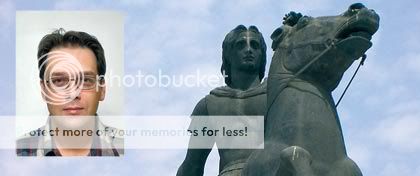 Vojislav Sarakinski, historian: quasi-scientific works are written with political, even politicant goals
Vojislav Sarakinski (1975) is employed at the Institute for History at the Philosophic Faculty, holding and in this very moment practicing the term exercises on subjects History of Ancient Macedonians prior to 323 BC, History of Ancient Macedonians 323 BC -313 CE, History of the Ancient East, History of Ancient Greece and History of Ancient Rome for the groups History and Classical Studies. Performance of teaching on the subject History of Ancient Macedonians, History of Ancient Age 1 and History of the Ancient Age 2 for the groups History with archivistics and Archeology under mentorship of Prof. Dr. Nade Proeva. M.A. Sarakinski, several years ago resisted Professors Boševski and Tentov from the Electrotechnical Faculty, which decided to get into the act of deciphering of ancient letters and languages. They provided “exegesis” of the mid-part of the text at the Rosetta Stone and proclaimed it as a Paleomacedonian. So, it would seem, everything started...
Written by: Branka D. Najdovska
You are among the rare ones who spoke publicly, I.e defied the so-called antiquization of Macedonia, with the text “The Discreet Death of the Methodology”...
-Basically, I opposed a very non-sustained, even pseudo-scientific work in which pretensions were made towards a spectacular discovery. I felt obliged do demystify a way of thinking which has nothing common not only with the study of Antiquity, but not even with the scientific work at all. Regarding the antiquzation – it is a political term which recently appeared in the public and which at that time still was not actual , although, a recognition has to be made that many things among us go into the direction of thinking of the authors of the work.
Let us clarify for the wider public: what is the Rosetta Stone? Does it have any relationship with us at all and meaning for us?
-For the scientists, the Rosetta Stone is a proclamation of one King from the dynasty of Ptolemaids in relation to the rights and obligations of royal statues within temples. That is a jurist and archival document which, in itself, does not contain anything especially interesting and is one of the line of other such proclamations. The Rosetta Stone became important for the science because, on the basis of demotic Egyptian and the Ancient Greek text which are on it, Champollion managed to decipher the Egyptian hieroglyphs; Therefore, it is a document with great scientific importance not so much because of its content, but because of the role he had in a certain moment from the development of science about the past, and that is why it is famous in the entire world.
Why somebody undertook to reexamine precisely the Rosetta Stone?
-That cannot be said with certainty by nobody, with the exception of the authors of the achievement, although I perceive that a new exegesis of the Rosetta Stone sound much more grandiose than a a new exegesis of a piece of papyrus in a museum depot. The undertakings with bombastic goals always have bombastic subjects of “investigation”: that is why Pyramids are being dug-out in Bosnia; Troy is everywhere from Herzegovina, via Italy, up to England, just not there where its has been found; Under the Sphinx there is a secret sanctuary of aliens; the Pyramids, the Sphinx, the Rosetta Stone and similar generally recognizable things are causing much greater publicity from a jar, or, for example, a part of a ring – if you strive towards publicity and not science.
Does a practice established itself, just like in this case, that non-competent ones are doing all and everything? Somehow, everybody got involved into that “changing of the consciousness, now and here”...?
-Although it is still not an everyday practice, that shall be present more and more. Among us it seems that the competence and professionalism are not important, but only interest towards certain theme, in order that a series of “works” are born with, allegedly spectacular discoveries. But that cannot be stopped, nor to be banned. Such works were present from always and they shall exist, not only among us , but everywhere throughout the world. But, what is really bad is the degree of media attention which is given to these private “hobby exercises”. Certainly that people shall continue to write and throw away with scientific “truths”, when the Media are asking statements from them, they are organizing promotion and conferences, they are inviting them on TV, they devote hours and hours on their theories. The trouble is, thus, in our society, especially in the Media which are in a hurry to gave them publicity, and are forgetting to ask themselves does that to which they pay such attention is deserving discussion at all. If this is a way to change somebody's consciousness, and I do not know why it should be changed, that that way is wrong and almost ridiculous.
Do at least some of these works have some scientific value?
-In general lines no, nor they could have; I am a historian, and I think that nobody would accept me to fix his teeth, or to project a house to him. Large part of these writings have nothing in common neither with the science, neither with the history, nor with the sane mind; a part are basically, to the certain extent, true, but they reveal to the world “grandiose” scientific truths: that the Ancient Macedonians had their own language, that Cleopatra VII originated from a Macedonian dynasty, and similar things that can be read in a high-school textbook.
Why the scientist did not reacted stronger in relation to these questions?
-A fact is that the scientific public in first time intimately laughed at them, but underestimated the influence of these “scientist”. Quasiscientific works are written not with scientific, but with political and even politicant goals, and scientists, as a rule, provide everything to by further away from daily politics. With that, they have left a broad and undefended field for expression of all those who want to speak about anything, and who most commonly do not know and cannot do that.
So, the scientists themselves “avoided” the debate...
-Its depends how do you define that “avoiding”, but in basis that maybe is true. Or, I would rather said that they did not managed themselves well into the entire situation. People which proffesionaly study the distant past (historians, archaeologists, classical philologists, numismatists, e***raphists) are usualy comparatively small group of people and they have homogeneous values in relation to the interest, ethics and quality of that what they do. They suddenly are forced to work as a part of a system based on different values, even on profit, which is incoprehenisble for them.
Is it a case that some relevant political factor approves such state of affairs because of profit?
-I am talking about the Media-televisions, weeklies, daily press, even publishing houses.It is clear that these are not a humanitarian organization, but they work on basis of market logic. Outside scientific circles you will have difficulty “selling” broken pot for cereals or ordinary glass, but that's why you will easily “sell” Pyramids, Sphinxs and Rosetta Stones. The public demands “great” answers and likable conclusions, now and here; and that, no serious explorer will neither pull out of sleeve, nor it will invent it in order to be liked by the audience.
However, it is not a state imposed by the media, but by other, conditionally said, political factors.
-That, also is true; and that is a part of the different values I mentioned. The ethics and the interests of the scientist and the ethics and interests of the politics are not the same. These value system collide – and here the scientist is faced with the strongest moral and professional dilemmas. In basis, the science about the past is never totally objective, nor it can be totally liberated from the person and the community. We like to believe that our findings are the total, objective and only truth, and actually we are making exegesis of the fact based on our own personal system of values. That is how we decide what to explore, what to “touch”, what to dig or provide exegesis again. In the moment when upon those solutions of ours “external”, non-scientific factor begin to influence, than the problems start.
Is it precisely because of that that the scientific public kept a long silence and with that approved the euphoria about the “direct relation of today's with Ancient Macedonians”?
-You shall understand that I cannot speak in the name of all. Who wanted to say something, he said it there where he found a place and desire; who kept silence, knows best why he kept silence. But, the problem is not that simple as you present it. In this case, if scientist are silent, it does not mean that they are approving the hysteria. If one needs to define the behavior of our academic community, it could be said that among us, mainly three patterns of behavior are manifesting themselves. The first pattern is the pattern of ignoring. A part of our scientists cannot comprehend from where so many pseudo-scientific theories and works appeared; they, in some sense, are ashamed to answer to such banalities and are hoping that this is a temporary fashion, something that will disappear out of itself. The second pattern is the pattern of late reaction. Many saw that the job went further from a distasteful joke and that something should be done, after all-here I include myself-but now they are facing with the unpleasant question “where you have been prior to now”, a question which sounds justified. The third pattern is the pattern of auto-censorship. People are silent because they know that what will say shall not have a resonance with the public; they know that they are going to be attacked on a non-scientific and lowly manner, so therefore are choosing either to be silent or to go forward with thesis which are “more acceptable” in this political moment.
The last edition of the “History of the Macedonian People”, by a group of authors, affirm the thesis that the ancient element is dominant among Macedonians. Is there any pattern of behavior here?
-I cannot answer this, because it would be ungrateful and dishonest to give an opinion about unread book. The book, so, should be primarily carefully read, and not comment on basis on several simplified television contribution and torn quotes. Regarding the expertly part of the question, I am not convinced that affinity to one or other genetic, ethnic or whatever element my be measured with deciliters, kilograms or percentages. Even if it can-the story about the ethnogenesis and ethnic belonging is so complex, and is a mosaic of so many different elements, that I do not believe that this in any way shall change what are we today.
Even if some genetic ancestry becomes proven, nevertheless, the nation depends from the culture, from the language...?
-Absolutely, but from many other things. Actually, the ethnic belonging of one human has a very little dependence with his genetic code. The question how a human feels and declares, to which community he belongs , where he sees and looks his place in the wider community, is not a genetic question at all, but is sociological and culturological. There is no certain primordial, inborn, priorly given and eternal feeling of belonging to one community-just like the identity of the community to which a human belongs is not cemented in time, but it continuously changes and evolves. This is especially proper for the Antiquity. In many cases we prefer to speak about belonging to a certain cultural sphere, for cultural identity and worldview, and not about ethnic identity. Imposition of language, changing of ethnic belonging, planned conquering and melting, precise definition of somebody's ethnicity simply did not exist as a concepts. For the human from Antiquity, especially after Alexander's conquests, these question would be banal.
What do you think, who needs this return to the past, “return of the identity of the dead ones”, something with which the present time is being killed? How much, to us, to Macedonians, these things are necessary?
-According to me, we are not returning to the past-that is physically unfeasible. We cannot abolish EVN* and “Vodostopanstvo”**, but shrouds on us, put a Macedonian causia on the head, to compete in chariot races, to go in line behind a long stick with a sun on the top and praise Apolo. That would be really antiquization, and that is why I think that this overused term is wrong in its root. What is happening to us today is painting the present times with some ancient nuances, strange combination of light populism and unscientific “re-reading” of the past; the final goals, which were recently so vividly explained have nothing common with the true scientific ethics. I, for example, think that our past, and our present times are perfectly varied and interesting; that our identity perfectly clearly drawn, that we have things to represent with, and things to be proud with just like we are; in order to be convinced and be proud from that, I don't need any reminiscences with symbols, signs and messages from the Antiquity. Furthermore, I do not see a reason to involve ourselves in debates who is older and who was here from ever. Such debates and quarrels are suitable only to nervous and uncertain people which are not certain in themselves, so they are looking for evidence about that how old and great they are.
*Electro-Energetic company
**Water supply company
As a scientist, but as a citizen of this state as well, on what we should focus ourselves in order to became “equal” with other peoples?
-We are absolutely equal with all other peoples. From where is the idea that our people is not equal, under what criteria and in relationship to what? Just because illogical restrictions are imposed on our states and tasks which are not demanded from other states, that maybe makes us unequal as a state, but not at all as a people. But, if you are talking about what should we do as a people, in order to lessen the burden from our state, that is something entirely else. I neither can, nor I like to give political lessons, because I'm qualified to talk only about the historical science. Here the answer is easy, and only one – focusing high standards, quality, ethics and professionalism in the work. It should be known precisely who is working what, and how he is doing that. So, an archaeologist should dig, not a doctor; exegesis should be made by a historian, not an electrician; classical philologist should translate, and not a lawyer; and vice versa, the historian and archaeologist should not build rails and multi-level buildings. And, of course-from all of them highest possible standards should be sought, and in exchange a full work independence should be provided for them. The scientific circle should be enough motivated, financed and supported to work on the information and obligatory, as an only front, to publish it there where its proper. Not in contact shows, on radio or in newspaper, but in a scientific publication, from where it will be spread throughout the world. As long as this is a preoccupation of politicians, economists, journalists, quasiscientist, amateurs and interested citizens, we won't have order and progress, but anarchy, bad foundation and bad basis for performance in the world, which shall result in failure.
In that case, do we need and certain “reexamination” of the scientists before the emanation and acceptance of their thesis?
-If we are talking about academically educated scientist-absolutely not. Who is he who shall decide where somebody's academic thesis is acceptable or not? It should be published, and than, with extensive scientific criticism, it will be easily seen whether its acceptable or not. Aprioristic checking is a censorship-and who will check “the checker”? But we are forgetting to often that the scientific polemics doesn't means fighting, assaults and accusations between people. Among us the art of scientific debate is forgotten; if you discuss for somebody's scientific thesis, that has a private perception and it returns to you as a personal assault. In healthy scientific circles it is perfectly normally that two scientists are close friends privately, and bitter opponents in scientific stances. So, that is a thing which should live again among us, and by no means any control or censorship.
source:Најдовска, Б.Д. "Квазинаучници ја антиквизираат нацијата", Глобус 115, 30.VI.2009
Translated by Vasko Gligorijević
Subscribe to:
Posts (Atom)


