Bibliography
Introduction
A brilliant, tireless, invincible glorious commander, Alexander, third in the dynasty of Argeades, has very properly been nominated as the Great. History reserved him a glorious destiny. He was designed to convey the glory of the Hellenic thought and the Hellenic civilisation to the extremities of the East and, furthermore, to establish new cities of Greek culture.
| Statue of Alexander the Great from Pergi, Asia Minor. |
Alexander became King of Macedonia at the age of 20, after the assassination of his father, King Philip, in 336 BC. From the very start of his reign, the new King had to confront his father's enemies. The members of the League of Corinth as well as the Thracians and the Illyrians considered the death of the mighty Macedonian King as an ideal opportunity to secede from the rule of the Macedonians. However, Alexander, a worthy heir to his father, after his recognition as ruler of Thessaly, directed his campaign against Peloponnesus, with a very specific plan of action in mind. During the Assembly in Corinth, in which all Greek city-states, except Sparta, were represented, he succeeded in becoming Leader of the Alliance and at the same time "Hegemon (Captain General)" in the war against the Persians. As recorded by Plutarch, Alexander, when returning from Corinth, went to Delphi to ask for the oracles of Gods. However, his arrival there coincided with the period of "dark" days, during which oracles were not given. Alexander dragged the priestess to the altar by force and demanded her to proceed with the oracle. The answer of the Priestess was "Invincible thou shall be, oh child!" Satisfied with the oracle, Alexander said that he did not wish another and let the Priestess go.
In the spring of 335 BC, Alexander campaigned out of Amphipolis against the Triballians and the Illyrians who, after King Philip's death, had shown a rebellious attitude. Later, he marched through Thrace, traversed Haemus Mountain (Now, Balkan) and defeated the Triballians and the Thracians. He then crossed Istros River (Now, Danube) using long ships from Byzantium as well as wooden canoes, with 1.500 Cavalrymen and 4.000 Infantrymen.
The ease, with which the Macedonians crossed Istros River, had a great impact on the Getae, living on the north bank of the river: they withdrew without battle. Afterwards, Alexander turned to Boeotia in order to subjugate Thebes that had seceded. The conquest of Thebes was followed by the slaughter of its citizens, mainly by Phocians, Plateans and other Boeotians. The destruction of Thebes was attributed to two factors: the rage of Gods, who wanted to punish the Thebans for their treason during the Persian wars, and the hatred of the Plateans, who had suffered destruction from the Thebans in times of peace. The fall of Thebes marked the end of Alexander's operations on European soil. These operations were just enough to build Alexander's reputation as a general, despite the fact that they lasted only one year.
After his successful operations, the young King returned to Macedonia in order to offer a sacrifice to Olympian Zeus and to organise the Olympian Contest at Aegae. In the winter of 335 BC, Alexander devoted himself to the organisation of his Kingdom, since he planned to leave for Asia for a long period of time. Initially, his intention was to conquer Persia, dethrone Darius and declare himself King of the Persians. In this way, he wished to revenge Xerxes who, in the past, had tried to enslave all the Greeks. His primary plan comprised three phases: first, the conquest of Asia Minor, then of Syria and Egypt, which he would use as a base for the operations of the last phase, and finally the conquest of the Kingdom of Persia.
The weakness of the Macedonians was the lack of a fleet, necessary for facing the Persian one, which numbered 400 warships. However, Alexander did not want to ask his Allies to provide him with ships. For reasons of precaution, the young Macedonian King left half of his military forces in Macedonia and entrusted the government of the country to Antipater, his faithful and experienced general.
Darius had risen to the throne of Persia in 335 BC. In comparison to Alexander, he had a very large army. Furthermore, while the treasury of Pella was already empty, long before Alexander's campaigns, Darius had fabulous treasures available. His vaults at Susa were full and "astronomical" amounts of gold had been amassed in the royal Palace of Persepolis. In addition, he had a large fleet, which controlled the coasts of Asia Minor, Syria, and Egypt, and was able to deny access to any enemy, who did not possess equal naval forces.
In those times, there was no social unrest in any part of the Persian Kingdom that could affect the defence of the country against an attacking enemy. However, there certainly were some ambitious satraps. On the other hand, Persia had not progressed in the modernisation of its warfare, while remarkable evolution had been made on the Greek part. Conscription of Greek Mercenaries by the Persians was not enough to cover the weaknesses and to fill the voids of the Persian Army, which also lacked officers capable of planning for any contingency or for counter attacks. Their abilities were limited to facing the enemy on the basis of numerical superiority, personal bravery in the battlefield and the use of their scythed chariots.
Alexander's army consisted of 30.000 Infantrymen and 5.000 Cavalrymen. The fundamental task organisation of the army, established by King Philip, comprised the Phalanx, light Cavalry, Hypaspists (Adjutants) and heavy Cavalry. Alexander, during his campaign to Asia, had six groups of the Macedonian Phalanx, which formed the main body of his army. The Phalanx was reinforced by Greek soldiers, either allies or mercenaries. Antigonus was the commander of the Allies, and Menander the commander of the Mercenaries.
Crossing of Hellespont (Dardanelles)
In 335 BC, Alexander sent Parmenion to Asia in order to secure bases in Propontis. Darius had ordered Memnon of Rhodes to confront Parmenion's manoeuvres. Memnon's efforts were fruitless and the coasts of the Hellespont fell in the hands of the Macedonian general.
| Head Representation of Alexander the Great as Hercules. |
It was from Pella in the spring of 334 BC that Alexander started his great campaign, which turned into a brilliant epopee. When he arrived at Sestos on the European coast of the Hellespont, he moved to Eleus, in order to offer sacrifice on the grave of Protesilaos who, in the days of the Trojan War, was the first to set foot on the coast and the first to be killed. From Eleus, Alexander came to the harbour of the Achaeans on the Asian coast. The Macedonian King was the first to disembark from the ship and threw his spear on the shore, thus symbolising the conquest of the land, he was standing on. Then he went to Ilion and dedicated his armour to Iliac Athena. Meanwhile, the Macedonian general Parmenion led the army from Sestos to Abydos with the help of 160 triremes and many other transport ships.
The Battle at Granikos
Alexander and his army initially marched northeast and then eastwards, until they came to the west bank of Granicus River, which flows from south to north into the Propontis. The Persians had already taken battle positions on the eastern bank of the river. Granicus is a mountain river, which flows torrentially in spring. Its bed had a width of 20 to 40 meters. At that time, it had abundant water but was shallow. The eastern bank, where the Persians stood, was steep and difficult for Alexander's attacking army.
Of the total available force of 35.000 men, Alexander used 5.000 Cavalrymen and 15.000 Infantrymen along the western bank of Granicus River. The Infantry was deployed in the centre and the Cavalry on both flanks. Alexander was commanding the right flank and Parmenion the left.
The Persians had 20.000 Cavalrymen and 20.000 Greek Mercenary Infantrymen. They had deployed the Cavalry in the front line, close to the riverbank, and the Infantry behind them. The Persians, realising that Alexander was on their left, reinforced their left flank with more Cavalry squadrons, assessing that the main weight of the battle would fall on the Macedonians' right flank.
However, Alexander having studied the enemy's movements, decided to attack the right flank opposite Parmenion. In order to complete his manoeuvre, Alexander put himself as head of the Cavalry, crossed the river and moved to the left, marching through the riverbed. These tactics allowed Alexander to attack the weakened right flank of the enemy and thus, after hard fight, he drove the Persians away. In the second phase of the battle, Alexander attacked the front with the Macedonian Phalanx against the main body of Mercenaries, while his Cavalry attacked the flanks and their rear lines. Most of Darius' Greek Mercenaries were killed and only 2.000 were taken as war prisoners.
Diodorus of Sicily mentions that in this battle Alexander:
"Proved himself as the factor of the victory"
| Diagram of the Battle at Granikos. |
The Conquest of Asia Minor
After this decisive battle, Alexander conquered Sardis and Ephesus without a fight. In Ephesus, the town of the goddess Artemis, he issued an order allowing all citizens in exile to return to their homes. He also abolished oligarchy and reinstituted the democracy. The Macedonian King offered a sacrifice to the goddess and organised a procession with the participation of his entire army. The next day, he left for Miletus, which he conquered with the co-operation of his fleet. During this operation, the Persian Fleet could not support the citizens of Miletus, because the Greek Fleet had blocked the harbour of the town. The Persians had anchored in the bay of Mycale and tried to mislead the Greek Fleet, smaller in strength, to a naval battle. However, the lack of provisions and water, soon forced the Persian Navy consisting of 400 ships to sail to Samos for re-supply. After a few days, the Persian Fleet appeared again off the coast of Miletus, and five of their ships sailed into the harbour hoping to find Alexander's ships without crews. However, they were noticed by Alexander's seamen, who immediately manned 10 ships, sailed after the Persian ones and captured one of them. This fact disappointed the Persians, who lost all hope and sailed off to Halicarnassus.
| Base encarved in relief of the latter Artemisio of Efessos, British Museum. |
While in Miletus, Alexander made a mistake. He decommissioned his Navy, believing that having conquered the coast of Asia Minor with his Macedonian Infantry was enough to confront the Persian Fleet. He also believed that the enemy ships would no longer be able to sail into the harbours for re-supply.
Soon, Alexander left Miletus and continued to Halicarnassus, which he besieged with the use of war machines. The Persians, realising that they would not be able to keep the town for long, set it to fire and sailed away to the island of Cos.
In the winter of 334-333 BC, Alexander decided to march southeast along the coast of Asia Minor and conquer the coastal towns of Lycia. After conquering Telmissos, Xanthos and Phasilis, he marched eastwards and liberated Perge and Side.
To Cilycia
Because the road to Side was inaccessible, Alexander turned to Phrygia, towards the interior of the country, and marched to the ancient town of Gordium near Sangarius River (Now, Sakarya). In the royal palace inside the citadel of Gordium, was the chariot of King Gordius, father of the mythical Midas. The chariot was tied with a dogwood knot to a pole. According to tradition, the person who would untie the knot would become the conqueror of Asia. Alexander acting impulsively cut off the knot with his sword.
In the spring of 333 BC, the Macedonian King headed east and, after conquering the town of Ankara, continued to Cappadocia, occupying all the territory surrounded by Halys River (Now, Kizil). Soon, he arrived at the Cilician Gates, southeast of the Taurus mountain range and in one night only, with a sudden attack, took over the area and marched towards Tarsus, where he camped. Alexander remained there for a period, because his health had suffered from extreme fatigue.
| March of Alexander the Great and Darius on the Plain of Issus. |
In October of 333 BC, after he had recovered, Alexander sent his general Parmenion to conquer and guard the passages between Cilicia and Syria. Meanwhile, Darius gathered his forces in Babylon and moved towards Cilicia. He camped east of Amanus Mountain, at Sochi in Assyria. Alexander's long stay in Cilicia, because of his illness, gave Darius and his staff the impression that Alexander feared combat.
Alexander was informed of the arrival of Darius at Sochi, and immediately marched along the coast of Cilicia, crossing "The Cilician Gates" at the inlet of Issus Bay, and occupied the town. The next day, he marched southwards, crossed the "Syrian and Cilician Gates" and came to Myriandros with the intention of crossing the "Syrian Gates" and attack Darius, whom he believed still at Sochi.
However, Darius, instead of waiting for Alexander in the Valley of Assyria, which was suitable for the movements of the large Persian Cavalry, regained courage and decided to move against the Macedonians. He headed west, crossed Amanus Mountain and came to the rear of Alexander's forces unnoticed. Then he conquered Issus, tortured and killed all the Macedonians, who were ill and had remained in the city, and the next day moved south towards Pinarus River.
The Battle at Issos
Darius' move from the open plain of Sochi, towards the narrow strip of land on the coast south of Issus, gave Alexander a great advantage, since this decision condemned a great part of Darius' large army to remain inactive. On the other hand, in order to safeguard his rear line, Alexander had to conquer the Southern Gates which led to the coastal strip of land. So, after a war council, Alexander ordered a body of Archers and another of Cavalrymen to conduct reconnaissance of the road, while at the same time, he and his army marched south of Amanus, towards "The Syrian Gates" that he conquered by midnight. Then, the Macedonian Army marched northwards to meet the Persian Army at the location they had camped, north of Pinarus River. This river was not very deep and not difficult for the Cavalry to cross, while the width of the flat land between the foot of the mountain and the sea did not exceed 2.700 meters. According to Arrian, Darius' army consisted of 600.000 men, including 30.000 Cavalrymen and 30.000 Greek Mercenaries. Although there is some contestation about these numbers today, certainly Darius had a great army, which offered him the possibility of taking the risk of a battle, despite his disadvantageous position.
Darius' forces were deployed from the mountain range to the sea - that is from left to right - as follows: 30.000 Cardaces soldiers, 30.000 Mercenaries next to them, another 30.000 Cardaces further to the right and, finally, 30.000 Cavalrymen at the right, towards the sea. The rest of his forces consisted of lightly armed Asians and they were deployed behind the Mercenaries.
| Diagram of the Phases of the Battle at Issus. |
When Alexander realised the way in which the enemy forces were positioned, he decided to deploy his forces from right to left in the following way: on the right, towards the mountain, he had his Cavalrymen carrying the sarissa spears; on the left were his Paionian Cavalrymen, the Macedonian Archers, the Cavalry of the "Hetairoi (Companions)", the Macedonian Phalanx, the Cretan Archers, and the Thessalian and the Allied Cavalrymen close to the sea. Moreover, towards the side of the mountain, he deployed some soldiers with spears, some Archers and a few Cavalrymen, in case he had to face an advanced Persian detachment. The Greek Mercenaries deployed along a second line.
The battle of Issus began in the afternoon hours, on one of the first days of November, in 333 BC. Alexander began to march against the enemy at a slow pace. But as soon as he came to within range of the enemy arrows, he launched a sudden attack with the Companions Cavalry, the light Cavalry and the squadrons of the right flank against the Cardaces, who where on the left flank of the barbarians. Soon, these dispersed and flew away. However, the Macedonian Phalanx, which was in the centre, could not keep the momentum of the Cavalry of the right flank. As a result, a gap was created and the Greek Mercenaries of the Persian Army ran to take advantage of it and to launch an attack at that point. Alexander, however, after the disorderly retreat of the Cardaces, turned to the left and attacked the Mercenaries forcing them to retreat. Then, Darius afraid of being taken as prisoner or be killed, grabbed the reins of his chariot and left alone without waiting for his charioteer. He soon abandoned his chariot, mantle, bow and shield, and tried to escape on horseback.
In the meantime, the Persian Cavalry, after passing through Pinarus River, attacked violently the section of Cavalry in its way. The battle was not on equal terms, due to the fact that 30.000 Persian Cavalrymen confronted just 2.500 of Alexander's Cavalrymen. However, when the Persian Cavalry realised that the Greek Mercenaries were retreating and Darius had abandoned the battle, they also fled. The Persians lost 100.000 Infantrymen and 10.000 Cavalrymen during the battle, while the losses of Macedonians were only 300 Infantrymen and 150 Cavalrymen.
Darius, in his dramatic flight, left behind his wife, his mother, and his three children. Although Alexander had been injured on his thigh, he did not forget to visit the wounded and also to care for the dignified burial of the fallen, parading all the forces of his army. The victory in Issus was celebrated with the founding of the city of Alexandria, which bears the name of Alexandretta , to this day.
The Conquest of Phoenicia and Egypt
While Darius was heading for the town of Thapsakos, situated on the west bank of Euphrates River, Alexander continued his march towards Phoenicia and camped at Marathas, a Phoenician town near the sea. When informed that the money, which Darius had sent to Damascus, had fallen into the hands of Parmenion, he ordered his general to return to Damascus and keep it safely there.
Afterwards, Alexander marched southwards and conquered Byblos and Sidon. When he arrived in front of Tyre, he asked permission to offer a sacrifice at the temple of Hercules. However, the inhabitants of Tyre informed him that he was "persona non grata" in their town.
Then Alexander decided to conquer Tyre and built a small causeway 700 meters offshore. The town was an island fortress surrounded by high walls and had two ports, in which its strong fleet had anchored. In order to conquer the town, Alexander decided to accumulate a mole and link it to the coast. Swamps were formed between the island and the coast, in the shallow part of the sea near the coast; the depth of the sea near the island was greater, about 3 fathoms.
To find the materials for making the mole, several buildings of the old town of Tyre, on the coast, were demolished; to cover needs in wood, trees were cut down from the forests of Lebanon. Apart from soldiers, residents of the area were also used to carry the materials and to construct the mole. When the construction of the mole had advanced, Alexander ordered his men to construct two wooden towers, each as big as 20 floors and put them on each end of the mole. These towers were equipped with big ballistic machines, to be used against the walls of Tyre. However one night, the Tyrians led an incendiary ship to the front part of the towers and managed to destroy both of them. Then, Alexander decided to widen the mole and put more towers and more ballistic machines on them.
Meanwhile, the Kings of the cities of Arados, Byblos and Sidon left the Persians, and made their Phoenician Fleet available to Alexander. Soon, the Kings of Cyprus came to Sidon with another 120 ships, and also made them available to Alexander. In addition, ships from Rhodes and Lycia arrived at Sidon; thus the total number of ships, under Alexander's command, reached 224.
The Tyrians, realising that Alexander had assembled a bigger fleet than theirs, secured their fleet inside the two ports of the island, closed their entries with triremes and threw huge rock blocks into the sea to stop enemy ships from approaching the walls of the town. In turn, Alexander put ballistic machines on his ships and sailed offshore, in order to attack the defences of Tyre. He also planned to recover the huge rock blocks that the Tyrians had thrown in the sea. When the Tyrians realised what Alexander had in mind, they sent divers to cut the cables from the anchors of the ships, hoping that the water currents would carry the enemy ships away. However, Alexander managed to keep the divers out of the way, by using chains instead of cables.
Subsequently, the besieged population attempted an attack against the ships of the Cypriots, anchored in the port opposite Sidon. For this reason, they manned three quintremes, three quadremes and seven triremes, rowed close to the Cypriot ships and then rammed them. But Alexander, after quickly manning one quintreme and five triremes, sailed against them. He managed to destroy some of the enemy ships and to drive the rest of them away. Three days later, Alexander launched a new attack on the island with his ships and managed to cause damage to the wall with his ballistic machines. He then sent two ships equipped with bridging planks to the breached side, and ordered his triremes to attack the two ports of the island. When the bridges of the ships were fixed on the walls, Alexander's shield-carrying soldiers ran and took the wall; Alexander and the Companions followed right after and moved towards the palace of the city. In the meantime, the Phoenicians and the Cypriots forced open the gates and began ramming the enemy ships inside the two ports. Then, the inhabitants of Tyre abandoned the wall, conquered by Alexander, and gathered at Agenorium temple to attack the Macedonians; but soon they were defeated.
Tyre fell in July of 332 BC after a seven month siege. The conquest of this city, invincible until then, became Alexander's new war trophy and established his fame as a victorious commander. After the occupation of Tyre, Alexander decided to march towards Egypt, since all the cities of Phoenicia and Palestine had capitulated to him. The only exception was Gaza, on the road leading south. The city of Gaza was built on a hill and was protected by high walls. The conquest of the city became possible after building an earthwork around its walls and using the ballistic machines, transferred from Tyre. After Gaza, Alexander marched during seven days and arrived at Pelusion in Egypt (Now, Port Said), situated on the Delta of the Nile, while his fleet sailed close along the coast. There, the Persian governor of Egypt gave him a friendly welcome and allowed the Macedonian garrison to camp in the town. The fleet continued sailing upstream until it came to Memphis. Alexander offered a sacrifice to the Gods and continued in the opposite direction of the Nile, where he built Alexandria. He, then, marched on to the oasis of Siwa to offer sacrifices in the temple of Ammon. There, after admiring the area, he received an oracle from the priest of the temple and returned to Egypt.
Afterwards, moving north, Alexander went to Tyre, followed by his fleet. There, he offered a sacrifice to Hercules and organised athletic and dramatic games. At that time, the sacred trireme "Paralos" sailed from Athens with two Athenian delegates, who managed to free Darius' Athenian Mercenaries, taken prisoners during the battle of Granicus.
The Battle at Gaugamela
Alexander left Tyre in the summer of 331 BC, leading 40.000 Infantrymen and 7.000 Cavalrymen towards Thapsacus, a Syrian town on the banks of Euphrates River. In August 331 BC, the Macedonian King crossed the river with his entire army, using two bridges built by Parmenion. From there, he marched northwards to Tiger River, planning the conquest of Babylon. After crossing the river with difficulty, he marched towards Gaugamela, a village in Assyria near Bumelus River, forty kilometres away from the town of Arbela (Now, Erbil).
According to information collected, Darius had camped in a valley near Gaugamela, with an army consisting of 1.000.000 Infantrymen, 40.000 Cavalrymen, 200 scythed chariots and some elephants. Alexander camped opposite Gaugamela for four days, in order to let his army rest. Then, leaving those unable to fight behind in the camp, he marched during the night, in order to fight against Darius' army by daybreak. First, accompanied by his lightly armed soldiers and the Cavalry of the Companions, he examined the location, where he aimed to give the battle; afterwards, he ordered his army to dine and rest. In the meantime, Darius kept his entire army in formation, as he had not entrenched his camp and was afraid of a surprise night attack by the Macedonians.
| Babylon - The Gate of Istar. |
Darius' army took the following disposition: the Cavalry from Bactria, Arachosia and Dahae were on the left flank towards the centre; then there was a mixed number of Persian Cavalry and Infantry and some Susian and Cadusian Cavalry. From the end of the right flank towards the centre were Cavalry from Syria and Mesopotamia as well as Cavalry from Media and Parthia. There were also some Sacians, Tapurians, Hyrcanians, Albanians and Sacecinians. Darius was in the centre of the disposition with his Persian Cavalry Guard and Persian "apple bearing" Infantry, some Indian Cavalrymen, Carians, Mardian Archers and Greek Mercenaries on either side of Darius. Behind the main formation was another line while, in front of this and to the left were Scythian Cavalrymen, 1.000 Bactrian Cavalrymen and 100 scythed chariots. On the right were Armenian and Cappadocian Cavalrymen and fifty scythed chariots. Finally, in the centre of the disposition were fifteen elephants and another fifty scythed chariots.
Alexander disposed his Army, from right to left, as follows: the Companions Cavalry and the Adjutants were on the right, the battalions of the Phalanges in the centre and the Allied and Thessalian Cavalry on the left. There was a second line behind the phalanges which, together with the front line, formed a double-headed Phalanx, able to fight on both directions. The left lateral rear guard was manned with Agrians, Macedonian Archers and in front of these were some scouts and Mercenary Cavalrymen. In front of the Companions in the centre were the remaining Agrians, some Archers and some spearmen. As right rear lateral guard were assigned Greek Mercenary Cavalrymen, scouts and Paionian Cavalrymen as well as Agrians, Macedonian Archers and Mercenaries.
When the battle began, Alexander noticed that the right flank of his army was opposite the centre of the Persians and there was a danger to be outflanked; so he moved to the right, while the Persians were attempting to move in the opposite direction. Then the Scythian Cavalrymen, on the left side of the Persians, launched an attack on the right flank under Alexander's command. They were driven back, however, by the Cavalry under Menidas' command. It was a fight between Cavalries. At the same time, the barbarians sent their scythed chariots forward hoping to confuse the Phalanx. Nevertheless, the spearmen, positioned in front of the Companions Cavalry, fought back with their spears. While the main Persian line advanced, Alexander waited for the right moment to start the attack with his Cavalry. The opportunity appeared, when a gap was formed between the centre and the Cavalry of the Persians, which had moved quickly to surround Alexander's right flank. He then surged forward with the Companions Cavalry and the Phalanx aiming at Darius. It did not take long before the Persian King fled, as he had done at Issus, followed by the left flank Cavalry. However, while the centre and the left flank of the Persians had been retreating, some Indian and Persian Cavalrymen took advantage of the gap between Alexander's centre and his left flank, and attacked the Macedonian supply transport packs. Then, the men in the second line, assigned directly behind the first one, turned around and neutralised the barbarians. At the same time, the Persian right flank Cavalry, not realising that Darius had fled, attacked the Macedonian left flank under the command of Parmenion; they pressed hard, until Alexander gave up the chase of Darius and rushed back with the Companions Cavalry to face the barbarians' right flank. Those amongst the enemy, who managed to save themselves, ran away as quickly as they could; Parmenion conquered the enemy camp, the supply transports, the elephants and the camels. Alexander and his Cavalrymen rested until midnight; then they marched to Arbela and took possession of Darius' treasure, effects, chariot, shield and bow. The battle at Gaugamela ended on 1 October 331 BC, with enemies' losses of over 300.000 souls.
The Conquest of Persepolis
While Darius was escaping with his Cavalry and his relatives towards Armenia, Alexander marched on to Babylon. There, he was welcomed by the people, the priests and the lords, who surrendered the city to him. From Babylon, Alexander went on to Susa, Darius' summer residence. Susa had already been conquered by Philoxenos, who had hasted there with a few men. Philoxenos sent Alexander a message saying that the royal treasure was untouched and that the satrap was ready to hand over the town. At Susa, Alexander received 50.000 silver talents, as well as plenty of pillage, taken by the Persians during their campaign against Greece.
| Persepolis - Capital of Darius. |
In January 330 BC, Alexander left Susa heading for the land of Persis. Soon, he crossed Pasitigris River and invaded the country of the Uxians. When he captured the passes controlled by the Uxians, he sent heavily armed men with Parmenion towards Persia through the carriageway, while he personally led the Infantry and the Companions Cavalry through a mountain road to the Gates of Persis. When he arrived there, he confronted Ariobarzanis with 40.000 Infantrymen and 700 Cavalrymen, who had built a wall among the narrow passes, making the advance impossible for Alexander. The Macedonian King left the main body of his forces in front of the walls, chose a few warriors and guided them though a path, shown to him by prisoners. When the enemy found out that they had been surrounded by the Macedonians, they left their positions and fled. After occupying the narrows, Alexander made his way towards Persepolis to prevent the guard from looting Darius' treasure. When he took control of Persepolis, he sent a few soldiers to Pasargades, to secure the treasure of Cyrus I, found there as well.
| Persepolis - Capital of Darius. |
Soon after, Alexander headed to Media, where Darius had sought refuge. When he arrived at Ecbatana, he moved forward with the Companions Cavalry, the Mercenaries Cavalry and the Macedonian Phalanx towards the Caspian Sea, in an attempt to catch Darius. Near the Caspian Gates, he was informed that Darius had been arrested and that Bessus, the Satrap of Bactria, had assumed power. Alexander continued his advance, dispersed the rebels, but did not manage to catch Darius alive, as he had been assassinated by barbarians. Then, Alexander sent Darius' corpse to Persepolis, to be buried in the royal tombs, according to the local burial rituals.
The East Satrapies Conquest
Darius' death set a clear landmark to the unprecedented campaign of Alexander the Great. After the Persian King's death, Alexander was presented as his legal successor. This new prospect changed the aims as well as the character of the campaign. The advance to the East sealed the official occupation of the entire Persian territory. Furthermore, in his capacity as legal successor of Darius, Alexander had to punish the assassins of the Persian King. The completion of the conquest of the Asian continent became Alexander's new vision for global domination and his deification.
The campaign to the east satrapies of the Persian Kingdom, from Hyrcania to the Indian Caucasus, Jaxartes (Now, Sir Daria) and Indus Rivers transforms Alexander's conquests into discovery missions, where geographic explorations became as glorious as his military successes. The King of Macedonia was the only European commander, who led a European army from the West to the conquest of the East.
| Alexandria Eschate (Farthest, now Hodgend) on Jaxartes River |
Alexander's objective for the first military operations was to clear Hyrcania from rebels, some of which were Greek Mercenaries of Darius. Alexander divided his army into three parts which cleared the area and finally met in Zadracarta, the capital of Hyrcania. The Greek Mercenaries, who had found refuge on the Elburz Mountains, showed up one day in his camp. Alexander set some of them free and enlisted the rest of them. After a short relaxation period in Zadracarta, Alexander passed by the north borders of Parthia and arrived at the boundaries of Aria. In the town of Susia, Alexander let Satirbarzanes, who accepted his authority, to keep his satrapy. While there, Alexander was informed that fugitive Bessus had found refuge in Bactria, bore the symbols of authority, was renamed to Artaxerxes, and declared himself as "King of Asia".
| The Hellinic City of ai Hanoum on Oxos River, Afghanistan. |
Alexander, leading all his Army, moved onwards to Bactria. But, when he received information that Satirbarzanes had revolted and was arming and assembling the Arians in their capital Artacoana, he decided to turn to that direction with a small part of his army. When he arrived in the city two days later, he realised that Satirbarzanes had escaped accompanied by a few Cavalrymen. At the end of this unexpected but brief operation, Alexander set off again for Bactria and, on the way, occupied the lands of Gandara and Ariaspi.
| Alexandria in Arahosia (Kadahar). |
In the winter of 330 BC he arrived near the Indian Caucasus (Hindu Kuch), where he founded a new town named Alexandria (Bagram), situated close to Kabul River. During the winter, due to heavy snowfalls, he did not conduct any campaign but was kept continuously informed about Bessus' movements; the latter with 7.000 soldiers kept ravaging the slopes of Caucasus, in order to impede the Macedonian advance. Moreover, Bessus, fearing that Alexander would attempt to chase him in the spring, passed Oxus River using boats that he burned afterwards, and then sought refuge in Nautaca of Sogdiana. Alexander followed Bessus to Sogdiana, situated between Oxus and Jaxartes Rivers, and then sent Ptolemy, son of Lagos, with three Companions Cavalry battalions, mounted Spearmen, Infantrymen and Archers against him. Ptolemy arrested him and then sent him to Alexander, naked and tied from the neck.
After Bessus was condemned, Alexander moved towards Maracanda (Samarqand), capital of Sogdiana and, after seizing seven fortresses, he arrived at Jaxartes River, at the north-eastern boundary of the Persian state. There, he founded the city of Alexandria Eschate (Farthest).
The Campaign to India
Alexander, in the spring of 327 BC, after having stabilised his position in Bactria and Sogdiana, decided to turn to the East and conquer India. Before the campaign, he made a meticulous preparation. The plan of this campaign provided for a march towards Kabul River valley and up to Indus River, then crossing Indus, anticipating local confrontations and massive battles in this area and, in the end, advance to the east up to the "Eoa (Eastern) sea". The Macedonian King left Amyntas in Bactria with 10.000 Infantrymen and 3.500 Cavalrymen, headed towards the Indian Caucasus and arrived in Alexandria - built by himself when he had passed for first time from there. Afterwards, he came up to Nicaea, where he offered sacrifice to Athena and then moved towards Kabul River. There he divided his army, sending Hephaestion and Perdicas to the country of Peucelaotis, situated between the Rivers Kabul and Indus, to prepare his passage. Alexander and the rest of the army moved through the country of the Aspians, the Guraeans and the Assakenois, along Khus River. There, he stayed during the winter, fighting with the people of these mountainous regions.
| The Campaign of Alexander the Great. |
In the spring of 326 BC, when Alexander reached Indus River, he found that the bridge that he had ordered to Hephaestion, was ready, along with many small ships and two triacontoroi (30-oars ships). The bridge of Hephaestion, used for the crossing of Indus River, was made of several boats, placed in parallel and tied up to each other. Moreover, wicker baskets full of stones were placed in each boat's prow. Ramps had been placed on each end of the bridge, and wooden planks and boards were mounted onto the boats. After crossing Indus, Alexander, followed by his army, reached Taxila in three days, where he was greeted by Taxilis, the deputy governor of the city.
Alexander held athletic and riding games and appointed a satrap as well as a Macedonian garrison made up of weak soldiers, and subsequently resumed his course towards the Hydaspes (Jhelum) River. According to available information, the Indian ruler Porus, with all his army, stood beyond the river with the intention to prevent Alexander from crossing it. Then, the Macedonian King sent soldiers back to Indus, to disassemble the floating bridge, used for its crossing, and to transport every single boat to the banks of Hydaspes. Alexander, along with the rest of his forces plus 5.000 Indians, assigned by Taxilis, headed for Hydaspes River.
The Battle at the Idaspis River
When Alexander reached the right bank of the river, he saw Porus with his army and his elephants. When the latter spotted the Macedonians, he set up guards at many points along the river. Alexander did likewise, placing various units at many points along the bank so as to mislead Porus about his intentions, while his scattered ships sailed along the banks. The river was high at that time of the year, because of all the rainfall and the melted snow. Alexander, realising that it would be difficult to cross the river because of the elephants which would prevent the horses from reaching the opposite shore, told his riders to shout loudly at night-time, in order to give the impression that they were preparing to cross the river. These noises forced Porus to keep moving his men and his elephants among the possible crossing points. However, since the Macedonians kept shouting and calling, at the end, Porus ignored the noise altogether.
The bed of Hydaspes River, which flows from north to south, formed a curve 16 kms away from Alexander's camp. On the opposite side of the curve was an island full of trees, as were the banks of the river at that location. During a rainy night, Alexander decided to cross the river at that point. He moved there with a part of his force, keeping a safe distance from the banks in order to remain unnoticed. The floating bridge was transported to that point of the river and, after being re-assembled, was kept in the forest. In the morning of the next day, the Cavalry and a part of the Infantry embarked onto the vessels towards the island. Alexander got on a triacontoros, along with some Companions and shield-bearers, and moved to the other side of the river, followed by some other triacontoroi. However, during the operation, the Macedonians were apprehended by guards, who hastened to inform Porus.
Alexander landed and advanced with his assembled Cavalry. He soon realised that he did not disembark onto the other side of the river, but onto a different island, a short distance from the bank. Fortunately, he found a place from where all the army could pass, so the Infantry and the Cavalry overcame the obstacle. Alexander's forces, assembled on the other side of the river, were 6.000 Infantrymen and 5.000 Cavalrymen. Without wasting time, Alexander engaged the enemy with only the Cavalry. Soon he was facing Porus' Cavalry that quickly fled. In this battle one of Porus' sons was killed. Then, Porus decided to attack Alexander. His force consisted of approximately 4.000 Cavalrymen, 300 chariots, 200 elephants and 30.000 Infantrymen.
| Diagram of the Battle at Hydaspes River |
After walking over a short distance, Porus lined up his army in an area without mud. He put the elephants in the front line, leaving a distance of 30 metres. The Infantry was in the second line in the empty spaces between the elephants. On the left and right of the Infantry were deployed Indian Cavalrymen and, in front of them, the chariots. This battle plan had a defensive character. On approaching the enemy, Alexander observed the disposition of the enemy forces and wisely decided to wait for the arrival of his Infantry. Alexander's plan involved a Cavalry assault against the Indian Cavalry and harassment of the Infantry. Afterwards, he would attack with his Archers, Lancers, and Companions Infantry against the enemy elephants and Infantrymen.
The battle took place in July 326 BC with the Macedonian Infantry as the leading force against the elephants. Alexander commenced the great battle on the banks of Hydaspes River, leading his Cavalry to the left side of the enemy's disposition, while the Infantry remained further to the rear and was moving to the right side. Before advancing, Alexander had sent Coenus with the rest of the Cavalry to the enemy's right side, in order to monitor the movements of the Cavalry, deployed there. At first, he used the Archers against the enemy's left flank and, then, he personally attacked the barbarians' left. At that moment the Indians, in their attempt to face Alexander, committed a huge mistake by bringing all their Cavalry to the left, opposite Alexander. Coenus, who had already sneaked there, attacked the rear of the enemy's Cavalry, which was forced to fight on two different fronts simultaneously against Alexander's and Coenus' Cavalry. Failing to confront Alexander's assaults, they ran into the empty spaces, between the elephants. When the elephants' riders moved the wild animals against Alexander's Cavalry, they faced an attack from the Companions Infantrymen, who started hitting the elephants' riders, as well as the wild animals, with spears and arrows.
| Image of an Elephant with Macedonian Soldiers as Riders |
That was the most brutal phase of the battle. The elephants turned against Alexander's Infantry, trampling some of them and throwing others brutally on the ground with their proboscises. The Macedonians were fighting in a compact column, striking the Indians, deployed between the elephants with their long sarissa spears. Seeing that that the battle was being held between the Infantrymen, Porus' Cavalry attempted a new assault, but was repelled once more. Thus the Indian Cavalry was completely neutralised. The battle was relentless. Alexander's Cavalry in a compact formation was inflicting heavy losses on the Indian Army during many repeated assaults. The battle was taking place in ever restricted spaces and was more and more confusing, since in the turmoil, the elephants trampled indiscriminately on Indians and Macedonians. Porus tried to overturn the situation, by conducting a counter-attack with warriors and forty elephants. Although its outcome was initially successful, it soon lost momentum after Alexander's attack with Archers and Agrians against the elephants. At the same time the column, consisted of the men that had recently crossed the river, attacked the injured and scared animals more efficiently. Moreover, as the battle went on, the elephants' assaults were becoming weaker; on the other hand, the Macedonians were neutralising the animals easier, striking their feet with axes and their curved swords, the "kopides". Then Alexander attacked the enemy from all sides and defeated them, while the Phalanx was reinforced with fresh men, who had just crossed the river.
Thus, the great battle of Hydaspes, which lasted all day, ended with a triumphant victory for Alexander. Losses for Porus rose to 20.000 Infantrymen, 3.000 Cavalrymen and half the force of elephants. Porus was among the prisoners.
The Decision Το Return
Alexander stayed near Hydaspes River for 30 days, in order to let his men rest. He ordered two cities to be built, one in the battlefield and the other at the point, where he had crossed. He called the first city as "Nicaea" (Victorious) and the second as "Bucephala", in memory of his horse, which died there. Subsequently, after leaving Craterus with the responsibility of building these two cities, he moved towards the interior, where he conquered another 37 cities.
The King of Macedonia advanced to Ashkini River (Now, Chenab). After crossing the river with boats, he advanced towards to Hydraotes river (Now, Ravi). Then, he marched on the city of Sagala, where neighbouring nations had gathered in order to stop his advance. Alexander, initially by using his Cavalry and then his Phalanx, managed to break the lines of the enemy, who had placed chariots in front of the city walls and entrenched in them. After his victory at Sagala, he advanced to Hyphasis River (Now, Beas), after which an immense desert stretched out. Alexander was "possessed" by a desire to go ahead, but he came up against the Macedonians' opposition; they suffered from fatigue, having loyally followed their King from battle to battle and risk after risk. For this reason, they gathered in the camp, where some wept for their fate, while others shouted that they would not follow Alexander, if he chose to continue his onward course. When Alexander was informed of the situation, he tried to calm the spirits and persuade the reactionaries to change their minds. Then Coenus, gathering his courage, stated the reasons for which the veterans, who had survived a large number of battles, wished finally to return to their home country and their wives and children. After three days, Alexander offered a sacrifice for the safe passage of Hyphasis River, during which the signs were ominous. Then, after summoning the eldest of the Companions, he informed them of his decision to return. After that decision, a climate of happiness prevailed and everyone went to his tent, wishing him many graces for granting their request and for letting the will of his men overrule his own.
After dividing his army into classes, Alexander ordered twelve altars to be built, on which sacrifices were offered, and then he held athletic and riding games. After that, he headed towards Hydaspes River. There, he worked on the reconstruction of the cities of Nicaea and Bucephala, destroyed by torrential rain. He also made some improvements in the system of administration of the area. Meanwhile, significant Infantry and Cavalry reinforcements arrived from Greece. After being briefed on geography of the area, Alexander decided to sail down Hydaspes River and then Indus River, in order to reach the sea.
Sailing Down Indus River
The fleet built for this reason consisted of eighty triacontoroi, ships for the Cavalry, transport ships and smaller craft. Alexander boarded with a part of the army composed of Adjutants, Archers, Agrians and a Cavalry detachment. Craterus with a part of the army marched along the right bank, while Hephaestion with the largest part of the army and 200 elephants advanced on the left one. The horn signalled the departure of the fleet, in the beginning of November 326 BC. After a few days afloat, all came up to a point where according to some accounts, the warlike people of Malli would be assembled, ready for an armed confrontation with Alexander. The battle between Alexander's army and the numerous Malli brought about heavy casualties and could have claimed Alexander's life; he was wounded in the chest.
After the victorious end of the battle for Alexander and while he was recovering from his injury, many new boats were built for the onward journey of the army. Nearly 1.700 Cavalrymen, and 10.000 Infantrymen, Archers and Agrians boarded onto the boats; the fleet sailed off to the confluence of Ashkini and Indus rivers. When they arrived there and while waiting for the arrival of the Infantry that was marching along the bank, they built some more vessels, a new city named Alexandria, and some shipyards. Subsequently the fleet sailed down Indus River and arrived at Pattala, a city abandoned by its inhabitants. Alexander ordered the fortification of the city, the excavation of wells and the building of a naval station and shipyards.
The Return to Persia
In the summer of 325 BC - after the completion of various reconnaissance missions - it was decided to return to Persia. The troops were divided into three sections. The first one was led by Craterus and included the elephants; they set off for Alexandria of Arachosia (Kandahar), passed through the valley of Etymandrus River (Now, Helmend), went on to Carmania, where they camped to wait for Alexander. Nearchos took charge of the navy and sailed along the coast of Persia bound for the Persian Gulf. The third section, under the leadership of Alexander, set off from Pattala in the end of August 324 BC, with the aim to pass the desert of Gedrosia (Balochistan), along the Persian Gulf coast, in an effort to benefit from the provisions of the fleet. In the first part of the march, they did not encounter any difficulties. The Arabic residents of the region between rivers Indus and Arabis did not offer any resistance. Afterwards, Alexander marched on Rhambakia (Bela). There, he gave the order for the construction of a new city. After the country of the Oreitians, Alexander entered Gedrosia, the biggest part of which is desert.
In the beginning of the march, the Macedonians found water and trees. Later on, the march became much more difficult, due to the heat and the lack of water. Moreover, Alexander chose to lead his Army through rough terrain of Gedrosia, with scarce food and water sources. They spent 60 days to travel from Ora to Poura, the capital of Gedrosia. The troops encountered incomparable hardships when going through this region. The great heat and the lack of water killed a large part of the army, in particular the package animals. A lot of animals had to be slaughtered to become food for the starving soldiers. Furthermore, when the army camped near a torrent, heavy rain caused flooding, sweeping away some women and children in the convoy and inflicting damage to the royal luggage and the animals. Sometimes, when the soldiers approached a spring, they drank water insatiably and some died after consuming excessive amounts of water. After resting in Poura, Alexander moved on to Carmania, where he met Craterus, already there with the rest of the men and the elephants.
In the meantime, after sailing around the countries of the Oreitians, the Gedrosians and the Ichthyophagi (Fish Eaters), Nearchos sailed to the coasts of Carmania and hastened to meet Alexander and speak about his experiences in detail. Alexander enjoyed his narration and ordered him to go back to the coast and continue the trip up to the estuary of Tiger River. After taking the fastest soldiers of the Infantrymen, the Companions Cavalry and some Archers with him, Alexander set off for Pasargades. There he was informed that the tomb of Cyrus, situated in the royal gardens, had been looted. After Pasargades, Alexander the Great went to Persepolis where he named his bodyguard Peucestas, the man who had saved him from certain death in the battle against the Malli, as satrap of Persia. After becoming satrap, Peucestas was vested in the Median uniform and learned the Persian language fluently. He adopted the Persian way of life and became popular with the population.
Before The End
In the spring of 324 BC, the completion of the occupation of the Persian country was celebrated in Susa with the marriages of Macedonians to Persian women. Alexander the Great, despite having recently married Roxanne, also married Stateira, the daughter of Darius. Also, as he wished to satisfy the Macedonian soldiers, he paid their debts, gave presents and paid tributes to the brave.
At this time, the satraps of the territory came to Susa together with 30.000 teenagers, whom Alexander named as the "Epigonoi (successors)". They carried Macedonian arms and were trained in the Macedonian way of fighting. A basic characteristic of Alexander's personality was his endless desire for new plans. After Nearchos' narrations, he was seized by a strong desire to explore the Persian Gulf. In the summer of 324 BC, he sent Hephaestion to the coast of the Persian Gulf, while he and his Adjutants and elite units boarded onto ships and following the current of Euleus River, headed for the sea. He reached the estuary of Tiger River and sailed in to meet Hephaestion. When sailing up the river, he ordered the destruction of the dams, constructed by the Persians. Upon his arrival at Opi, he announced the return of the old and the wounded to their homes. But as the soldiers were not satisfied by this announcement, they asked for the discharge of all of the Army; moreover, they told Alexander to continue the campaign by himself or with his father Ammon. Then, Alexander mentioned everything he and his father (Philip) had done for them and invited them to leave and abandon him in the hands of the vanquished barbarians. Afterwards, he invited the prominent people of Persia and gave them the most important posts and declared some of them as his relatives.
This attitude forced the Macedonians to hasten to the palace and throw their weapons in front of the gates, as a gesture of petition. When Alexander came out to meet them, a Macedonian asked him why he had declared the Persians as his relatives; he answered that he considered all Macedonians as his relatives. Thus, the misunderstanding was cleared and they were reconciled. Alexander returned to Babylon, which he wanted to make the capital of his kingdom. Not long after this, he was visited by delegates from neighbouring countries, who wanted to crown him as the King of Asia. There, Alexander bended over his future plans, which included circumnavigating the Arabian Peninsula, and the exploration of the coasts of Northern Africa up to the Pillars of Hercules. It was natural for Alexander, after having conquered the Orient, to desire the expansion of the Greek civilisation all over the world.
The Death of Alexander
On 2 June 323 BC, before his campaign to Arabia, Alexander made the proper sacrifices and then joined a symposium. During the symposium, he recited the lyrics of a scene from "Andromeda" by Euripides. At dawn, his friend Medius suggested to continue their entertainment. Indeed, according to the royal journals, the symposium took place during the nights of 2 and 3 June. During that night, for the first time the King developed fever. He had a bath and went to his bed. Later, he met his generals and, despite the continuing fever, announced the date of departure for Arabia: 22 and 23 of the month Daesius, ignoring the fact that the Macedonians considered this month as unfavourable for the onset of campaigns. In the night Alexander, burning by high fever, asked for his bed to be transferred to the banks of the river. There, he washed his hair and rested.
| Alexanders' Head, British Museum. |
The day after this bath, he made the usual sacrifice and spent the rest of the day discussing with Medius. After calling his generals to a meeting for the next morning, he dined. In the night, he developed high temperature. The next day, after washing his hair and making a sacrifice, he gave the order to Nearchos to depart in three days. The day after, despite the fever, he washed his hair, offered a sacrifice and ordered his generals to have everything ready for the departure of the fleet. In the night, he washed his hair but his condition by then was critical. The following day, due to the fever, he asked to be transferred to the swimming pool. He felt better and held a discussion with his generals. On 24 June, he once more developed high fever; when he went to the altar for his daily sacrifice, he had to be supported by his men. He asked them to wait in the yard, and ordered his chiliarchs (one thousand-men) pentacosiarchs (five hundred-men) leaders to wait in front of the gates. In the palace, where he was transferred, he met his generals but he could not speak to them any more, despite the fact that he recognised them. His fever lasted two more days. Meanwhile, rumours had been spreading all over that he was already dead. However, most people went to see him for the last time. All the soldiers passed in front of him with tears in their eyes. Alexander could not speak, but greeted them by nodding his head and blinking his eyes.
In the royal journals, it was written that, of his companions, Peitho, Attalus, Demophon, Peucestas, Cleomenes, Menidas and Seleucus, after sleeping in the temple of Serapes, asked the god if he would prefer to transfer Alexander to his temple, so that Alexander could pray to him and receive healing. The priests gave a negative answer, and this was announced to Alexander. After a while, Alexander the Great died. A few moments before his death, he was asked to whom he would hand over his Kingdom; he answered "to cratisto (to the mightiest)" and added that he would continue his work from beyond the grave.
Bibliography
- Arrianos: Ascention of Alexander, Papyrus, Athens, 1938
- Diodorus of Sicily: Histiorische bibliothek, Leipzig, 1890
- Plutarch: Alexander, Papyrus, Athens, 1940
- Tzahos E.E.: The Macedonian Army, Military Review 6/95, HAGS/7th SO/1995
- Tzahos E.E.: King Philip and the End of the Athenian Naval Supremacy, Military Review 1/95, HAGS, 7th SO/1995
- Bosworth A:B: Conquest and Empire, the Reign of Alexander the Great, Cambridge 1988
- Bury J.B.: History of Greece, London, 1952
- Cummings L.V.: Alexander the Great, Boston 1940
- Droysen J.G.: Geschichte Alexanders der Grossen, Duesseldorf 1966
- Fondazione Memmo: Alessandro Magno, Leonardo Arte, Roma 1995
- Green P. : Alexander of Macedon, A historical Biography, Berkeley- Los Angeles,1991
- Hammond N.G.L.: Alexander the Great, Bristol 1989
- Holt Fr.L.: Alexander the Great and Bactria, Leiden 1988
- Milns R.D.: Alexander the Great, London 1968
- Robinson C.A.: History of Alexander the Great, vol .I,II .Providence , !953 - 1963
- Schachermeyr F.: Alexander der Grosse, Wien 1973
- Tarn W.W.: Alexander the Great, Cambridge 1948

 The common definition of "taking text out of context" is to remove a passage from its surrounding matter in such a way as to distort its true meaning. In other words, a shorter extract or phrase is used purposedly in an attempt to represent the views of the person being quoted inaccurately. The latter certainly became an effective tool on the hands of the usual peddlers of false history; originating mainly from the "most radical Slavic groups" of the Former Yugoslav Republic of Macedonia (FYROM) as Prof. Eugene Borza [1] correctly concluded. Since the overwhelming evidence was against their illusions de grandeur, they had to invent an effective way to present the facts distorted in their favour, and misinterpreting positions became a usual tactic.
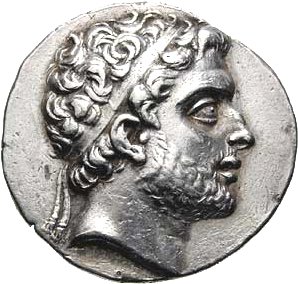 Philip V of Macedon
 Alexander The Great King of all Hellenes


