Tuesday, April 29, 2008

Episcopal Basilica ( 6th-4th cent AD), the oldest Greek Christian church in FYROM


Summary

The Episcopal Basilica is one of the greatest and most elaborate late Classical sacral buildings of the archaeological site of Stobi. It was erected on the eastern part of the main street -Via Sacra. In this location, the remains of two buildings, known as the Old and the New Basilica, built and reconstructed in several phases between the 4th and the 5th century AD, were excavated.

The Old Basilica is probably the oldest Greek Christian church discovered on the territory of the FYROM.

The basilica was constructed during the ministry of the bishop Budios, present at the First Ecumenical Council in Nicea in 325.

The Old Basilica is a three-aisled building. Fresco paintings as well as the geometric and floral pavement mosaics date from the first construction period. The second construction phase, dating back to the first half of the 5th century, corresponds to the ministry of the Bishop Eustathios.

The remains of the fresco paintings decorated with the monograms of Christ and the Bishop Eustathios, and the mosaics in the nave, date from the same period.

At the end of the 5th century, the New Basilica, significantly larger, was constructed four meters above the level of the earlier church. Parts of walls adorned with gold mosaics, the remains of a crypt in the apse, and the columns date from the first construction phase.

An inscription describing the Bishop Philippos as the patron of the church, situated above the entrance of the nave, dates back to the second construction phase, around 530 AD.

The New Basilica ceased to function in the second half of the 6th century, after a catastrophic earthquake, which destroyed the city.


Greek Fresco

Much of the fresco that stood in the northeast conch has now been mended (FIG. Below).


The later design was a Greek cross with loops at the ends of each arm on the left and a still unidentified object on the right; the cross is yellow brown. Figures of the earlier composition can be seen in the center and on the right where the later lime wash is not so fully preserved. It is of interest to note that the human (or saintly) figures seem to be related to a slightly different "vertical" than the later designs. A closer look at the earlier figures is rewarding (FIG. BELOW).


A face in three-quarters view was partially obscured on the left by a face in full-frontal position, a startling but effective method for showing perspective. We have noted elsewhere that different sizes of figures were also employed to aid perspective.
The Greek letters ΛAOC above the figures to the right also belong to the earlier composition.
They could be a complete word in themselves ("people"), or perhaps were the last letters of the name of a saint (e.g. NIKOLAOS-ΝΙΚΟΛΑΟΣ ).
Hopefully, the beginning of the text will be found preserved when we eventually remove the late coating of lime wash on the left of the conch.

Greek Inscription

The Episcopal basilica dedicated by Bishop Philippos stood above the ruined early Roman theater from which many of the marbles used in the construction of the church were taken.
Its western entrance was from a paved and colonnaded street leading into the heart of the city from the Porta Heraclea.
The irregular, almost triangular form of this end of the basilica where the atrium was located was appar- ently the result of construction within space already clearly defined, chiefly by the street itself.The name is preserved on the lintel of the central doorway between the narthex and the nave.
The inscription in Greek reads:
source
  1. Excavations at Stobi, 1970, James Wiseman and Djordje Mano-Zissi, American Journal of Archaeology, Vol. 75, No. 4, (Oct., 1971), pp. 395-411, Archaeological Institute of America
  2. Excavations at Stobi, 1973-1974 by James Wiseman and Djordje Mano-Zissi , Journal of Field Archaeology, Vol. 1, No. 1/2, (1974), pp. 117-148, Boston University


Sunday, April 20, 2008

CYRIL AND METHODIUS: THE GREEK APOSTLES OF THE SLAVS


In 826 or 827 there was born the greatest son(s) of Macedonia since Alexander the Great. Indeed if we consider the in­fluence of his work through the centuries he may be coun­ted greater than Alexander, though his weapon was the pen and not the sword. Constantine and Methodius were the sons of a military officer in the province of Thessalonike.

Methodius was born about 815, and after an education in Thessalonike he entered the civil service and was appointed governor of a district in Macedonia. The younger son Con­stantine born 826, also studied in Thessalonike. Soon, about 843, he felt the call of learning — his biographer recounts that he found the education he could obtain in Macedonia did not fit him to read Gregory of Nazianzos with full understanding — and went to the capital. There he studied under Photios and Leo the Mathematician. As Leo had been metropolitan of Thessalonike from 839 to 843, it may well have been this enlightened prelate who en­couraged the young man to move to Constantinople. He proved a brilliant scholar, and became private secretary to the patriarch and later professor in the newly founded uni­versity, teaching probably rhetoric. He had a talent for languages, and in 855 was a member of a mission to Caliph Mutawakkil to arrange an exchange of prisoners. In 860-61, he was sent, along with Methodios, who had by now become a monk, via Kherson in the Crimea to the capital of the Khazars on the Caspian Sea. There, we are told, he engaged in learned debate with the Jews of Khazaria. On the way there he had discovered at Kherson the alleged relics of St. Clement of Rome. In the year after his return from Khazaria king Rastislav of Moravia sent an urgent request to the emperor Michael III for religious teachers.

German clergy were conducting missionary work in his country, and he was anxious not to see it become a German dependency. The emperor and his advisers welcomed this opportunity to assert Byzantine prestige and authority in central Europe. It was to Constantine and Methodius that they turned. Both were by now prominent men in Byzantine life — Methodios was abbot of an impor­tant monastery — and had wide diplomatic experience. There was a further reason for the emperor's choice: the brothers knew perfect Slavonic.

Soon the brothers set out for distant Moravia. From then on their story belongs to world history. Constantine — who changed his name to Cyril on becoming a monk — and Methodios became the Apostles of the Slavs. They provided not only an alphabet and translation of the Bible and liturgical texts for their proselytes. They created for the Slavonic peoples a literary language and gave them access to the heritage of Greek and European culture.

The account given in the biographies of Cyril and Methodius cannot be wholly believed. The Slavonic alphabet was a marvel of phonological analysis, and can scarcely have been invented in a few days. And the working out of the abstract and technical vocabulary needed to translate the Bible and theological texts demand­ed many years work. It is reasonable to suppose that Cyril and Methodius had for long been consider­ing the problems of evangelization of the Slavs in their native Macedonia, and had come to the conclusion that it was possible only through the Slavonic tongue. Cyril was an accomplished linguist, and Methodius had long experience of governing a predominantly Slav population. They may also have had in mind the eventual conversion of Bulgaria, which in fact took place a few years after they left for Moravia.

A modified form of Cyril's alphabet is still in use from the Arctic Ocean to the Greek frontier and from the Baltic to the Behring Strait.

His mortal remains lay in the crypt of the Church of Saint Clement in Rome until 1975, when they were transferred to the church of Saint Demetrios, Thessalonike.

Disputes of the Saints origin

The conversion of the Slavs to the christian faith through the Greek Orthodox Church was done during the 9th century by two Greek Thessalonian monks named Cyril and Methodius. They taught the Greek based Cyrillic script to the Slavs and enlightened them regarding religion. The cultural history of the Slavs, founded on Byzantine Christiano/Hellenic culture, begins from this period. Even this event which affected almost half of the inhabitants of Europe, including the eastern and southern Slavs, owes its existence to Macedonia, to the Greek Macedonian monks and to the Byzantine Greek culture.

As Marcus Templar mention that term “Slav Apostles” or the “Apostles of the Slavs” does not mean that the two brothers were Slavs. St. Thomas is called “the Indian Apostle,” but we all know that he was not an Indian. He simply taught Christianity to the Indians. The Greek brothers from Thessaloniki taught Christianity to the Slavs, they gave them the alphabet (presently called Cyrillic), and they translated the sacred and liturgical books of Christianity into the Old Church Slavonic, otherwise known as Old Bulgarian.

Slavmcedonians of FYROM maintain a strange untruthful theory, that is, that Cyril and Methodius as Thessalonians were Slavs and consequently, the FYROM Slavs as descendants of the Macedonians enjoy the privelege of having enlightened their compatriots.These theories received a powerful slap from the Slav Pope John Paul II, who on the 31 of December 1980, and through an official apostolic cirgular ( Egregiae Virtuis ) addressed to the entire catholic church, as well as with a letter to the President of the Greek Republic, Constatine Karamnlis, proclaims that Cyril and Methodius , ' brother Greeks, born in Thessaloniki' are consecrated 'divine protectors of Europe'.

The Pope repeated his proclamation on the 14th of February 1981 in the church of Saint Celemens in Rome.The Pope apart, other Slavs, politicians and historians accept the Greekness of Methodius and Cryil. For example, the Czech Byzantinist Fr. Dvornik, the Serb historians of ancient Serbian literature, P. Popovitch, Dj. Sh. Radovich and Dj. Trijunovich.

Also the Slovenian historian and professor of the University of Ljubljana, B. Grajenauer, and the Serb Professor V. Bogdanovich who in his opus The History of Ancient Serbian Literature writes: " Cyril and Methodius were born in Thessaloniki and in their lineage they are not Slavs but Greeks."

Bulgarian Professors Ivan Lazaroff, Plamen Pavloff, Ivan Tyutyundzijeff and Milko Palangurski of the Faculty of History of Sts. Cyril and Methodius University in Veliko Tŭrnovo, Bulgaria in their book, Kratka istoriya na bŭlgarskiya narod (Short History of the Bulgarian Nation, pp 36-38), state very explicitly that the two brothers were Greeks from Thessaloniki.

The late Oscar Halecki, Professor of Eastern European History, in his book Borderlands of Western Civilization, A History of East Central Europe (chapter Moravian State and the Apostles of the Slavs) agrees with the authors of Kratka istoriya na bŭlgarskiya narod.

The falsification of Macedonian history until World War II was mainly the work of Bulgarian historians of the pre-war regime. This line was followed even after World War II by the Bulgaro-Macedonians of America, with the result of creating sharp conflicts between themselves and our compatriot immigrants of Macedonia.

sources

  1. Helen Ahrweiler in the Volume "Macedonia: 4000 years of Greek History and Civilization"
  2. The Falsification of Macedonian History by Nicholas Martis
  3. Byzantine, Slavs and Mount Athos, by Tachiaos
  4. Fallacies and facts on the Macedonian Issue by Marcus Templar

Saturday, April 12, 2008

Frequently Asked Questions on Byzantine Macedonia, Part 1

Q1 ) FYROM Skopjans accuse us Macedonians in Greece of changing the names of our cities into Greek ones some time in the 20th century instead of using the slavic names assigned to these cities since "ancient" (sic) names. They claim that Edessa for example should not be called so but VODEN instead, and Thessaloniki should be called SOLUN.

Cities in Macedonia, the ancient kingdom and the province of Greece, still have the names they had in antiquity, at least for the cities that existed at that time. The names of some of these cities may not be even of Greek origin, thus showing that Skopjan claims are not only false but at least silly or absurd.

The Skopjans claim that the Macedonian city of Edessa in the Pella prefecture of Macedonia, Greece, should not be called so but Voden instead. They also claim that we Macedonias changed the name of the city from the slavic one "VODEN" into the "greek" one EDESSA. The city of EDESSA has been called so since prehistoric times. It is amusing to point out that many believe the name Edessa is not of Greek, but possibly of phrygic origin denoting a place rich of waters. Edessa has always been famous of her waterfalls. Others may claim that the suffix "-dessa" may indicate 'water' in some prehistoric form of the greek word (GK:YDVR) for water. This connection of the name 'EDESSA' with 'water' had confused many historians until 1976. They used to believe that Edessa was ancient Aegae, the royal city of the Macedonian Kings. They thought that the word 'Aegae' was derived not from the word 'aega' (she-goat) as this is related with the myth of the creation of the Macedonian state by Karanos, but from the doric prefix Aeg- denoting 'water' (cf Edessa). In Doric, 'aegae' means '(water) waves' (The 'Aegean Sea' is an obvious example). Given that both names Edessa and Aegae have to do with 'waters' archaelogists thought that Edessa=Aegae.

This argument was put in rest by Nicholas L. G. Hammond in 1968 when he suggested that Vergina and not Edessa was the ancient Aegae, a correct assertion as it was proved in 1976 by the excavations of M. Andronikos in Vergina. Though Vergina is not on the sea shore of Thermaikos Bay it is believed that in the BC centuries the present lands separating Vergina from the sea were wetlands.

It is noted that the slavic word VODEN also denotes 'water'. It is also worth mentioning that the city of Skopje whose name is probably derives from the greek one 'Skopia', was invariably called 'Uskub', 'Skupoi', 'Skup', 'Skopje', and as of few years ago 'Skoplje'.

Another Example is the city of Kastoria in Western Macedonia, Greece. Skopjans prefer to call it Kostur and suggest that Greeks should call it so. The name of the city 'Kastoria' comes from the mythical hero Kastor (Castor) brother of Polydeukes, son of Leda and Zeus.

Regarding Thessaloniki (called Salonica or Saloniki also in English) if one opens an ancient map he will realize that the name of the city has been Thessaloniki and not Solun (as Skopjan suggest that we should call the city) since ancient times.


Q2) FYROM Skopjans claim that when Slavs descended to the Balkan peninsula, in the 7th century AD, Macedonians vanished and there was a kind of 'slavicization' of Macedonia which 'gave birth' to the "Slavic-Macedononians" as Skopjans claim they are (at least some of them), the supposedly deserved ancestors of ancient Macedonians. Are such claims true say up to 15th century AD?

The distinction between Macedonians, Thessalians, Athenians, Spartans and Lacaedemonians in antiquity which indicated among other things greek tribes of distinct customs, spoken dialects ceased to exist with the passage of time. As of the hellenistic period almost all Greeks were using the attic dialect for their communication while all the other dialects (of greek) were dropped from regular use. The rise of Christianity erased distinctions based in religious matters and the place of residence was then used distinguish say Thessalians from Macedonians and Athenians. Their common greek dialect (the attic one) though evolved differently in various regions thus giving the various dialects of modern greek.

To say that Macedonians vanished some time in the 7AD century is to claim that the Greeks (many of them ancestors of doric people called Macedonians, other possibly ancestor of other aeolic, doric or ionic people, others of mixed parentage) residing in Macedonia were all killed at that time, an absurdity.

Around 688, emperor Justinian B', after the defeat of the Bulgars and Slavs in lower Moissia transferred all the Slavs in the northern european part of his empire (that is of Macedonia and Thrace of nowadays Greece and territories covering the Rep. of Skopje, Albania and parts of Bulgaria) to Asia Minor. These were estimated to be 80,000 but probably were more than that since two years later the emperor preparing for a war against the Arabs conscripted 30,000 men from this population to his army. These Slavs subsequently switched sides and supported the Arabs. The emperor for retribution killed all the remaining Slavs in Asia Minor.

About one hundred years later, in 773AD, the Bulgarian population in the Balkans was reduced after repeated defeats in battles with the Byzantine emperors. When the Bulgars decided to strengthen their army and find new recruits they marched to Thessaly, since there were no Slavs in Macedonia, to capture a small Slavic tribe living there. On their way there they were annihilated by the Byzantine forces. In the next century forced movements of Slavic populations from Greece to Asia Minor continued.

The conclusion is that the Byzantine emperors did everything possible to clear up the northern territories (including Macedonia and Thrace of modern day Greece) of their empire of Slavs.
Various non-Greek sources indicate that not only Macedonia of modern day Greece but also Rep. of Skopje (the latter, if not entirely, at least predominantly) were Greek till the late 15th century AD.

C. Jirecek, in "Geschichte der Serben" claimed that Macedonians were always Greek and all the area south of the line defined by the cities Achris-Skopje-Nissa-Sofia-Aimos-Messimbria was greek (an assertion also confirmed by other authors such as Th. Mommsen, A. Karnach).
Hertzberg (in "Geschichte Byzantinissen") (Vol B, Book A, Chapter Gamma, page 184, 1906 edition). said that in 1282, the population below the line Euxinus Pontus-Aimos-Kustendil-Skopje-Skutari was Greek, in tongue, in customs and working for the greek interests.
One can then wonder when the Bulgarian idiom spoken by the Skopjans was in use say in the lands of nowadays Rep. of Skopje, let alone in antiquity [since Skopjans claim that the Slavic idiom spoken by the Slavs who descended to the Balkans in the 7th AD century was used by the ancient Macedonian 1000-1500 years earlier!].

The French historian Haumant, in "La formation de la Yugoslavie", mentioned that in the 13th century the area from Prisreni to Nissa was empty of people. If there were no Slavs there, then how and when the "Macedonians" of Skopjan type appeared in Macedonia and the Republic of Skopje? This is the reason Albanians (70%?) occupy the region of Cossyphopedio (Kosovo).
Hertzberg, in "Geschichte Byzantinissen", mentioned that when in the 14th century Dushan shared his kingdom with his son he kept the greek area south of Skopje and gave his son the northern Serbian areas (this is also confirmed by a Czech historian, Jirecek). All his orders were then written in Greek and not in any idiom like the onenow spoken in the Republic of Skopje. In 1350 when John Katakouzenos was in the city of Verhoia representatives of all big greek cities (Skopje included) visited him and asked for help. Jirecek mentioned in his book that at this time Skopje was a greek city inhabited mainly by Greeks despite being part of the Serbian kingdom for more than a century. Following Dushan's death around 1355 his son's empire began to collapse. Dushan's brother, Symeon, proclaimed himself an emperor and accorded himself the surname of "Palaeologos" in an attempt to gain the favor of the Greek population of his kingdom(empire). He also wrote his orders in Greek (and not in any strange called slavic idioms).
Soon the Greeks gained the control of the garrisons of various greek cities (such as Verhoia, Edessa, and Skopje). Officials in Dushan's empire quickly abandoned these greek cities and moved to Prisreni and later to Krusevach. The greek inhabitants remained in the areas they had been living for many centuries, if not millenia.

Since even in the years of Dushan, when the slavic influence and control in the areas of Macedonia(Greece), western part of Albania, Republic of Skopje and Yugoslavia (Serbia+Kosovo) was at its peak Macedonian Greeks were not "slavisized", how was that possible under the Ottoman rule, when after the defeat of Serbia by the Ottomans circa 1459, the Slavs migrated to the north and the area south of the city of Skopje was inhabited by Greeks only? If the strong presence of Slavs at that time didn't cause the Macedonians to vanish how was that possible to happen before? How come the vanished Macedonians of 7th AD survived as late as 15th AD? and later?

Q3) Was the Bulgarian King Samuel of FYROM Skopjan nationality as some Skopjans claimed he was?

Skopjans in order to by-pass the now established truths about the greekness of the ancient Macedonians and build a future for their so-called "macedonian nationality" and acquire historical rights to the Macedonian area claim that the infrastructure and population of the kingdom which Samuel established for a period of close to 18 years with the city of Achris as its capital was "Macedonian" (of the Skopjan type).

They also claim that Samuel was also a "macedonian" (of the Skopjan type) even though certain historias today believe that he was an Armenian. They also claim that Samuel as a ruler of a state that also included Macedonia was himself a Macedonian and that the state he established was the first "Macedonian state" (of the Skopjan type). Regarding Samuel, he was a Bulgarian king and not a "Macedonian" one, and the state he founded was a Bulgarian one as well. It is for this reason that the emperor Vasileios II of the Byzantine empire, who defeated Samuel, is known in history as Vasileios the Bulgar-slayer and not as Vasileios the "macedonian"-slayer.

This fact is supported by historians such as Vasiliev and Levtchenko.

There is another piece of evidence which shows that the Skopjan claims that Samuel was a "Macedonian" are ridiculous. An inscription from the city of Monastirio dated 1017 has been preserved where John, nephew of Samuel and son of his elder brother Aaron is mentioned to be of Bulgarian descent. This inscription has been published in the book written by Gordana Tomovic "Morfologija Cirilickin Natpisa na Balkann", Belgrade, 1974, page 33.

It is worth mentioning that the area of Achris ws inhabited in the Roman and Byzantine periods by Greeks. The book "The tombs of Trebenitse" by Keramopoullos (page 490) shows inscriptions from that period referring to persons with Greek names only. On one inscription the God of Lychnetis was Heracles Megistos.

Friday, March 28, 2008

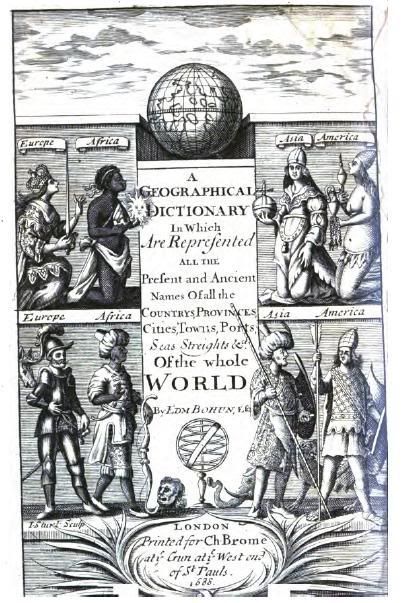
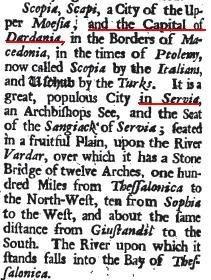
Geographical Dictionary by Edmund Bohun, published in 1688


Geographical Dictionary, In which are represented all the present and ancient names of all the Countrys (sic), Provinces, Cities, Towns, Ports, Seas Straights of the whole world", By Edmund Bohun, published in 1688.
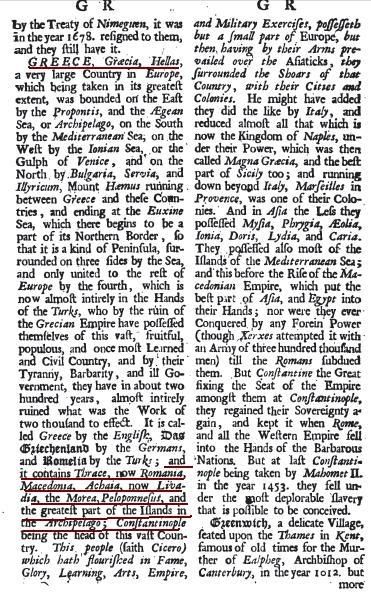
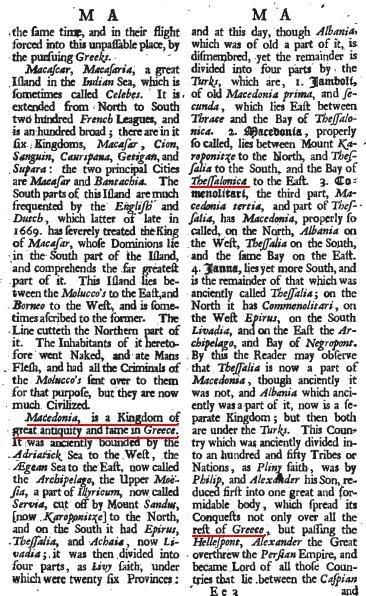
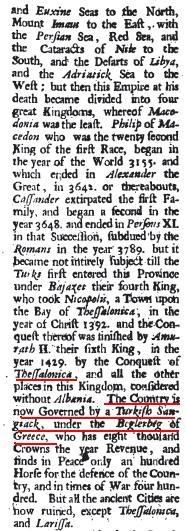
Lets have a look at the definitions of "Greece", "Macedonia" and "Scopia" as defined by the contemporary writer.

GREECE


MACEDONIA.....is a kingdom of great antiquity and fame in Greece


THESSALONICA


SCOPIA....the Capital of Dardania


by Chris Filippou

Friday, March 21, 2008

Peter Green, Ernst Badian, Eugene Borza e.t.c. never had the ability to ANSWER in .....

simples questions or doubts. These doubts can be repudiated by the following remarks:
  • IT IS DIFFICULT TO BELIEVE THAT, AT THAT TIME, A GREEK ROYAL HOUSEHOLD WAS IN A POSITION TO conquer and rule over an alien people which spoke a different language, while surrounded by a local military aristocracy-also speaking a different language-which never desired to remove the foreign ruler, It is not only nalve to accept such an idea, it would also compel us to accept a fact for which one could not easily supply an analogy from some other country.
  • EVEN IF WE DO ACCEPT THIS RATHER IMPROBABLE FACT, WHAT SHOULD HAVE HAPPENED AS A NATURAL CONSEQUENCE WOULD HAVE BEEN THE LINGUISTIC ASSIMILATION OF THE GREEK ROYAL HOUSEHOLD BY ITS SUBJECTS, AND NEVER THE REVERSE. What always happens in the history of the nations is the linguistic absorption of the foreign rulers by the local people.Even when the rulers comprise an entire nation , it is sufficient for them to be less in number.
  • EVEN IF THE MACEDONIAN KINGS DID IMPOSE GREEK ON THEIR SUBJECTS AS A FOREIGN LANGUAGE, IT WOULD HAVE BEEN IMPOSSIBLE FOR THE PEOPLE TO LEARN IT SO QUICKLY, AND NOT TO PRESERVE ,THEIR OWN LANGUAGE SIDE BY SIDE WITH IT, which, as we know today, always happens in such cases, and impossible also for such a thing to escape the attention of Titus Livy, the Roman historian, who mentions that in the 3rd century B.C. the Macedonians spoke the same language as the (Greek) Aetolians and Acarnanians

These observations very much discredit any suspicion that the Greek kings of Macedonia could have made Greek speakers of a foreign people at such an early period, when there existed neither schools, nor printing, nor church.
What would be able to dispose conclusively of this idea would be nothing other than a text written in the ancient Macedonian dialect-i.e. the dialect which the Macedonians spoke before they supposedly became Greek speakers, but unfortunately this does not exist.

All the ancient inscriptions from the depths of the Macedonian earth which have come to light under the archaeologists trowel belong to the era when the Macedonian kings had already made Attic the official dialect of their nation. To date, it has not been possible to find anywhere an inscription, even of one single phrase, written before the 5th century B.C.; that is to say, before the time when the Macedonians supposedly became speakers of Greek.

How are we to explain this?

IT IS ENTIRELY IMPROBABLE THAT THE MACEDONIANS DID NOT WRITE IN THE 6TH CENTURY B.C., SINCE THE GREEK SCRIPT WAS BY THEN ALREADY KNOWN TO PEOPLES FURTHER TO THE NORTH OF THEM. it her, therefore, the old Macedonian inscriptions were all carved onto some perishable material and have disappeared without trace in the passage of time; or we must keep hoping that somewhere, they too await the archaeological pickaxe or the farmer's plough to drag them into the light of day.

MACEDONIANS had only GREEK names and spread GREEK civilization ONLY.

Is that Hellenization ?

if yes I challenge to ANYONE to show me any NOT GREEK that spread from the MACEDONIANS ?

Saturday, March 15, 2008

Frequently Asked Questions on ancient Macedonia, Part 2

Q9) "Hellas" and "Macedonia". When was the first time that the word Hellas was used to describe the country inhabited by people belonging to Hellenic (greek) tribes?

Although the words Hellas and Hellen (and the other two English equivalents Greece and Greek) have been used to describe the country and the people of modern day Greece, their use in ancient times differed in various periods of time.

The usage of these words to describe the various hellenic tribes as a whole was unknown to the people of the Homeric poems. In Iliad, the words Hellen (Gk: ELLHN) and Hellas (Gk: ELLAS) defined a small greek tribe and the land inhabited by them in Thessaly. (Iliad B' 683)
"OI T' EIXON FUIHN HD' ELLADA KALLIGYNAIKA, MYRMIDONES DE KALEYNTO KAI ELLHNES KAI AXAIOI".

At some earlier line (B' 530) there is a reference to the word "PANELLHNVN". This word since the time of Aristarchos has been considered to be absent in the original poem and was added at some later time.

Plutarchos (Lykourgos 6) wrote about the message brought from Delphoi to Sparta by Lykourgos "DIOS (S)ELLANIOU KAI AUHNAS (S)ELLANIAS IERON IDRYSAMENON...". Because of this reference, it is believed that the words "Hellas" and "Hellen" became more widely used after the dispersion of the Dorians. It is also possible that they were sacred words possibly related to the (S)elles priests of the Dodonian Zeus.
[the parenthesized (S) is to mean that the S say in the word SELLANIOY was later dropped from use thus giving ELLANIOY.]

The words Hellas and Hellen became more widely used some time in the 8-7th century BC and in the 5th century BC we find the first references of them to describe the lands and the Greek people living south of river Peneios. In the 4th century BC and later they were also used to describe the various hellenic (greek) tribes as a whole. The passage from Herodotos (I,56), mentioned in a number 8 question indicated another use of these words, that of distinguishing Ionian Greeks from Dorian Greek.

Since the Macedonians were pretty much isolated from the Greeks of Southern Greece up to the early 5th century BC, the words 'Hellas' and 'Hellen' were not used by them to describe collectively the lands of various hellenic tribes, as this was also true for all the other greek tribes until the 8-7th century BC.

Hence when the Macedonians initiated contacts with other Greek tribes they continued to use the word 'Macedonian' to describe themselves instead of the collective 'Hellen(es)'. This is the reason various authors (such as Isocrates, Philippos 154) use the term "Hellenes" and "Macedonians" on the one hand and 'barbarians" on the other to distinguish the greek tribes (of Macedonians and other Hellenes) from the non-greek ones (barbarians).

The intellectual Athenians of the 4th century gave yet another definition for the word "Hellen" (Isocrates, Panegyrikos 50), that of the person having an Athenian educational background, "... the name 'Hellenes' suggests no longer the people but an intelligence, and that the title 'Hellenes' is applied rather to those who share our [note: the 'our' refers to the Athenians] culture than to those who share a common blood".

It is also believed (N.G.L. Hammond,page 6) that the distinction made by authors of Macedonians and Hellenes differentiates only the descendants of Hellen from the descendants of Thyia, as in the genealogy provided by Hesiod. According to Hesiod, Deucalion had a son Hellen and a daughter Thyia. The ancestors of Hellen were Dorus, Xouthus (whose son was Ion) and Aeolus. Thyia had two sons Magnes and Macedon. According to Hellanikos on the other hand, Macedon was a son of Aeolus.

Q10) Was the Macedonian tongue a greek dialect or not?

Yes it was a greek (doric) dialect.

We shall break this discussion into two parts. The first one consists of evidence found prior to the excavations in Vergina by the late Professor Manolis Andronikos. The second one consists of evidence found mainly since then. This evidence leads beyond any doubt to the conclusion that the Macedonians spoke a greek dialect which was basically a doric one, it borrowed words and was influenced by the aeolic dialect spoken by the Thessalian neighbours of Macedonians, and also borrowed few words of Phrygic and Illyrian origin.

The Thessalian (aeolic) influence convinced some researchers that the genealogy of Makedon given by Hellanikos (see Question 3) was more accurate than that given by Hesiodos.

In the volume "Macedonia: 4000 years of Greek history and civilization" Professor M. Sakellariou examined the words known to be unique in the macedonian dialect of greek and related their root to the roots of words of other Greek dialects. Summarizing, many of the words that were previously considered of non-Greek origin were also in (rare) use in other parts of Greece.

There have been made various claims that the Macedonians up to some time in the 4th century BC used to speak a non-Greek language and at that time (around 340BC) were 'hellenized' by the Athenians and thus learned how to speak the attic dialect. These claims can be easily proved to be totally false even if one uses only pre-Vergina evidence.
Below we present various views on the topic.

Pre-Vergina evidence.

Fr. Sturz (in "De Dialecto Macedonica et Alexandrina", 1808) concluded that the Macedonian tongue was a greek doric dialect. August Flick, O. Hoffmann, Otto Abel, and Karl Belloch, as well as Georg Busolt, Fritz Geyer, Ulrich Wilcken, Helmuth Berve, Gustave Glotz, P. Roussel, P Pouquet, A Jarde, R Cohen, J. Bury, St. Casson, W. Heurtley, D. Hogarth, J. de Waele, just to name a few (non-Greek) historians and archaeologists, shared the same views.
On the other hand, there were some historians and writers such as M. Vasmer (Revue du ministere d' instruction publique de Russie, 1908), P Kretschmer and Bulgarians G. Kazarow and Vlad. Georgiev that rejected this thesis. Georgiev attempted to show that Macedonians were member of a Thracoillyrian nation thus speaking illyrian, a non-greek language. That this was not the case was shown in Question 6. G Weigand also shared the opinions of these authors. G. Hatzidakes rejected these theses in various texts and among them in "Zur Abstammung der alten Makedonier (eine ethnologische Studie)". For more details we refer to Daskalakis (page 104).
Coins found in Macedonia have inscriptions in greek and are dated from the early 5th BC century. Such found coins are the following ones.
  • An octadrachm of Alexander I (circa 478BC).
  • Coins from the reign of Archelaos (413-399BC) and Amyntas III (393-370BC).
  • the ring of Sindos with the word Gk:'DVRON' (Gift) dated around 480BC.

These coins are dated well before 340BC, the time of the alleged "hellenization" of Macedonians.
Macedonians had their own month names. If one accepts the thesis that Macedonian were 'hellenized' by the Athenians some time around 340BC hen one can safely assume that these names must be identical to those used by the Athenians. If not, they would show the linguistic roots of the Macedonians prior to their alleged who claimed that Dorians and Macedonians belonged to the same tribe (Herodotos claimed that the Macedonians who descended to southern Greece after crossing Doris became known as Dorians) and thus Macedonians were a Greek tribe, the month names of Macedonians were Greek and were different from the ones used by the Athenians. The list of these names used by the Macedonians and the list of month names of the Lacedaemonians (who were Dorians) have a common intersection, the names Artemisios and Apellaios.

Persians when first occupied Macedonia during their conquests in Europe around 510-480BC described the people living in Macedonia as "The Greeks wearing a shield-like hat" and who were non other than the Macedonians themselves. This incident occurred long before the alleged "hellenization" of Macedonians.

It is believed that the worship of the 12 Olympian Gods had started in Macedonia (as related to their place of "residence". Mountain Olympos is located in Pieria and both these names are Greek. It is claimed the magnificent view of Mt. Olympos when viewed from Macedonia, while its view from the south (Thessaly) is hindered by other mountains, inspired the Macedonians and from the the other Greeks to consider this mountain the residence of their Gods.
Athenian comedies used to make fun of the idioms and the dialects of other Greeks like those of Spartans, Boeoteans and of course Macedonians. Some time in the 5th century BC a comedy entitled "Pausanias or Macedonians?" written by the Athenian Strattis was played in Athens. In various parts of this comedy a Macedonian explains how various words of the attic dialect are called in the Macedonian dialect.

It can be inferred from these references that Macedonians spoke a Doric greek dialect. In a work of the ancient writer Athenaios, one can find samples of the work of Strattis. In an article written by A. Koerte quoting Athenaios VII,323b we can find in that comedy of Strattis the following conversation:

"STRATTIS GOYN EN MAKEDOSIN EROMENOU TINOS ATTIKOY VS AGNOOYNTOS TO ONOMA KAI LEGONTOS: H SFYRAINA D' ESTI TIS;" FHSIN O ETEROS " KESTRAN MEN YMMES VTTIKOI KIKLHSKETE".

In English (as it appeared in the article by M. Sakellariou) an Athenian asks "sledfish, what do you mean?" and a Macedonian replies "wha ye Attics ca' a hammer-fush, ma freen" i.e. in my own words, which i hope do not change the meaning of this phrase "what you Attics call a hammer-fush, (we call a) freen".

One can appreciate the value of the Macedonian's reply for the object under discussion if he does not forget that as is clear from many passages in Aristophanes the attic comedians made their non-Greeks speak broken Greek with an a mixture of barbarian words (some of them imaginary) while Lacedaemonians, Boeotians, Macedonians and other Greeks spoke their own dialects. The Macedonian's reply is in good Greek with dialect (ymmes, sfyraina) and archaizing elements (kiklhskete). Both YMMES and SFYRAINA are not attic words but they are Greek. Therefore claims that Athenians "hellenized" Macedonians seem to be baseless. It is also noted that these words were used by the Macedonians some time in the 5th century BC that is at least 50 years before their alleged hellenization.

An ambassador from Macedonia speaking to the Aetolians in 200BC observed that the Macedonians, the Aetolians and the Arkanians all spoke the same language.
The expressions "aneboa makedonisti", "makedonisti th fvnh" have been taken by opponents of the thesis that the Macedonians were Greeks as indicating that their language differed from Greek. One can claim that these formulation indicate a Greek dialect (cf [In Greek] "aiolizein th fvnh", "attikizei", "attikisti", "boivtiazein","dvrizein" etc).

To those who are more interested in the characteristics of the dialect of Greek spoken by the Macedonians the article by M. Sakellariou in "Macedonia: 4000 years of Greek history and civilization" is available on request. In general few words of non-greek origin were used in the Macedonian dialect of greek an most of these words were proper names. Some of them were names of Egyptian deities worshipped in Macedonia after the 3rd century BC. Even in the times of Herodotos (II 153, III 27, IV 155, VI 27) barbarian (non-greek) names were in use by Greeks. Strabo VII 7,1 (C321) also mentioned various names of non-greek origin such as KEKROPS (Greek: KEKROC) KODROS, AIKLOS (Gk: A.I.KLOS), KOTHOS (Gk: KOUOS), DRYMAS (Gk: DRYMAS) KRINAKOS (Gk: KRINAKOS).

It should also be mentioned that many place-names in ancient Macedonia (and modern-day Macedonia of Greece) are of Greek origin and of use in other areas of Greece as well. Such names are: Argos (Gk: ARGOS), also found in Thessaly and Peloponnesos. Arnissa(Gk: ARNISSA) reminds of Arnen (Gk: ARNHN) of Thessaly and Boeotia. Arethoussa (Gk: AREUOYSSA) also found in Ithaca, Boeotia, Syracuses. Prasias a lake and a city name is also found in Athens as PRASIAI, and many other ones (such as Oedomenae, Petra, Fila, Gortynia, Pynda etc).
Many other words of the Macedonian dialect are of ancient doric origin such as [the macedonian-doric and attic equivalent names are shown in Greek only]: santoria = svthria, zereuron = bereuron, barauron xarvn = xairvn arkon = argos dvraj = uvraj danon = uanon , uanatos kadaron = kauaron sarisa = dory (from the verb sairv, sarvnv) etc. Some other words of the macedonian dialect of greek can be traced back in the Homeric poems: amalos = apalos indea = meshmbrian ( indion hmar) leykanih = laimos lisson = omalon , leion (lygos = rabdos).
Fore more details see the work of Geyer Fr., where he showed that the names of macedonian months and festivities although they could not be found anywhere in classic Greece were archaic Greek ones and showed the doric origin of the Macedonians.

The fact that Macedonians participated in various celebrations like the Amphictyonies and the Phocica also show the belief of themselves and the other Greeks in their origin. It is for these reasons that Professor F. Papazoglou in "Historija Hellenizma", Belgrade, 1967 claimed that Macedonians were Greeks, a claim also supported by Heinz Kreissing in "Povijest Hellenizma", Zagreb, 1988.

Prof. Arnold Toynbee in "The Greeks and their Heritages", Oxford University Press, 1981 also claimed that ancient Macedonians were Greeks.

Post-Vergina evidence.

The excavations in Vergina have brought to light many tombs that buried ancient Macedonians. There are inscription on these tombs with the names of the deceased person and those of his/her progenitors. All names found so far have been Greek. Given that some of these tombs are dated from the 350BC era, one can conclude that by some time in late 5th century Macedonians have been naming their children with Greek names. And since contacts with the Athenians were rare to non-existent at that time one can safely conclude that claims that Macedonians were not Greeks and were only 'hellenized' in the 4th century BC are false.
Published information on the excavations in Vergina is mostly in the form of papers submitted to various conferences.

Q11) "ANEBOA MAKEDONISTI" ?

Those who claim that the Macedonians were not a Greek tribe considered this expression as evidence that the language of the Macedonians was a non-greek one. Previous questions (Question 10) discussed the refutation of this thesis in more detail. A discussion of this phrase only will be dealt here. It is based on that of the book by Daskalakis (see references).
The expression "ANEBOA MAKEDONISTI" was first found in the works of Plutarchos (ALEXANDORS LI, 4) and that of the Latin Kurtius Rufus. The phrase is found in the following passage [ In Greek: ]

"TVN DE SVMATOFYLAKVN ENOS, ARISTOFANOYS, FUASANTOS YFELESUAI, KAI TVN ALLVN PERIEXONTVN KAI DEOMENVN, ANAPHDHSAS (cf Alexandros) ANEBOA MAKEDONISTI KALVN TOYS YPASPISTAS (TOYTO D' HN SYMBOLO UORYBOU MEGALOU), KAI TON SALPIGKTHN EKELEYSE SAHMAINEIN, KAI PYJ EPAISEN, VS DIATRIBONTA KAI MH BOYLOMENON..."

On the other hand Arrhianos, whose sources included lost works of Alexander's co-fighters and eye witnesses, describing this episode that resulted in the death of Kleitos used the following phrase: " ALEJANDROS DE EBOA ANAKALVN TOYS YPASPISTAS". No reference to MAKEDONISTI appeared in Arrhianos' version of the episode. This may lead to the conclusion that the word "MAKEDONISTI" was somehow added at some later time, or the interpretation that has been given to it by some translators was not the one intended by Plutarchos. It is also noted that references to the expression "Macedonia and the other Greece" are numerous in his work.

In Plutarchos' rendition of the episode the distinction between ANEBOA (called, shouted, roared) and KALVN (calling) is evident. Given the explanatory statement "TOYTO D' HN SYMBOLO UORYBOY MEGALOY" ('this was a sign of great noise') it can be concluded that ANEBOA referred to some kind of password used by ALEXANDER the Great to call his YPASPISTAS (sort of bodyguards) in cases of emergencies only, that is why its use caused great disturbance.

The absence of MAKEDONISTI in Arrhianos' rendition seems to agree with this interpretation. Let alone the fact that following this incident Alexander talked to his YPASPISTAS in attic greek. The expression "aneboa makedonisti", if this indeed appeared in the original text, is no more different from other similar expression "aiolizein th fvnh", "attikizei", "attikisti", "boivtiazein","dvrizein" which were used to denote various dialects of ancient greek.
A Latin writer Kurtius (other than the aforementioned Kurtius Rufus) gave a description of this episode similar to that of Arrhianos. No reference to MAKEDONISTI was made by him and he only wrote "that Alexander ordered via a trumpet call his soldiers to gather outside the royal tent".

There is another passage in the work of Kurtius Rufus describing the trial of Filotas which is being used by proponents of the thesis that the Macedonians spoke a non-greek language. Allegedly Filotas during his trial used the attic dialect forcing Alexander to accuse him of not using his (Filotas's) mother tongue (macedonian, supposedly a non-greek language).

Subsequently, Alexander also accused Filotas of being unwilling to learn how to speak his mother tongue! This passage contains several contradictions notwithstanding the one that Filotas was not capable of speaking his mother tongue. Alexander on the other hand, allegedly accuses Filotas of detesting the macedonian dialect but according to Filotas' reply this accusation is spelled by Alexander in the attic rather than the macedonian dialect! This fact alone, had this episode really happened, could have been used against Alexander himself as a counter argument and accusation. It is this reference to Alexander that made H. Bardon, publisher of Rufus's works to wonder how it was possible for Alexander to fall in such a contradiction and to accuse others of something that he himself was fighting for.

Neither Arrhianos, who lived closer to the era this episode occurred, nor Plutarchos present this incident mentioned in the work of Kurtius Rufus. H. Bardon, French publisher of Rufus's works (pub. Belles Lettres vol 1 page 201 note 1) commenting on the alleged speech of Filotas said that Kurtius Rufus was accustomed to rhetoric artifices and as a result historic truth suffered in that part of his work. All in all it can be safely concluded that this passage was more of a product of the rhetoric talents of Rufus thus attributing to Filotas a speech Filotas never gave rather than presenting the actual events. Writers who lived well before Rufus and close to the time of the incident were not aware of such a speech by Filotas.

Q12) There is a reference in a work by Pausanias that may give the impression that Macedonians, around 214-213BC, were speaking a non-Greek language.

Advocates of the thesis that the Macedonian spoke a non-greek language claim that this language was spoken by them up to some time in mid 4th century BC. At that time Macedonians within few years were fully hellenized and since then they have been speaking Greek.
Long but relevant Parenthesis. Skip it if not interested: Some of these advocates accept a Skopjan point of view that all Macedonians perished and thus vanished when Slavs first appeared in the Balkan peninsula in the 7th century AD. All of a sudden these new Slavs became heir-apparents of the Macedonians, were granted presumably by Marshall Tito the exclusive right to be called 'Macedonians' and named the Bulgarian idiom also consisting of Greek, Turkish, and Albanian words formed at least 1000 years after their descent to the Balkans "the Macedonian language".

Some of them, possibly all, claim that this Slavic origin language was the language spoken by the Macedonians before the the Cyrillic alphabet was introduced to these and other Slavs along with many greek words by two Macedonian (Greek) brothers, Kontantinos (later called Cyril) and Methodios from Thessaloniki. It is quite interesting to know how these Macedonian brothers escaped the fate of other fellow Macedonians and didn't perish during the descent of Slavs in the Balkan peninsula, as the advocates of Skopjan claimed that it had happened.

According to Pausanias (Messenians IV 29, 1) the residents of Messene a night around 214-213BC first thought that the Lacedaemonians had attacked them. Later, by the arms and the voices, realized that those who attacked them were soldiers led by king Demetrios. Since at that time a Demetrios was King of Macedonia, it was assumed that the attackers were Macedonians. Some authors claimed that the 'voices' reference was to mean that the Macedonians (attackers) were speaking a non-greek language at that time, an argument not accepted for the Macedonians of that time by almost everyone.

Later on, it was realized that the Demetrios in question was not the king of Macedonia, son of Philippos E', but Demetrios the Pharian, an Illyrian, who was later killed during this campaign against Messene.

Frequently Asked Questions on Macedonia compiled by Alexandros Gerbessiotis

Wednesday, March 12, 2008

Ancient Graves Found in Thessaloniki


ATHENS, Greece (AP) -
Greek workers discovered around 1,000 graves, some filled with ancient treasures, while excavating for a subway system in the historic city of Thessaloniki, the state archaeological authority said Monday.
Some of the graves, which dated from the first century B.C. to the 5th century A.D., contained jewelry, coins and various pieces of art, the Greek archaeological service said in a statement.
Thessaloniki was founded around 315 B.C. and flourished during the Roman and Byzantine eras. Today it is the Mediterranean country's second largest city.

Most of the graves - 886 - were just east of the city center in what was the eastern cemetery during Roman and Byzantine times. Those graves ranged from traces of wooden coffins left in simple holes in the ground, to marble enclosures in five-room family mausoleums.
A separate group of 94 graves were found near the city's train station, in what was once part of the city's western cemetery.
More findings were expected as digging for the Thessaloniki metro continues. Digging started in 2006 and the first 13 stations are expected to be done by the end of 2012. A 10-station extension to the west and east has been announced.
source : ap.google.com

Sunday, March 09, 2008

Frequently Asked Questions on ancient Macedonia, Part 1


Q1) What were the borders of ancient Macedonia ?

Thucydides (II 99) defined ancient Macedonia as the area extending to the eastw as far as the lands of mountain Paggaion, east of river Strymon, to the south to the Thermaikos Bay, Chalcidice, river Pineios (the border with Thessaly) and the Kambounia mountains, to the north up to (including) the city of Pella, south of the lands of Paeonians, and to the west to the mountains (Pindos, Tymfe etc) that separate Macedonia from Epeiros and ancient Illyria (today's Albania).

Macedonia, as defined by Thucydides, coincides with the region of Macedonia of modern Greece minus some lands of the Chalcidice prefecture.

In later dates the borders of the Macedonian State (that is, the lands ruled by the Macedonian Kings) varied and depending on the circumstances it extended westwards up to the Adriatic Sea, eastwards up to river Evros and beyond, and to the north up to the city of Lychnidon between the lakes of Brygies and Lyhnetis [the translation of some Greek names into English may seem weird. Blame me for this.]. References pointing to the borders of the Macedonian state can be found in Strabo, VII.

The terms Macedonia and Macedonian State may seem analogous to the terms Great Britain and British Empire.


Q2) When did the first hellenic tribes reside in the area later called by them Macedonia?

The first hellenic tribes of Dorians and Achaeoi resided in Macedonia in prehistoric times, first in Emathia near mountain Vermion and later expanded northwards and eastwards to cover the lands outlined in Question 1. Herodotos mentioned that around the 9th century BC the Macedonian State had the city of Aegae as its capital and that either Caranos or Perdikkas was considered the founder of the Macedonian dynasty.

[ Note: The ancient royal city of Aegae is located in modern day Vergine in the Emathia prefecture of Greece. Excavations which began in 1976 by the late Professor Manolis Andronikos revealed that the site of the city was indeed located near Vergina and not near Edessa as many archaeologists, Professor Andronikos included, previously believed. It was Professor N. G. L. Hammond who in 1968 first suggested that Vergina was the place to look for Aegae, a belief peculiar even to himself at that time. The first royal tombs in Vergina were excavated in 1976-1977 and one of them is believed to belong to Philippos II, father of Alexander the Great. ]

According to Herodotos, the Makednoi (Macedonians) who crossed Doris and moved to Peloponnesos were later called Dorians. Since the term Dorians is much more well known than the term Makednoi we shall also use it to identify the latter people in the discussion to follow.

The Dorians who formed the Macedonian state came in contact with the local Pelasgic population whose size was much smaller than the one residing at the sea shores and the islands of Southern Greece. It is for this reason that German Historian K. Belloch considered the Macedonians the purest Greeks of any other part of Greece (Gr. Geschichte, I, 1a, p92). The Dorians(Makednoi) of Macedonia were larger in number than those who moved southwards. This is because those who moved southwards were reduced in number either due to attrition or to settlements in the areas they visited along their movement to Southern Greece.

Such a place of permanent residence for some Makednoi(Dorians) was Doris. When these Dorians (known until then as Makednoi only) moved to Peloponnesos they became known there as Dorians (that is, the people [coming] from Doris).

Q3) What is the meaning of the word 'Macedon'? References.

The word Macedon (Gk: Makedvn) is very likely to come from the greek word 'makednos' first mentioned in Homer's Odyssey (Od. H106), and later by Herodotos, who called 'Makednon eunos' the various Doric tribes among which he included the Macedonians (Her. I.56, VIII.43).

The word 'Makednos' has the meaning of long, tall, and highlander. Some archaeologists believe that the Macedonians were called so because they were tall. Nowadays the meaning of 'highlander' is more prevalent. This is because Macedonians used to live early in prehistoric times in the mountains of Vermio in Greece.

The greek words Macetia (Gk: MAKETIA) and Macetae (Gk: MAKETAI) were also used in early times to identify Macedonia and the Macedonians.

The biblic Hettieim or Kitim and Kitiaioi originate from Maketia and Maketai.

Hesiod in Theogonia, written in the middles of 8th century BC, claimed that Makednos and Magnes who used to live in the lands around mountain Olympos and Pieria were sons of Zeus and Thyias, daughter of Deukalion. This suggests that the other Greeks of that time believed that the Macedonians and Magnetes belonged to the same tribe (a hellenic one).

Hellanikos, who lived at the time of Herodotos, considered Macedon son of Aeolos. Apollodoros considered Macedon son of Lykaon and thus grandson of the king of Argos Pelasgos and Lykaon king of Arcadians whose 50 sons became leaders of various greek tribes. On the other hand Aelianos considered Lykaon, King of Emathia and Pindos, son of Macedon.

Aeschylus, in Iketidai, had the king of Argos Pelasgos boasting that his family was ruling the lands beyond Pindos and Dodoni up to river Strymon (that is including Macedonia, the one part of modern day Greece).

Q4) The Macedonian state until the end of the 6th century BC.

The Macedonians until the 6th century BC lived isolated from the other Greeks a pastoral life known as transhumant pastoralism moving their herds to the mountain pastures in the spring and to the lowland pastures in the winter (see N. G. L. Hammond).

Their language was affected by the way of their life and was not as linguistically developed as that of Athens. Macedonians built their houses on hilltop and well-protected areas and retained the lifestyle of the original Dorians possibly emphasized by the need of intermittent wars needed to preserve their own existence.

A German historian and linguist, O. Hoffmann, considered Macedonians a greek tribe that first lived in the mountains of Pindos then moved towards the lands of river Haliakmon and in some unknown time towards the valley of river Axios.

The first contact between the Macedonians and other Greeks (those of Chalcidice) occurred at the end of the 6th century BC when Amyntas I, father of Alexander I, conquered Anthemounta in Chalcidice. This contact terminates the isolationism of the Macedonian State and signifies a new era of participation in the events taking place in the hellenic world by forging alliances with various city-states, becoming an enemy of other ones, and switching sides, as fit to the interests of the State.

There are some people who advocate the thesis that the Macedonians were not Greek. An English archaeologist, St. Casson, observed that it was difficult to give a definition of what could be considered 'hellenic'. If one, according to him, included in such a definition everything found north or south of the Korinthos bay (in Peloponnesos, Southern Greece) between the 10th and 8th century BC, then Macedonia should be considered greek. The people, according to Casson, living in Macedonia were using the same jewels with those living in Sparta, Olympia, Delphoi, Aegina, and Argos. This at least proves the close relations of the people living in these areas in the first centuries of the 1st millenium BC.

The recent excavations in Vergina confirm the conclusions of Casson for the remaining centuries.

Q5) What were the relations of Macedonia with the other two Greek Kingdoms of Thessaly and Epeiros?

Epeiros, Macedonia and Thessaly were all inhabited by Greek tribes. Epeiros, Macedonia and Thessaly had more in common than any other Greek state. All three were kingdoms [monarchies], a form of government highly disliked by the Greeks in the South [Sparta being a sole exception had two kings]. For Epeiros and Macedonia monarchy was the result of the pastoral life which forced people to live in areas surrounded by mountains and be isolated from the other Greeks.

Despite references by Thucydides that the Epeirotians were not Greek, excavations in Epeiros in the 1950s proved such claims of Thucydides to be totally untrue, since it can now be proved that Molossians, Athamanians, Chaones and Thesprotians and other people living in Epeiros [known collectively as Epeirotians] were Greek, speaking Greek and writing in Greek throughout the lifetime of Thucydides and even before that according to the archaeological evidence found so far.

Ancient Greeks (Iliad P.234) believed that Dodoni in Epeiros was the center of the Hellenic world and that the names Hellas and Hellenes were first given to the people of Epeiros also called Graecoi, the root of the English word 'Greek'. For more details we refer to Aristotle's Meteorologica 352a, 34.

Macedonians were in close contacts with both the Thessalians and the Epeirotians. Marriages among the members of the royal families of the three kingdoms were common. Olympias, mother of Alexander the Great, was a Molossian princess. Molossians believed that the founder of their tribe was Neoptolemos son of homeric Achilles. Macedonians and Epeirotians were many times allies in wars against their common enemy, the Illyrians. Diodoros (XV 13) mentioned that in a single battle following an Illyrian invasion of Macedonia 15,000 Epeirotians were killed, a quite high number, by the Greek standards of that time.


Q6) What were the relations between the Macedonians and the Illyrians?

The Illyrians were Indoeuropeans and used to live in nowadays Albania and the western-northwestern part of the Republic of Skopje. They were not a greek tribe. Nowadays Albanians can be considered descendants of the ancient Illyrians although many other people lived in Illyria in various times (such as Greeks, Latins, Germans, Slavs, and Turks). The modern albanian language seems to have greek elements but these elements were most probably introduced in the older illyrian language during the hellenistic and roman periods and later, in the byzantine times, when Illyrians appeared to be speaking Greek.

Various authors have supported the thesis that Illyrians and Macedonians belonged to the same (non-greek) tribe and spoke the same (non-greek) language. Given that it has been proved beyond any reasonable doubt (see following questions) that the language spoken by ancient Macedonians was a greek dialect such claims are not true. An ancient writer Polyvios (XXVII 8,9) wrote that Macedonians were using translators in their contacts with the Illyrians, which implies that they were not speaking the same language.

Illyrians used to live up to the hellenistic and roman years a primitive life raiding neighboring areas. Raids by Illyrians, whenever they were able to cross the mountain passes, in Macedonia and Epeiros were frequent [See also Question 5]. In the early 4th century BC, when the succession to the Macedonian throne was problematic Illyrians invaded Macedonia and occupied most of the lands of the Macedonian State. They were driven out of the State only with the combined efforts of Macedonians, Epeirotians, Thessalians and the settlers of Chalcidici.


Q7) What was the Macedonian form of government?

It was mentioned in a previous question that the Macedonian State was a kingdom. The form of government reminded that found in Iliad and Odyssey. The rule of the Macedonian king was not absolute and his 'hetairoi', as the Macedonian soldiers were called, were consulting the king sometimes quite vociferously. It was not uncommon even for Alexander the Great to have to convince his Macedonian soldiers for his future actions and to request their approval. The institution of 'hetairoi' had its roots in Homer (Iliad D 204, 532, E 663, Z 170,260) where the Myrmidon soldiers of Achilles were called so.


Q8) What did ancient Greek writers write about Macedonia?

Aeschylus (Iketidai, 250) and Herodotus (V 22) believed that Macedonians were Dorian Greeks. Herodotos claimed that the Macedonians (called at that time Makednoi) who moved to Peloponnesos from Doris were later called Dorians.

[The English translation of the works by Herodotus we use is due to A. D. Godley and published by Harvard University Press in the US, and Willian Heineman Ltd in Great Britain as part of the Loeb Classical Library]

In Herodotus Book I, 56 (page 53) it is mentioned
"These races, Ionian and Dorian, were the foremost in ancient time, the first a Pelasgian and the second an Hellenic people. The Pelasgian stock has never yet left its habitation, the Hellenic has wandered often and afar. For in the days of king Deucalion it inhabited the land of Phthia, then in the time of Dorus son of Hellen the country called Histiaean, under Ossa and Olympus; driven by the Cadmeans from this Histiaean country it settled about Pindus in the parts called Macednian; thence again it migrated to Dryopia, and at last came from Dryopia to Peloponnesos, where it took the name of Dorian".

Elsewhere, VIII-43 (referring to the naval battle in Salamis) Herodotos wrote
"The Peloponnesians that were with the fleet were, firstly, the Lacedaemonians, with sixteen ships, and the Corinthians with the same number of ships as at Atemisium; the Sicyonians furnished fifteen, the Epidaurians ten, the Troezinians five, the people of Hermione three; all these, except the people of Hermione were of Dorian and Macedonian stock, and had last come from Erineus and Pindus and the Dryopian region. The people of Hermione are Dryopians, driven by Heracles and the Malians from the country now called Doris.".

In another passage Herodotos described how the Macedonian state had been founded (VIII,136-138).

There is one passage in Thucydides that descries the Molossians and other Epeirotian tribes among the 'barbarians'. It was proved following the excavations in Epeiros in 1950-1960 that the Molossians and other Epeirotian tribes were Greek, speaking Greek, and writing in Greek well before Thucydides' time. Thus Thucydides was wrong for these tribes. He was also wrong if he claimed, as some translators allege, that Macedonians had not been a greek tribe. Thucydides had also accused the Eurytanes, another Greek tribe, of being barbarians for their bad and improper use of the greek language and their aboriginal customs. The misinterpreted passage of Thucydides is given below. In Thucydides IV,124,1 (Loeb edition by C.F. Smith) the following passage appeared. "The total hellenic force was about three thousand; the cavalry that went with them, Macedonians and Chalcidians, were all told a little less than one thousand, and there was besides a great multitude of barbarians".

[In Gk: "MAKEDONVN JYN XALKIDEYSIN OLIGVN ES XILIOYS, KAI ALLOS OMILOS TVN BARBARVN POLYS"]

This passage is sometimes misinterpreted so that Macedonians and Chalcidians for that matter appear to be considered barbarians by Thucydides. That this is not so can follow from an analysis of this passage. First, no one ever considered the Chalcidians, whose number is added to that of Macedonians, barbarians. Second, Thucydides distinguishes Macedonians and Chalcidians on the one hand and barbarians on the other by using the adjective few (Gk: OLIGVN) for the former and many for the latter (Gk:POLY). These two adjective clearly indicate a contradistinction.

Euripides lived many years and died in Macedonia. Many of his tragedies were written and played while he was in Macedonia. This would have been impossible, had the Macedonians been 'barbarians' (non-Greek). This is because in one of these tragedies, 'Iphigeneia in Aulis', the Greek superiority over the barbarians is emphasized. The following epigram in memory of Euripides which is attributed by some authors to Thucydides may give us more light to the actual beliefs of the people of that time (and possibly Thucydides)

"MNHMA MEN ELLAS APAS' EYRIPIDOU, OSTEA D' ISXEI GH MAKEDVN, H GAR DEJATO TERMA BIOU".

In brief, Macedonia, the land that holds the bones of Euripides is considered part of Greece.

Polyvios (VII 11,4, V 103,9, XVIII, XXXiV 7,13 , VII 9,1 IX 37,7) clearly stated his belief that Macedonia was greek, part of Greece, and considered Achaeans and Macedonians of the same race. The same beliefs were shared by Strabo as well as Titus Livius, to name a few other writers. It is also interesting to note that Polyvios describing the Balkan Peninsula he says that it includes Greece, Illyria and Thrace. One can thus deduce that he includes Macedonia in Greece. Had he not done so, he could have listed her separately.

Plutarchos(Flam. XI) describes Titus Contus Flamininus during the Isthmia celebrations claimed that Macedonia prevented barbarian barbarian attacks against Southern Greece.

Arrhianos' work is full of references to "Macedonia and the other Greece".

Frequently Asked Questions on Macedonia compiled by Alexandros Gerbessiotis

Wednesday, March 05, 2008

Macedonian Panhellenism before and during the Asian expedition


Panhellenism during classical ages was a political ideology supporting the belief that the Greek cities could solve their political, social, and economic problems by uniting in common cause and conquering all or part of the mighty Persian Empire. Although the origins of panhellenism should be found in 5th century, it was during the 4th century it reached its peak. Beginning with the Olympic Oration of Gorgias (408 or 392 according to others) and a little later with Lysias (probably 388 BC), it was finally culminated later with Isocrates. In his Panegyricus, Isocrates argued that Athens and Sparta together should share the hegemony. However he later hoped that a single leader, such as Philip of Macedon, could first reconcile and then lead the united Greeks in the great crusade. In accordance during the summer of 337 Philip of Macedon summoned delegates from various Greek states to Corinth. He established there a permanent seat the so-called League of Corinth, an organization which was surely meant both to recall and to be the successor of the Hellenic League of 480. These delegates, after Philip's suggestion, declared war on Persia with Philip himself as supreme commander. Philip's assasination a little later paused for a while Macedonian plans for the Asian expedition which was destined to be fulfilled by his son Alexander.


Here we have to acknowledge there were also attempts in the past of ambitius Greek leaders to unite Greeks against their common enemy, the Persians. When the Spartan king Agesilaus invaded Asia in 396 he was greatly admired, according to Xenophon (Ages. 1. 8), because he desired to requite the King of Persia for his ancestor's previous invasion of Greece. He also wished to gain independence for the Greek cities in Asia. When first Philip and then Alexander announced their intention of invading Asia, they employed the very same justification as had Agesilaus. This was to free the Greeks in Asia from Persian rule and to punish the Persians for their invasion of Greece in 480. Ironically Agesilaus evenif he was successful in the beginning of his Asian adventure had to cancel a little later his Asian expedition after he was recalled to defend Sparta in 394 because the most powerful of the Greek states (Athens, Argos, Thebes, and Corinth) were quick to fight against Sparta with Persian money. Spartan army and navy had to fight at certain occasions a united Persian-Greek army (ie Battle of Knidus).


Here we must understand the vast majority of Greeks were not "thrilled" with the idea of concentration of power to a single person. Bringing back to mind the case of Jason of Pherae, despite Isocrates claim (Phil. 119.20) that he "obtained the greatest reputation" by merely proclaiming that he intended to cross over to Asia and make war upon the King, in fact Jason was so dreaded by the Greeks that in 370 his assassins were honoured in most of the cities which they entered. This was a clear proof, in Xenophon's opinion (Hell. 6. 4. 32), of how much the Greeks feared that Jason would become their tyrant. It was these suspicions that Greeks had felt for Jason which forced Philip to stress that he wasnt their tyrant but instead their Leader and avenger.


After the assasination of Philip, his successor to the throne of Macedon, Alexander managed to fulfil his father's plans. Lets analyze what position had Panhellenism in Alexander's campaign. In the beginning of his expedition Alexander showed to everybody the Panhellenic character of his campaign.


  • In his letter to Darius in 332 BC, as reported by Arrian, Alexander subtly weaves together Greek and Macedonian grievances (2. 14. 5.6): "Your ancestors invaded Macedonia and the rest of Greece and did us great harm, although you had suffered no prior injury; I have been appointed hegemon of the Greeks and have invaded Asia in the desire to take vengeance on the Persians for the aggressions which you began."

  • When he reached the Hellespont he sacrificed at the tomb of Protesilaus at Elaeus, who was the first of the Achaeans to be killed during the Trojan War. Right after, in imitation of Protesilaus, he was the first to leap ashore onto Asian soil. As soon as he crossed he proceeded to Troy, where he sacrificed in the temple of Athena and exchanged his own armour for a set dating from the Trojan War. Those arms were always carried before him in battle. He also crowned the tomb of Achilles and performed other ceremonies there. Xerxes had sacrificed at Troy before invading Greece and so it was only to be expected that Alexander would do likewise before invading Asia.

  • After the battle of the Granicus, Alexander sent 300 Persian panoplies to Athens as a dedication to Athena (Arr.1. 16. 7; Plut. Alex. 16. 17.18). The inscription attached to the dedication was pointed: OAlexander the son of Philip and the Greeks except the Lacedaemonians from the barbarians who dwell in Asia. During the battle of the Granicus, Alexander slaughtered most of the 20,000 Greek mercenaries who fought for the Persians and dispatched some 2,000 of them as prisoners to Macedonia, where they would be subject to hard labour. His justification, as Arrian (1. 16. 6) explains, was because though being Greeks, in violation of the common resolutions of the Greeks, they had fought against Greece for barbarians. Alexander then proceeded, although with some flexibility on his part, to keep his word and liberate the Greek cities of Asia.

  • While en route from Miletus to Caria he proclaimed that he had undertaken the war against the Persians for the sake of the freedom of the Greeks (Diod. 17. 24. 1: cf. Arr. 1. 18. 1.2). Later, in Lycia near the city of Xanthus, Alexander was encouraged by the discovery of a bronze tablet which allegedly predicted the destruction of the Persian Empire by Greeks. Decades ago, Cimon, the son of Miltiades according to Plutarch (Cimon 18. 7) sent messengers to the shrine of Ammon to consult the god during operations against the Persian empire. After his conquest of Egypt, Alexander followed the example of the famous Greek leader Cimon and consulted the oracle of Zeus Ammon. Perhaps Alexander may have wanted the Athenians and other Greeks to see him as completing the task which Cimon had begun more than a century earlier.

  • Before the battle of Issus, Alexander encouraged his Greek forces with the appropriate panhellenic themes. Curtius (3. 10) and Justin (11. 9. 3.6) claim that Alexander said what was appropriate to each of the nationalities in his army and give a similar account of what he said to the Greeks. To quote Justin: Ohe rode round his troops addressing remarks tailored to each nationality among them and he Oinspired the Greeks by reminding them of past wars and of their deadly hatred for the Persians The battle of Gaugamela was nothing short of a panhellenist set piece. As Plutarch describes it (Alex. 33. 1), before the battle Alexander made a very long speech to the Thessalians and the other Greeks and when they encouraged him with shouts to lead them against the barbarians, he shifted his spear into his left hand and with his right he called upon the gods, as Callisthenes says, praying to them, if indeed he was truly sprung from Zeus, to defend and strengthen the Greeks.

  • Following the battle Alexander took steps seeking, as Plutarch (Alex. 34) says, to win the favour of the Greeks. He wrote to them that the tyrannies had been abolished (meaning those in Asia) and that the Greeks were autonomous. He wrote separately to the Plataeans that he would rebuild Plataea because their ancestors had furnished territory to the Greeks for the struggle on behalf of their freedom. He also sent a portion of the spoils to the people of Croton because the athlete Phayllus had fitted out a ship at his own expense with which he fought at Salamis in 480 (Plut. Alex. 34). In this way Alexander, always mindful of the significant gesture, linked his victory at Gaugamela with the Greek victories at both Plataea and Salamis.

  • As Alexander proceeded eastwards, more gestures followed. After the capture of Susa in 331 he sent (or promised to send) back to Athens the bronze statues of Harmodius and Aristogeiton and the seated figure of Artemis Celcaea which Xerxes had removed (Arr. 3. 16.7.8); something which he may actually have done in 324 (Arr. 7. 19. 2)

  • The burning of Persepolis. When Alexander first arrived he handed over the city proper, apart from the palace complex, to be sacked by his troops. According to the vulgate tradition, Alexander proclaimed that Persepolis was the most hostile city in Asia and should be destroyed in retaliation for the invasions of Xerxes and Darius. Alexander then wintered at the palace complex and Plutarch claims that when Demaratus the Corinthian, who had been a friend of Philip's, saw Alexander seated on the throne of Darius, he said that Othose Greeks were deprived of great pleasure who had died before seeing Alexander seated on that throne. None the less, at the end of his sojourn, the palace was destroyed. The official explanation for this act of terrorism is provided by Arrian (3. 18. 12; cf. Strabo 15. 3. 6): that Alexander wished to punish the Persians for their invasion of Greece, the destruction of Athens, the burning of the temples, and for all their other crimes against the Greeks.

  • Because Alexander soon disbanded his allied contingents at Ecbatana in 330 (Arr. 3. 19. 5.6; cf. Diod. 17. 74. 3; Curt. 6. 2. 15.17), it is generally asserted that the panhellenic part of the expedition was over. But this was not true for several reasons and it should be emphasized that no ancient source marks this as a turning point. First of all, to Alexander's panhellenic audience in Greece the burning indeed would have signalled that the destruction of Athens had been avenged, but it would not obviously have signalled the end of the panhellenic campaign. Isocrates had urged Philip (Phil. 154) Oto rule as many of the barbarians as possible and Alexander still had a long way to go in order to fulfil that recommendation. Secondly, Arrian says that not a few of the Greek troops stayed on as mercenaries, and this may have been Alexander's way of transferring the cost of their maintenance from their home cities to himself in the wake of his seizure of the Persian royal treasuries.

  • an incident took place in the summer of 329 that unequivocally demonstrates that the war of revenge was still being employed. Curtius narrates in vivid detail how Alexander, after he had crossed the Oxus river, came upon a small town in Bactria, inhabited by the Branchidae. These Branchidae, Curtius tells us, were the descendants of the priests who had violated the temple of Apollo at Didyma and betrayed it to Xerxes in 479. lexander took a terrible revenge upon them for their ancestors' treachery: the Branchidae were massacred as traitors and their town was destroyed root and branch.

  • During 326 BC, when he was crossing the river Hydaspes in a storm just before his battle with Porus, according to Onesicritus, Alexander cried out OOh Athenians, could you possibly believe what sort of dangers I am undergoing in order to win a good reputation in your eyes.

  • During the winter of 325/4 BC the historian Theopompus of Chios wrote a letter to Alexander in which he laments that although Harpalus had spent more than two hundred talents on memorials for his deceased mistress, no one had yet adorned the grave of those who died in Cilicia on behalf of your kingship and the freedom of the Greeks.This does not demonstrate that Theopompus was himself a panhellenist but rather, it indicates that a Greek on the island f Chios, who was trying to ingratiate himself, thought that Othe freedom of the Greeks of Asia was still an important slogan to Alexander. Many of those cities must have felt that Alexander was sincere enough, since they not only granted him divine honours, but maintained his cult for centuries after his death.

  • we have Diodorus' description of the funeral pyre of Hephaestion, which was no doubt designed by Alexander himself. Hephaestion died in the autumn of 324, after the marriages at Susa and the banquet of reconciliation at Opis. Diodorus (17. 115. 4) says of the pyre, which must have looked like a ziggurat, that the first level was decorated with the prows of 240 quinqueremes, each bearing two kneeling archers and armed male figures; this, we can infer, alluded to the battle of Salamis. The fourth level, he tells us, carried a centauromachy rendered in gold and the sixth level was covered with Macedonian and Persian arms, Osignifying the bravery of the one people and the defeats of the other. The centauromachy, in particular, was surely meant to evoke the Greek/barbarian antithesis of fifth-century Athenian public monuments .

Bibliography: Alexander the Great and Panhellenism - Michael Flower (Franklin and Marshall College, Pennsylvania)


Source: Ptolemy in macedoniaontheweb

Thursday, February 07, 2008

Were the ancient Macedonians Greeks?


They should learn proper Greek and be trained in Macedonian weapons.
Plutarch , Alexander, 47,6
It is known these days for an international dispute to ramify into the dawn of history, culture, linguistics and human rights all at once. Yet, this is exactly what has happened since World War II with the so-called Macedonian Question, which after periods of quiescence has erupt from into a vehement verbal conflict. Ever since the “tall ones” the "ΜΑΚΕΔΟΝΟΙ" as they were called in Homeric Greek, settled down in the Balkan Peninsula named after them, Macedonia, from the Greek name Μακεδονία, has rarely been free from controversy. Even now when the Balkans are no longer the powder keg that they used to be (other regions compete for this honour) a festering debate continues to cloud relations between three neighbouring countries, namely ex-Yugoslavia (FYROM), Bulgaria and Greece.
Below is an intresting abstract from 'Macedonia: 4000 years of Greek History and Civilization'(The Early Years,The inhabitants, Greek edition) that explains some thinks regarding the question of this thread...
There has been much discussion on the question of the nationality of the Macedonians.
Three main views have emerged:
First, the Macedonians were Greeks; second, the Macedonians were not Greeks; and third, the Macedonians were neither Greeks nor Macedonians: they were Illyrians or Thracians. These differences of opinion are due to the contradictory nature of evidence handed down from antiquity.
Let us see some of the available evidence:
  1. A Persian inscription dating from 513 BCE records the European peoples who were, at that date, subject to the Great King. One of these people is described as Yauna Takabara, meaning "Ionians whose head-dress is like a shield". The Persians, like other eastern peoples of antiquity, are known to have applied the term "Ionians" to all Greeks; on the other hand the head-dress resembling a shield has been rightly recognized as that of depicted on Macedonian coins.
  2. In a fragment of Hellanikos (fifth century BCE), Makedon, the mythical founder of the Macedonians, appears as the son of Aiolos. This genealogical relationship reflects the idea the Macedonians were a section of the Aeolians, a sub-division of the Greek race.
  3. After the battle of Issos, Alexander the Great sent a letter to Darius that read as follows: "Your ancestors came to Macedonia and the rest of Greece and did us much harm though we had done them no prior injury; I have been appointed commander-in-chief of the Greeks and invaded Asia in the desire to take vengeance on Persia for your aggressions." From this extract it emerges clearly that Alexander regarded Macedonia as a Greek country, identified the sufferings of Macedonia at the hands of the Persians with the destruction they had wrought in southern Greece , and represented himself as the avenger of all these wrongs.
  4. The formulation "Macedonia and the rest of Greece" also occurs in the treaty of alliance between Philip V of Macedonia and Hannibal. In the same text the phrase "the Macedonians and the rest of the Greeks" occurs twice.
  5. Other passages demonstrate that non-Macedonian Greeks also thought of the Macedonians as their kindred, and of Macedonia as a Greek country. In 217 BCE Agelaos of Naupactos, speaking to a gathering at which Philip V and representatives of his allies were present, prayed that internecine wars between the Greeks would cease. In 211 BCE, Lykiscos, representative of the Acarnanians, described the Macedonians as kinsfolk of the Achaeans. Macedonia is accounted part of Greece by various authors.
  6. The general sense of a passage in Thucydides gives the impression that the historian considered the Macedonians barbarians. Various ancient geographers and historians of the classical and post-classical periods, such as Ephoros, Pseudo-Scylax, Dionysios son of Calliphon and Dionysios Periegetes, put the northern borders of Greece at the line from Ambracian Gulf to the Peneios. Isocrates places Macedonia outside the boundaries of Greece and describes the Macedonians as ούχομόφυλονγένος(an unrelated race). Medeios of Larisa, who accompanied Alexander on his campaign in Asia, calls the Thessalians "the most northernly of the Greeks".
  7. When Alexander I, king of the Macedonians, wanted to compete at Olympia(possibly in 496 BCE), his prospective opponents attempted to exclude him by arguing that only Greeks, and not barbarians, could take part in the Olympic Games. Alexander proved that he was a Greek and was therefore allowed to compete.

An evaluation of the evidence suggests the following:

  1. One ancient tradition connects the Macedonians with the Dorians and another traces the family to Argosin the Peloponnese. From this it can be deduced that the Macedonians, like the Dorians, were Greeks.
  2. In official documents of Alexander the Great and Philip V, Macedonia is described as a Greek country; in the first of them, Alexander represents himself as the avenger of the evils wrought by the Persians both in Macedonia and in the rest of Greece; and an ambassador of Philip V classifies the Macedonians with the Greeks in contradistinction with "foreigners"(αλλοεθνείς) and "barbarians" (βάρβαροι). The Macedonian kings, although they believed that they had a different ancestry from their subjects, did not consider themselves to be ruling outside Greece , or over a people foreign to the Greeks

In conclusion, the hypothesis that the Macedonians were Greeks is supported by all the reliable evidence: the ancient tradition that the Dorians were descended from a section of the Macedonians; the view the Macedonian kings held about themselves; and the testimony of Hellanicos, who lived at the Macedonian court. All the testimonia that contradict this view are external and derive either from observers who might have been mistaken, or from enemies of the Macedonians.

The language is not the only criterion used in the disputes between nations to define ethnicity. Archaeology plays an important role in projecting ethnic claims over history and civilization on earth. By digging, the archaeologists discover the past of a nation and can expose it to the public's admiration in archaeological museums. In the dispute between the Greeks and the Slavs on what was the ethnicity of ancient Macedonians, the new spectacular archaeological findings in Vergina, Pella, Dion, and other locations in Hellenic Macedonia, and even as far north as Skopje, unambivalently prove the ancient Macedonians' Hellenism. Archaeology legitimizes the Greek ethnic position on the Macedonian Question point out George Papavizas in his magnifisic book Claiming Macedonia .

Manolis Andronikos, the eminent archaeologist who headed the excavations in Vergina, wrote with respect to the epigraphic evidence of the stones discovered in Vergina: "In the most convincing way the evidence confirms the opinion of the historians who maintain that the ancient Macedonians were a Greek tribe ... and shows that the theory they were of Illyrian or Thracian origin and were Hellenized by Philip and Alexander rests on no objective criteria"+

sources
1-Andronicos, Manolis. Vergina: The Royal Tombs. Athens: Ekdotike Athenon S.A., 1984.
2-'Macedonia: 4000 years of Greek History and Civilization',Athens: Ekdotike Athenon S.A., 1989

Tuesday, February 05, 2008

Hellenistic era finds on Kuwaiti isle

5 Feb 2008

Archaeological excavations on Failaka Island, located 20 km off the coast of Kuwait City in the extreme western end of the Persian Gulf, have brought to light a series of significant Hellenistic period findings, beginning roughly during the period immediately following the death of Alexander the Great.

Remains of a fort, temple, shrine, and ancient Greek inscriptions have been unearthed, with the discoveries presented during a press conference at the culture ministry in Athens on Tuesday by Greek archaeologists working at the site in cooperation with the Kuwaiti government.

The head of the six-week-old mission, Angeliki Kottaridis, said Greek colonists in the region arrived with Alexander the Great, with their presence on the isle evident for at least two centuries. According to ancient sources, Alexander the Great himself had named the island Icarus, while his Seleucid successors continued to consider the island a strategic asset due to its position at the mouth of today's Shatt al-Arab, formed by the confluence of the Euphates adn Tigis Rivers in southern Mesopotamia.

The island was later named Failaka after the fort built on the island, with one possibility being that it was derived from the Greek word "filakio" for outpost. The temple and the entire eastern section of the Hellenistic fort were discovered following earlier excavations by Danish, American and French archaeologists. The Greek mission proceeded with the systematic excavation of the western section of the complex, discovering a part of the western wall, a workshop processing stone offerings and a chamber that was part of a Hellenistic era building.

Greek archaeologists also helped in the preservation work done on the noted stele of Icarus ,bearing a large Greek inscription, on display at the Museum of Kuwait, which itself suffered serious damage during the Iraqi invasion.

The archaeological mission was the result of an agreement signed last summer between the Greek culture ministry and the responsible Kuwaiti agency. Interest to renew the bilateral cooperation agreement has been positively met by the Greek ministry.

Caption:
An undated handout photo released on 01 August 2007 shows the temple of Artemis in the ancient town of Icarus, on Kuwait's Failaka island in the Persian Gulf.

ANA-MPA/ EPA/ STR